
Eco-Friendly Footwear: Enhancing Comfort and Sustainability
Choosing footwear that cares for your feet and the planet no longer means sacrificing style or comfort. With the footwear industry creating major environmental challenges, eco-friendly shoes offer smart solutions that blend modern design with ethical practices. Discover how sustainable shoe materials and innovative production methods can help you walk easier, support foot health, and align with your values for a greener future.
Table of Contents
- Eco-Friendly Footwear Explained Accurately
- Types Of Sustainable Shoe Materials Used
- Technological Advances In Eco-Friendly Shoes
- Health And Comfort Impacts For Daily Wear
- Financial Costs And Environmental Benefits
- Comparing Alternatives And Avoiding Common Pitfalls
Key Takeaways
| Point | Details |
|---|---|
| Sustainable footwear design | Focuses on minimising environmental impact through innovative materials and production methods. |
| Circular economy principles | Emphasise durability and recyclability, extending the lifecycle of footwear. |
| Technological advances | Drive efficiency and reduce carbon footprints in manufacturing processes. |
| Consumer awareness | Critical to investigate beyond marketing claims to validate sustainable practices. |
Eco-friendly footwear explained accurately
The footwear industry represents a significant environmental challenge, with traditional manufacturing processes generating substantial ecological impacts. Sustainable design approaches are revolutionising how shoes are conceptualised, produced, and consumed, addressing critical environmental concerns.
Eco-friendly footwear involves comprehensive strategies that transform conventional production methods. These approaches focus on minimising environmental harm through innovative design and material selection. Key elements include:
- Utilising recycled and renewable materials
- Reducing water and energy consumption during manufacturing
- Implementing circular economy principles
- Designing for long-term durability and recyclability
- Ensuring ethical worker conditions and fair labour practices
The environmental implications of footwear production extend far beyond simple material choices. Sustainable shoe design requires holistic thinking that considers every stage of a product’s lifecycle, from raw material extraction to eventual disposal or recycling.
Sustainable footwear isn’t just about the end product - it’s about reimagining the entire production ecosystem.
Manufacturers are increasingly adopting distributed economy concepts that support local production, reduce transportation emissions, and create more resilient supply chains. This approach not only minimises carbon footprint but also supports small businesses and regional economic development.
Pro tip: When purchasing eco-friendly footwear, look beyond marketing claims and investigate the brand’s actual sustainability practices and certifications.
Types of sustainable shoe materials used
Sustainable footwear is transforming the fashion industry through innovative material choices that prioritise environmental responsibility. Biobased and biodegradable materials are revolutionising how shoes are manufactured, offering alternatives to traditional petroleum-based products.
The landscape of sustainable shoe materials is remarkably diverse, encompassing both natural and technologically advanced options. Key materials include:
- Organic cotton: Grown without harmful pesticides
- Pineapple leaf fibres (Piñatex): A leather alternative made from agricultural waste
- Natural latex: Renewable and biodegradable
- Cork: Lightweight and environmentally friendly
- Recycled plastics: Transforming waste into functional footwear components
- Algae-based foam: Innovative material reducing environmental impact
Manufacturers are increasingly adopting sustainable design principles that emphasise durability, repairability, and minimal environmental footprint. These approaches go beyond material selection, considering the entire lifecycle of the shoe from production to eventual disposal.
Sustainable materials are not just an ecological choice - they represent a fundamental reimagining of how we create and consume footwear.
The evolution of sustainable shoe materials demonstrates a growing commitment to environmental stewardship. By selecting innovative, renewable resources, shoe manufacturers are creating products that minimise ecological harm while maintaining high performance and aesthetic standards.
Pro tip: When evaluating sustainable shoes, look beyond marketing claims and research the specific materials and manufacturing processes used.
Technological advances in eco-friendly shoes
The footwear industry is experiencing a remarkable technological transformation, driven by innovative approaches to sustainability and design. Additive manufacturing techniques are revolutionising shoe production, enabling more efficient and environmentally conscious manufacturing processes.
Cutting-edge technological advances in eco-friendly shoes encompass several critical areas of innovation:
- Glueless mechanical assembly using snapfit technologies
- Advanced material optimization techniques
- Zero-carbon manufacturing approaches
- Computational design for structural efficiency
- Carbon-negative material development
- Precision manufacturing with minimal waste
Zero-carbon shoe technologies are pushing the boundaries of environmental responsibility. Manufacturers are now developing shoes made from carbon-negative wool and implementing innovative production methods that dramatically reduce carbon emissions.
Technological innovation in footwear is not just about performance - it’s about reimagining our relationship with material consumption and environmental stewardship.
The European Commission’s Product Environmental Footprint method is providing crucial guidance, helping manufacturers measure and communicate the environmental performance of their shoes. This transparency enables consumers to make more informed choices about their footwear purchases, driving further innovation in sustainable design.
Pro tip: When assessing eco-friendly shoe technologies, look beyond marketing claims and examine the specific manufacturing processes and material sources.
Health and comfort impacts for daily wear
Daily footwear plays a critical role in maintaining overall physical well-being, extending far beyond simple aesthetic considerations. Sustainable shoe design focuses intently on balancing biomechanical support with environmental consciousness, ensuring comfort and health are paramount.
Comfort in daily wear involves multiple interconnected factors that directly influence personal health and mobility:
- Ergonomic foot support: Preventing strain and potential long-term musculoskeletal issues
- Proper arch alignment: Reducing stress on ankles, knees, and lower back
- Breathable materials: Minimising moisture and preventing skin irritations
- Shock absorption: Protecting joints during walking and daily activities
- Weight distribution: Ensuring even pressure across foot surfaces
- Flexible construction: Allowing natural foot movement and flexibility
Ethical footwear brands recognise that true comfort transcends immediate physical sensation, incorporating holistic design principles that consider long-term physiological impacts. By prioritising biomechanical needs alongside environmental sustainability, these manufacturers are revolutionising how we understand daily footwear.
Comfort is not a luxury - it’s a fundamental requirement for maintaining daily physical health and mobility.
The relationship between shoe design and human physiology is increasingly sophisticated, with advanced materials and computational design enabling unprecedented levels of personalised comfort and support. Modern sustainable shoes are engineered to adapt to individual biomechanical variations, providing tailored support for diverse physical needs.

Pro tip: Rotate between multiple pairs of shoes to prevent repetitive stress and allow each pair to recover its structural integrity between uses.
Financial costs and environmental benefits
Sustainable footwear represents a nuanced economic and ecological investment, balancing immediate financial considerations with long-term environmental impacts. Sustainable production costs demonstrate that eco-friendly manufacturing often requires higher initial investments but delivers substantial environmental advantages.
The financial landscape of sustainable footwear involves several key economic dimensions:
- Higher initial purchase prices: Reflecting advanced material and production technologies
- Reduced long-term environmental expenses: Minimising waste management and carbon mitigation costs
- Extended product lifecycle: Decreasing frequency of shoe replacements
- Lower ecological footprint: Reducing greenhouse gas emissions
- Innovative material research: Driving technological advancements
- Consumer value alignment: Supporting environmentally responsible manufacturing
Zero-carbon footwear strategies are demonstrating that ecological responsibility can be economically viable. Brands are increasingly proving that sustainable production can balance environmental stewardship with competitive pricing structures.
Economic sustainability is not about reducing costs, but about investing intelligently in our ecological future.
Consumers are progressively recognising that the true cost of footwear extends beyond the price tag, encompassing environmental and social implications. This shift in perception is driving market demand for transparently produced, ecologically responsible shoes that provide genuine long-term value.
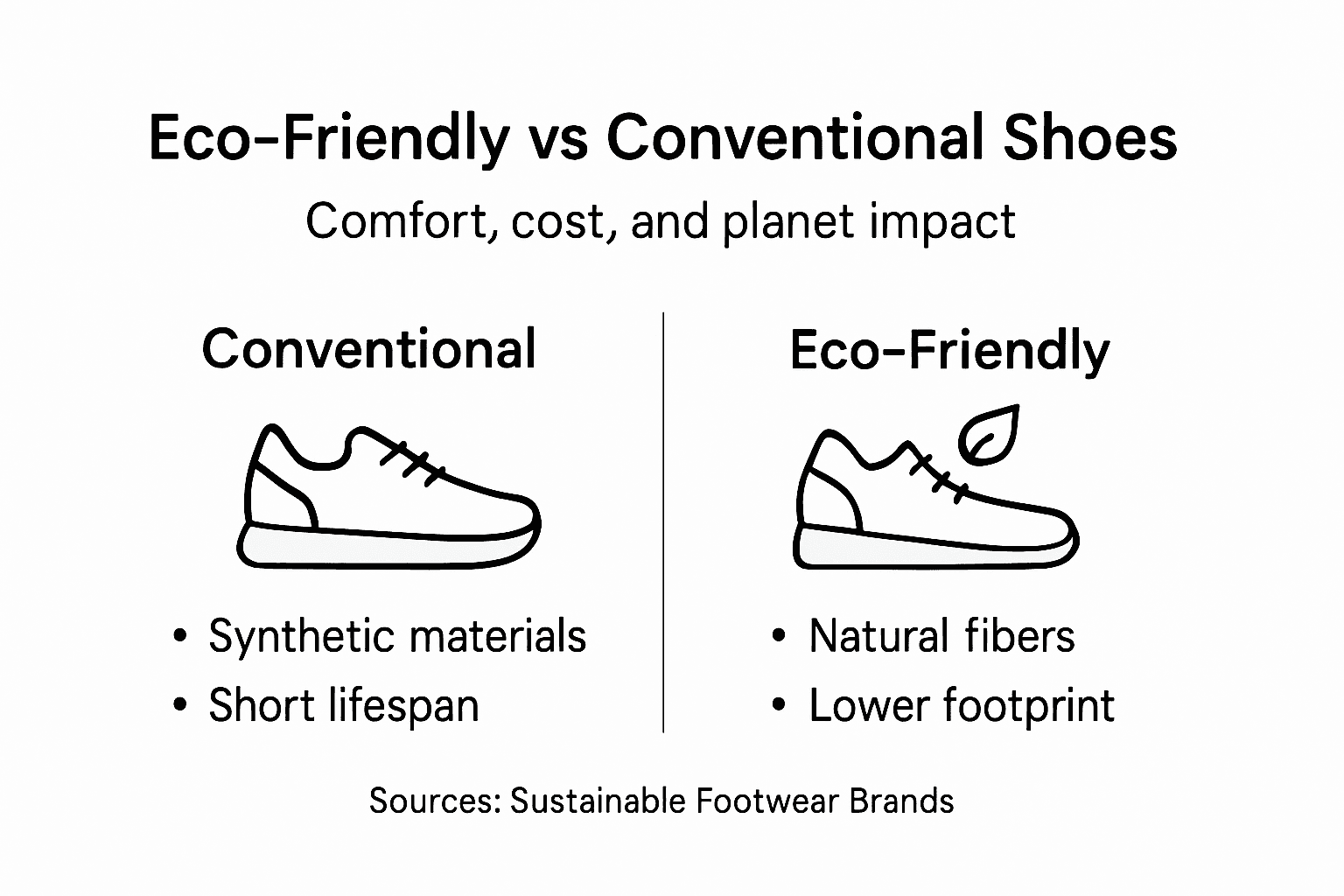
Here is a summary of the economic and environmental trade-offs associated with sustainable footwear:
| Aspect | Conventional Footwear | Sustainable Footwear |
|---|---|---|
| Upfront Cost | Generally lower | Somewhat higher due to materials |
| Product Longevity | Shorter lifespan | Extended due to improved durability |
| Waste Generation | High, limited recycling | Low, circular economy focus |
| Long-Term Value | Frequent replacement needed | Fewer replacements, lower impact |
Pro tip: Consider sustainable shoes as a long-term investment, evaluating their total lifecycle cost rather than just the initial purchase price.
Comparing alternatives and avoiding common pitfalls
Navigating the landscape of sustainable footwear requires a sophisticated understanding of both potential innovations and potential missteps. Sustainable design strategies demand comprehensive approaches that go beyond superficial environmental claims.
Common pitfalls in sustainable footwear selection include:
- Greenwashing: Marketing claims without substantive environmental improvements
- Single-solution thinking: Overreliance on one sustainability metric
- Neglecting local production contexts: Ignoring regional manufacturing implications
- Overlooking durability: Prioritising short-term environmental credentials
- Ignoring lifecycle assessments: Failing to evaluate total environmental impact
- Minimal transparency: Lack of comprehensive environmental reporting
Product environmental footprint assessment is becoming increasingly crucial in distinguishing genuinely sustainable footwear from marketing-driven alternatives. Brands must demonstrate comprehensive ecological considerations beyond superficial claims.
True sustainability requires holistic thinking, not isolated environmental gestures.
Consumers should approach sustainable footwear selection with critical analysis, understanding that genuine ecological responsibility involves complex, interconnected considerations. This means examining manufacturing processes, material sourcing, worker conditions, and long-term environmental implications.
To help identify truly sustainable footwear, consider the following comparison of verification factors:
| Verification Factor | Why It Matters | What To Look For |
|---|---|---|
| Material Transparency | Ensures genuine ecological claim | Full disclosure of all shoe materials |
| Ethical Manufacturing | Protects workers and environment | Independent labour and safety certifications |
| Lifecycle Assessment | Calculates total environmental cost | Published cradle-to-grave impact data |
| Third-Party Certifications | Confirms external sustainability checks | Recognised eco-labels (e.g., EU Ecolabel) |
Pro tip: Request detailed environmental impact documentation from manufacturers to validate sustainability claims beyond marketing materials.
Discover Eco-Friendly Footwear That Combines Comfort and Sustainability
Choosing footwear that supports both your foot health and the environment can be a challenge. This article highlights the importance of sustainable design and advanced materials that deliver long-lasting comfort and reduce ecological impact. At YDA UK, we understand the need for shoes that offer ergonomic support, breathable construction, and durability without compromising our planet’s future.
Explore our range of innovative shoes designed with cutting-edge YDA Technology to meet your everyday comfort and sustainability goals. Whether you are seeking stylish solutions for your daily wear or specialised comfort features, our carefully crafted collection adapts to your needs while promoting environmental responsibility.

Take a step towards better foot health and a greener world by browsing our selection at Shoes – YDA UK. Visit our Home Page – YDA UK to learn more about our commitment to sustainable, high-performance footwear and find your perfect pair today.
Frequently Asked Questions
What are the key features of eco-friendly footwear?
Eco-friendly footwear incorporates sustainable design principles, such as using recycled and renewable materials, reducing water and energy consumption during manufacturing, and ensuring ethical labour practices. These shoes aim for durability and recyclability throughout their lifecycle.
How do sustainable materials impact the comfort of footwear?
Sustainable materials, such as organic cotton and natural latex, enhance comfort by providing breathability, proper arch alignment, and shock absorption. Additionally, innovative materials like algae-based foam can reduce the overall environmental impact while maintaining high performance.
What role does technology play in sustainable footwear production?
Technology in eco-friendly footwear includes advanced manufacturing techniques, such as glueless assembly and zero-carbon production methods. These innovations help reduce waste, enhance material efficiency, and create shoes that are both sustainable and comfortable for daily wear.
How can I effectively evaluate the sustainability claims of footwear brands?
To assess the sustainability of footwear brands, look for transparency in materials used, ethical manufacturing practices, and lifecycle assessments. It’s essential to verify claims through independent certifications and examine the overall environmental impact reported by the manufacturers.