
Common foot problems and solutions: your 2026 guide
TL;DR:
- Most foot problems, like plantar fasciitis and fungal infections, improve significantly with early identification and proper footwear. Conservative treatments such as stretching, supportive shoes, and hygiene habits are effective, but prompt medical review is essential for red-flag symptoms. Choosing appropriate shoes and maintaining good foot hygiene can prevent recurrence and enhance long-term foot health.
Your feet carry you through every step of the day, yet most people only pay attention to them when something goes wrong. Common foot problems and solutions are more relevant than ever, with conditions ranging from plantar fasciitis to fungal infections affecting millions of UK adults every year. Knowing how to identify foot conditions early, choosing the right footwear, and following evidence-based treatment plans can mean the difference between a few weeks of discomfort and months of chronic pain. This guide covers the most frequent issues you are likely to encounter and exactly what to do about them.
Table of Contents
- Key takeaways
- 1. Common foot problems and solutions: what you need to know first
- 2. Plantar fasciitis: the most common cause of heel pain
- 3. Morton’s neuroma: burning and numbness between your toes
- 4. Athlete’s foot: identification, treatment, and prevention
- 5. Bunions, blisters, corns, and calluses
- 6. When to seek medical advice
- My perspective on managing foot problems effectively
- How Ydauk supports your foot health every day
- FAQ
Key takeaways
| Point | Details |
|---|---|
| Early identification matters | Learning how to identify foot issues early prevents minor problems from becoming chronic conditions. |
| Footwear is a frontline treatment | The best footwear for foot problems provides arch support, adequate width, and breathable materials. |
| Most problems respond to conservative care | Plantar fasciitis, Morton’s neuroma, and fungal infections all improve with non-surgical approaches first. |
| Red flags require prompt medical review | Swelling with fever, numbness, or skin colour changes needs urgent professional assessment. |
| Prevention reduces recurrence | Combining treatment with hygiene habits and footwear rotation stops most foot problems returning. |
1. Common foot problems and solutions: what you need to know first
Before tackling specific conditions, it helps to understand why foot problems are so common. Your feet absorb forces equal to several times your body weight with every stride, and they operate inside enclosed, often warm and damp shoes for hours at a time. That combination creates the perfect conditions for mechanical strain, fungal growth, and pressure injuries. Persistent foot pain often signals deeper biomechanical or systemic problems beyond local discomfort, so treating only the symptom you can see rarely solves the underlying issue. The sections below address each major condition with that broader picture in mind.
2. Plantar fasciitis: the most common cause of heel pain
Plantar fasciitis affects roughly 1 in 10 UK adults and is one of the most frequently reported common foot injuries seen in GP surgeries. The hallmark symptom is a sharp, stabbing pain at the base of the heel, worst with your very first steps in the morning.
That distinctive first-step pain has a clear mechanical explanation. The plantar fascia, a thick band of tissue running along your sole, shortens overnight as you rest. The moment you put weight through it, the tissue is abruptly stretched. Performing a simple calf stretch and toe pull before you even stand up gently lengthens the fascia and dramatically reduces that initial spike of pain.
Treatment priorities for plantar fasciitis:
- Stretching programme: Calf and arch stretches twice daily, including before rising from bed
- Footwear: Cushioned, supportive shoes with a slight heel raise reduce tensile load on the fascia; learn how to buy shoes for foot pain to make an informed choice
- Orthotics: Custom or over-the-counter insoles distribute pressure away from the heel
- Activity modification: Reduce high-impact activity such as running on hard surfaces during flare-ups
- Ice and anti-inflammatory medication: Useful in acute phases but not a long-term solution on their own
Most cases resolve within 6 to 12 weeks with consistent conservative treatment, though recovery can extend up to 18 months in stubborn cases.
Pro Tip: Roll a frozen water bottle under your foot for 10 minutes after long periods of standing. It combines the benefits of arch massage and cold therapy in one simple step.
3. Morton’s neuroma: burning and numbness between your toes
Morton’s neuroma is a thickening of the tissue surrounding a nerve between the third and fourth toes. Readers often describe the feeling as “walking on a pebble” or a burning, electric sensation radiating towards the toes. Tight footwear compresses the forefoot and aggravates the nerve, which is why women in narrow-fitting heels experience this condition far more often than the general population.
- Key symptoms: Burning or tingling between toes, numbness in the affected toes, sensation of a lump underfoot
- Conservative first steps: Wide-fitting shoes, metatarsal pads to offload the nerve, and avoiding high heels
- Injection therapy: Corticosteroid injections achieve 82 to 90% partial or complete relief as a first-line intervention
- Surgical consideration: Surgery is reserved for cases where conservative treatment has failed after six or more months
One detail worth knowing about injection technique: the corticosteroid is placed beside the neuroma, not directly into it, to avoid damaging surrounding tissue. Multiple smaller injections over several sessions tend to produce better outcomes than a single large dose.
Pro Tip: When choosing footwear for Morton’s neuroma, prioritise a wide toe box over cushioning alone. The nerve needs room, not just padding. Explore orthotic-friendly footwear options that accommodate metatarsal insoles comfortably.
4. Athlete’s foot: identification, treatment, and prevention
Athlete’s foot (tinea pedis) is a fungal infection that causes itching, scaling, and sometimes painful fissures, typically starting between the toes. It thrives in warm, moist environments, which means communal changing rooms, swimming pools, and sweaty trainers are common sources.
Treatment is straightforward with antifungal creams or sprays, but the pattern of recurrence is frustratingly high. The reason is simple:
- People stop applying medication the moment the rash disappears, before the infection is fully cleared
- Fungal spores remain viable in shoes and socks, reinfecting the skin repeatedly
- Conditions that favour the fungus, such as sweat and poor ventilation, are never addressed
Continue antifungal treatment for one to two weeks after the rash clears to eradicate the infection completely. Treating your shoes is equally non-negotiable. Fungal spores survive for months inside footwear, and reapplying cream to clean feet while stepping back into infected trainers restarts the cycle immediately.
Prevention habits that actually make a difference:
- Use antifungal powder inside shoes, not just on your feet
- Rotate shoes daily and allow them to dry fully between wears
- Wear breathable natural materials and change socks after exercise
- Wear flip-flops in communal showers and changing rooms without exception
Integrating prevention with treatment is the only reliable way to manage fungal foot infections over time. Treating the skin without treating the environment is like baling water from a leaking boat.
Pro Tip: Sprinkle antifungal powder into your shoes every morning before putting them on, not just after showering. This keeps the internal environment hostile to fungal regrowth throughout the day.
5. Bunions, blisters, corns, and calluses
These four conditions are among the most common foot problems people manage at home, yet small mistakes in care cause unnecessary pain and complications.
Bunions form when the big toe drifts towards the second toe, creating a bony prominence at the joint. Tight or narrow footwear does not cause bunions directly, but it accelerates their progression and makes them significantly more painful. Wide, low-heeled shoes reduce the pressure on the joint. Moleskin padding provides a buffer between the bunion and the shoe upper.
Blisters are caused by repetitive friction between skin and shoe surfaces before the skin has toughened. The fluid-filled pocket is your body’s protective response. The key rule: do not burst a blister unless it is very large or in a location that makes walking impossible. Intact blisters heal faster and carry less infection risk. If bursting is unavoidable, use a sterile needle, drain from the edge, and leave the overlying skin in place as a natural dressing.
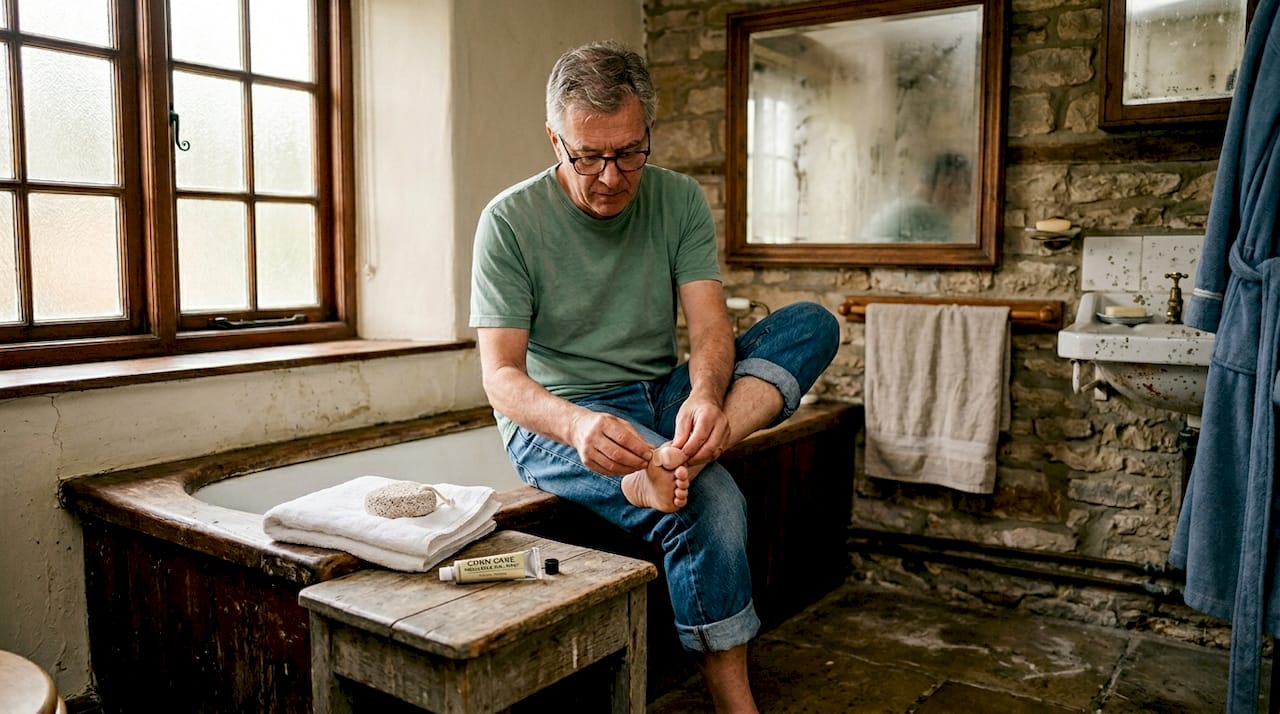
Corns and calluses are layers of hardened skin your body builds in response to sustained pressure. The difference is straightforward. Calluses are broad, flat patches of thickened skin with no clear centre. Corns have a hard, concentrated core that presses into deeper tissue and causes sharper, more localised pain. Gentle pumice stone use after bathing softens both, but addressing the footwear pressure point is the only lasting solution. Medicated corn plasters contain salicylic acid and work well, but avoid them if you have diabetes or poor circulation, as they can cause tissue damage.
- Choosing shoes for foot problems with proper width and depth prevents the majority of these friction-based conditions
- Replace worn footwear: a collapsed heel counter causes instability and increases friction throughout the shoe
- Moisture-wicking socks reduce blister risk substantially on long walks
6. When to seek medical advice
Knowing when a foot problem exceeds home management is one of the most underrated foot health solutions. Most people either rush to their GP for minor issues or, more dangerously, delay seeking help for symptoms that genuinely warrant urgent attention.
| Symptom | What it likely means | Action required |
|---|---|---|
| Swelling, redness, and local warmth | Possible infection or inflammatory arthritis | See GP within 24 hours |
| Swelling with fever | Possible systemic infection or cellulitis | Seek urgent care today |
| Swelling not improving after 3 days | Possible fracture or ligament damage | GP or walk-in centre |
| Numbness, cold skin, or pallor | Possible vascular or nerve compromise | Emergency care immediately |
| Big toe pain with swelling at night | Possible gout or arthritis | GP within 48 hours |
| Burning sensation throughout the foot | Possible neuropathy | GP for further investigation |
Swelling that causes cold, pale skin or extreme pain points to neurovascular compromise and requires emergency medical care. This is not a situation for rest-and-see.
For people with diabetes, any foot wound, ulcer, or unexplained pain requires same-day assessment given the elevated risk of serious complications. The threshold for seeking help should be considerably lower than it is for the general population. Shoes designed specifically for diabetic foot comfort can reduce ulcer risk substantially in day-to-day life.
My perspective on managing foot problems effectively
I have spent years looking closely at how people respond to foot pain, and the pattern I see most often is this: people tolerate discomfort for far longer than they should, then expect a quick fix once the problem becomes unbearable. That is not how feet work.
What I have learned is that early intervention is not just about getting better faster. It is about avoiding the cascade of compensatory problems that develop when you walk differently to protect a painful foot. A sore heel changes your gait. A changed gait loads your knee differently. Within weeks, a simple case of plantar fasciitis can produce hip pain and lower back stiffness that outlast the original injury.
The other thing I would push back on is the tendency to separate footwear from treatment. Most people treat their shoes as a cosmetic choice and their physiotherapy exercises as the “real” treatment. In my view, that is the wrong way round. Early intervention and proper footwear are critical to avoiding long-term complications, and the shoe you wear every day does more cumulative work than a ten-minute stretching routine. Choose footwear as deliberately as you would choose any other medical intervention.
Finally, do not treat pain relief as the end goal. Pain relief is a signal that the condition is improving, not proof that it has resolved. Stopping treatment the moment symptoms ease is the single most common reason foot problems return.
— Panagiotis
How Ydauk supports your foot health every day
If any of the conditions covered above sound familiar, the right footwear is a practical and often underused part of your recovery and prevention plan.

Ydauk’s range is built around YDA Technology, an approach to footwear design that prioritises arch support, forefoot cushioning, and energy-efficient construction to reduce the mechanical stress that drives most common foot injuries. Whether you are managing plantar fasciitis, recovering from Morton’s neuroma, or simply trying to prevent the daily discomfort that builds with the wrong shoes, understanding how YDA shoes work is a practical starting point.
Beyond the product range, the Ydauk blog carries in-depth guidance on selecting shoes for swollen feet and choosing orthopaedic shoes for lasting comfort. If you are ready to make your footwear work as hard as your treatment plan does, Ydauk is the place to start.
FAQ
What causes plantar fasciitis and how long does it last?
Plantar fasciitis is caused by repeated strain on the thick tissue band running along the sole of the foot, most often linked to prolonged standing, high-impact activity, or unsupportive footwear. Most cases resolve within 6 to 12 weeks with stretching and appropriate shoes, though recovery can take up to 18 months in persistent cases.
How do I know if I have Morton’s neuroma?
The most recognisable symptoms are a burning or electric sensation between the third and fourth toes, a feeling of standing on a pebble, and toe numbness. A GP or podiatrist can confirm the diagnosis, and first-line treatment with corticosteroid injections achieves relief in 82 to 90% of cases.
Why does athlete’s foot keep coming back?
Recurrence is almost always caused by stopping treatment too early or failing to treat the shoes. Fungal spores survive for months inside footwear, so continuing antifungal treatment for one to two weeks after the rash clears and using antifungal powder in your shoes is the most reliable way to break the cycle.
When should foot swelling be treated as an emergency?
Swelling accompanied by fever, skin that becomes cold and pale, extreme pain, or numbness requires emergency care, as these signs can indicate infection spreading systemically or loss of blood supply to the foot. Swelling that does not improve within three days after an injury also warrants prompt professional review.
Can footwear genuinely help with common foot conditions?
Yes, and more significantly than most people expect. The right shoes reduce mechanical load on the plantar fascia, offload pressure from neuromas, and create a less hospitable environment for fungal infections through breathability and proper fit. Footwear is not a substitute for treatment, but it is an integral part of it.