
Use the 6mm Rule to Find Your Width: Women's Shoe Width Chart
Most women wear a B width, the standard medium size across UK and US footwear, but “standard” is not “yours” until you measure it. Widths run from narrow (AAA or AA) through medium (B) to wide and extra wide (2E, 4E), and the only reliable way to find yours is to measure the ball of your foot while standing, on both feet, and use the larger number. Once you have that measurement in millimetres or inches, the chart below tells you exactly where you land.
TL;DR:
- Measuring your foot’s width in the afternoon with socks on is crucial to accurately selecting your size and avoiding discomfort.
- Each letter width step, such as B to D, adds approximately 6 mm or a quarter inch at the ball of the foot, which can significantly affect fit.
- Different shoe types, like heels and boots, require wider sizes or adjustable features to accommodate how pressure shifts across the foot.
- International sizing systems vary, with Europeans and Japanese measuring width in millimeters rather than letter codes, making direct comparison unreliable.
- Proper foot shape and arch height influence the ideal width, especially for flat feet or narrow heels, demanding specific measurements and adjustable footwear.
Table of Contents
- Women’s shoe width chart: sizes, millimetres and letter codes
- How to measure your foot width at home
- What the width letters actually mean for you
- Signs your shoe width is wrong, and how to fix it
- Why measuring properly matters more than guessing
- Do shoe widths mean the same thing everywhere?
- How your foot type and arch shape affect the width you need
- Choosing the right width for heels, sneakers and boots
- A few habits worth building into every shoe purchase
- How YDA UK helps you buy the right width the first time
- Sources
- FAQ
Women’s shoe width chart: sizes, millimetres and letter codes
Letters alone do not tell you much without a size attached to them, because a B width on a size 5 foot is narrower in absolute terms than a B width on a size 9. The chart below pairs common UK and US women’s sizes with the ball-of-foot measurement that typically corresponds to each width code.
Each letter step up (B to D, D to 2E) adds roughly 6 mm, or about a quarter inch, at the ball of the foot. That is why a small jump in size can feel like a big change in comfort even though the letter code has only moved one notch. It also explains why relying on the letter alone can mislead you: a “wide” in a size 3 might measure narrower in millimetres than a “medium” in a size 8.
Brand lasts vary enough that two pairs labelled the same width can fit differently. A shoe with a narrower toe box or a curved last will feel tighter than the chart suggests, even at an identical width code. When a brand publishes its own chart, or explicit “narrow, medium, wide” labelling instead of letters, trust that over a generic conversion. For a deeper breakdown of how these codes apply across sizes, YDA UK’s shoe width chart guide covers the labelling conventions in more depth.
How to measure your foot width at home
You need three things: a piece of paper bigger than your foot, a pen, and a ruler or tape measure. The whole process takes under three minutes, and doing it properly the first time saves you from returning shoes later.
- Time it right. Measure in the afternoon or evening, not first thing in the morning. Feet swell slightly over the course of the day, and an afternoon measurement captures the size your shoes actually need to accommodate.
- Set up on a hard floor. Place the paper against a wall on a hard, flat surface. Carpet compresses under your weight and skews the reading.
- Stand naturally. Wear the socks you would normally wear with the shoes you are buying, then stand with your full weight on the foot, tracing around it with the pen held vertically.
- Mark the widest point. This is almost always across the ball of the foot, just below your toes, not at the heel or the arch.
- Measure across, not around. Use a ruler to measure the straight-line distance between the two widest points on your tracing, in millimetres or inches.
- Repeat on both feet. Most people have a size difference between feet. Use the larger measurement when choosing your width, and pad or insert the smaller foot if needed.
- Cross-reference the chart. Match your measurement to the closest size row above to find your letter code.
Pro Tip: If you plan to wear orthotic insoles or thick winter socks with the shoe, trace your foot while wearing them. A tracing done barehand and bare-socked will underestimate the room you actually need once your usual insole goes in.
For a version of this method with photographs at each step, YDA UK’s guide on measuring your shoe size in millimetres walks through the same process with more visual detail.
What the width letters actually mean for you
Here is where a lot of confusion creeps in: B is medium for women, but D is medium for men. If you are ever handed a men’s chart, or comparing your partner’s trainers to your own, that difference matters. A women’s D is already a wide fit, roughly one full letter step above standard.
- AAA and AA sit at the narrow end, common in dress shoes and some heels built on a slim last.
- B is the default medium width most women’s shoes are built around.
- D is one step wide for women, comparable to a medium fit in men’s sizing.
- 2E and 4E are extra wide and rare in standard women’s ranges, more often found in comfort or orthopaedic lines.
Because each letter step adds around 6 mm at the ball of the foot, moving from a B to a D in the same size gives you roughly a quarter inch more room across the forefoot. If a brand only publishes millimetre measurements with no letter at all, take your own ball-of-foot figure and slot it into the closest row on the chart above rather than guessing from the size alone.
Signs your shoe width is wrong, and how to fix it
Your feet will tell you fairly quickly if the width is off, often before you consciously notice discomfort. Blisters or calluses that keep forming in the same spot, bruised or blackened toenails, and a persistent ache across the ball of the foot all point to a shoe that is too narrow. Heel slip, your foot sliding forward inside the shoe, or the upper folding and creasing oddly, usually means the shoe is too wide for you rather than too narrow.
- Too narrow: pinching at the widest part of the foot, numbness in the toes, visible red pressure marks after wearing.
- Too wide: heel lifting with every step, foot sliding forward into the toe box, excess material bunching at the sides.
Lacing adjustments, gel heel grips, and removable insoles solve minor width mismatches, but they are patches, not fixes. If you need a half-size or full letter wider to stop the pain, size up in width rather than persisting with lacing tricks that only mask the problem.
Pro Tip: Measuring beats guessing every time. A direct ball-of-foot measurement is more reliable than working backwards from symptoms, because pain shows up after the damage has already started.
If you have diabetes, poor circulation, or any nerve sensitivity in your feet, do not rely on pain as a warning sign at all, since these conditions can mask pressure damage until it becomes serious. Persistent discomfort, colour changes, or swelling that does not settle deserves a podiatrist’s assessment rather than a wider pair of trainers.
Why measuring properly matters more than guessing
Getting the width right the first time avoids the return-and-reorder cycle that wastes both money and patience. Educational content around the measure-first principle often includes detailed guides on foot health and fit rather than treating width as an afterthought to size.
- The women’s shoe size chart guide pairs length and width conversions so you are not solving half the problem.
- The YDA Technology overview explains how footwear construction affects stability and comfort once the width is correct.
- Guides on measuring at home break the process into podiatrist-aligned steps rather than rough estimates.
Precise measurement is also a foot health issue, not just a comfort one. Ill-fitting width is one of the most common preventable causes of blisters, bunions, and nerve compression, particularly for anyone on their feet most of the day.
Do shoe widths mean the same thing everywhere?
No, and this trips up a lot of shoppers buying from international sites. UK and US letter systems (AAA through 4E) are broadly aligned, but European sizing rarely uses letters at all. Continental brands typically build shoes on a single standard last per size and expect you to size up in length to gain width, rather than offering a distinct wide fit.
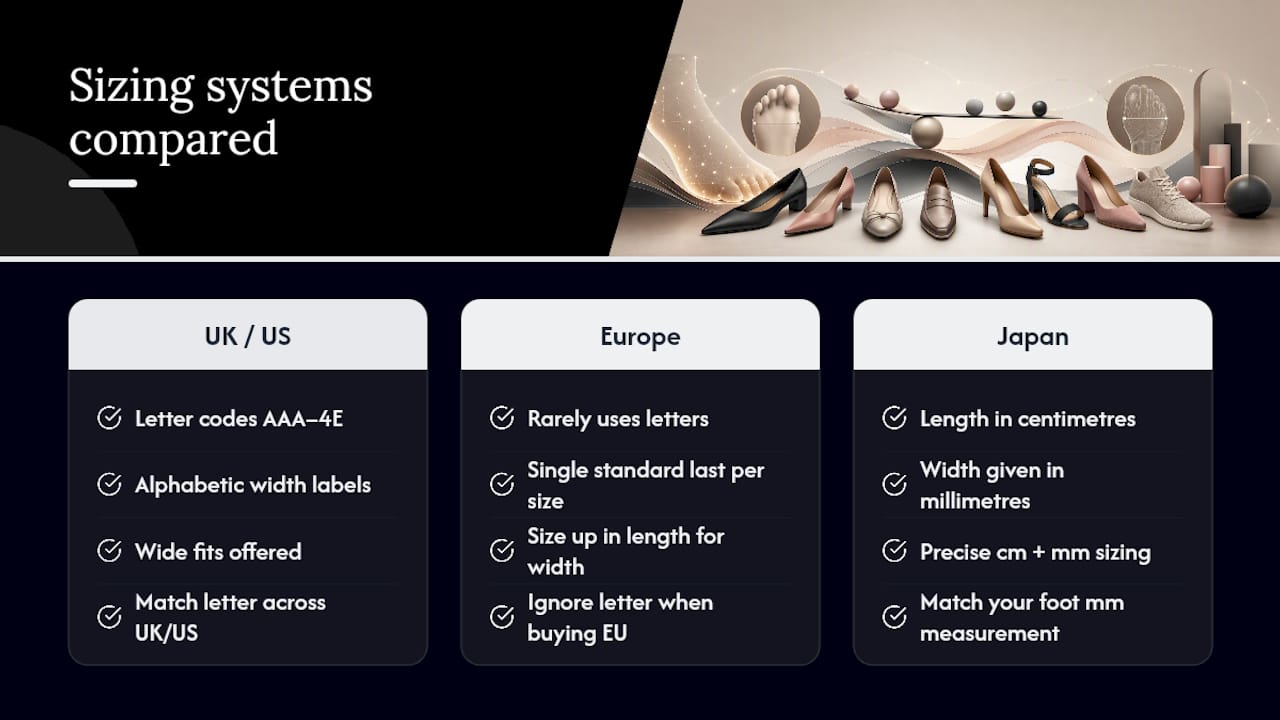
Japanese sizing takes a different approach again, measuring foot length in centimetres and often listing width separately as a millimetre figure rather than a letter, since traditional Japanese footwear sizing has historically prioritised precise length and girth measurements over the alphabetic system used in Britain and America.
Practically, this means a “wide” UK 6 will not automatically match a wide-labelled European or Japanese equivalent. Your safest approach when buying from a European or Japanese brand is to ignore the letter entirely and match your own ball-of-foot millimetre measurement against whatever numeric width or girth figure the brand publishes. Retailers that sell internationally, such as ASOS’s size charts, tend to publish length-to-size conversions precisely because letter-based width does not travel well across borders. Always check both the length and width conversion together rather than assuming one region’s medium equals another’s.
How your foot type and arch shape affect the width you need
Width is not just about the ball of your foot. Arch height changes how your foot behaves inside a shoe, and it interacts with width in ways that are easy to overlook. A high arch tends to concentrate pressure on a narrower band across the forefoot and heel, which can make a true-to-measurement width still feel tight if the shoe’s arch support does not match your foot’s shape.
Flat or low arches usually splay wider under load, meaning the ball-of-foot measurement you take standing (rather than sitting) will read noticeably larger than a seated measurement, sometimes enough to bump you a full letter width. If you have flat feet, always measure standing with your full weight down, since that is the true width your shoes need to accommodate.
Foot shape also matters beyond arch height. A foot with a wide forefoot and narrow heel, sometimes called a combination foot, is genuinely difficult to fit in a single width code, because the shoe that suits your forefoot will gape at the heel. In that case, look for shoes with adjustable lacing or straps that can cinch the heel independently of the toe box, rather than chasing a single “correct” width letter that does not exist for your foot shape.
Choosing the right width for heels, sneakers and boots
The width you need is not fixed. It shifts depending on what kind of shoe you are buying, because different shoe types put pressure on your foot differently.
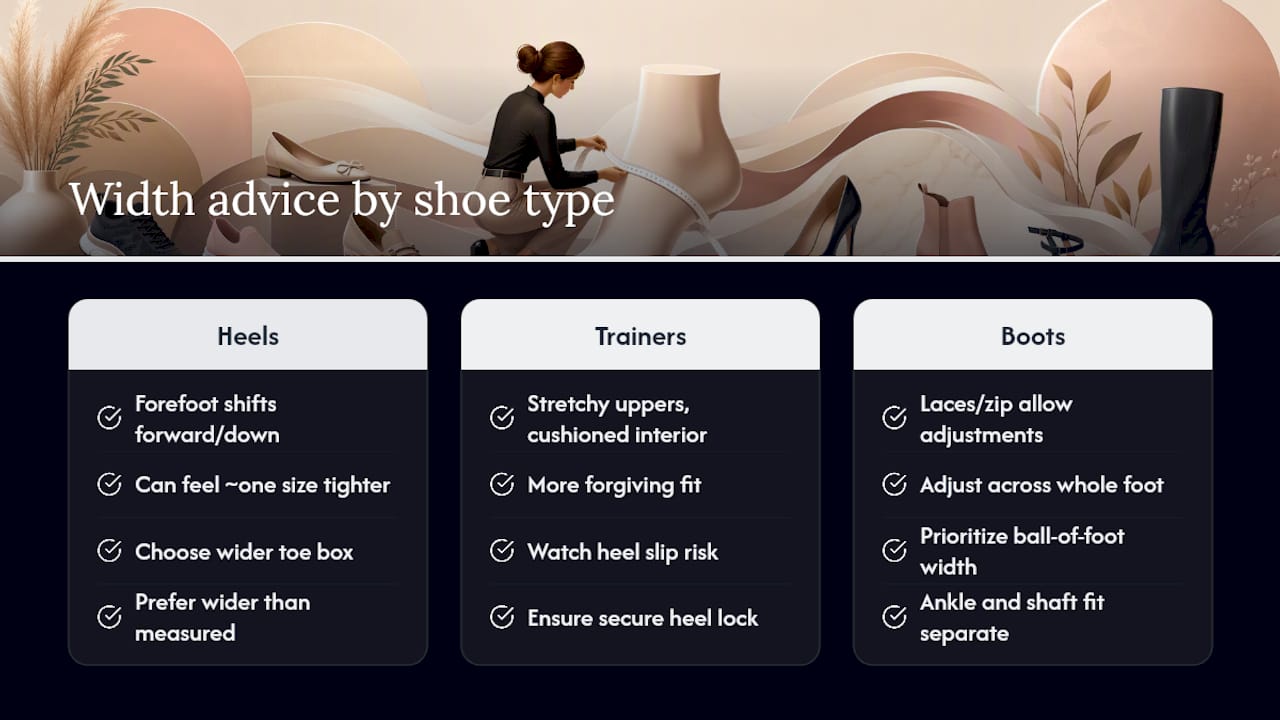
Heels compress the forefoot forward and down, so a width that feels fine in a flat trainer can feel a full size tighter in a heel of the same nominal width. If you regularly wear heels, size slightly wider than your measured width or look specifically for heels with a wider toe box design rather than relying on the standard width code.
Trainers and sneakers are more forgiving because most have stretchable uppers and cushioned interiors that flex with your foot, but the width still governs how the shoe locks your heel in place. A trainer that is technically wide enough at the forefoot but too generous overall will let your heel slide, undermining the stability the shoe is meant to provide.
Boots, particularly lace-up or zip styles, are the easiest to adjust after the fact because laces let you fine-tune width across the whole foot rather than committing to one fixed fit. For boots, prioritise getting the width right at the ball of the foot and accept that the ankle and shaft fit is a separate, adjustable variable. Across all three categories, a roomier toe box, stretch panels, or an adjustable closure often solves a width problem that chasing a wider letter code alone would not.
A few habits worth building into every shoe purchase
Measure in the afternoon, in the socks you actually wear, and check both feet rather than assuming symmetry. Try the measurement again with your usual insole in place if you use one, since that changes the room you need. The one habit worth making non-negotiable: never buy shoes online without measuring first, no matter how confident you feel about your usual size.
— Panagiotis
How YDA UK helps you buy the right width the first time
There are other ways to chase a better fit, stretchers, insoles, half-size adjustments, but none of them fix a shoe that was the wrong width to begin with. Some footwear brands build around getting that starting point right, with high-performance shoes designed for foot health, comfort, and everyday stability rather than a one-size-fits-most last.

Before you order, use the measurement steps above alongside YDA UK’s own foot measurement guide to confirm your exact width in millimetres. Pair that figure with the YDA Technology page to understand how the construction supports the fit once you have it, then browse the current range of footwear to find a pair built around the width you actually measured, not the one you guessed.
Sources
- Shoe Width Chart — Men’s, Women’s & Kids’ Width Guide
- Shoe width chart: what the letters actually mean | KickVerdict
- How to measure your foot length and width at home
FAQ
What are women’s shoe widths?
Women’s shoe widths run on a letter scale from AAA and AA (narrow) through B (medium) to D, 2E, and 4E (wide to extra wide). B is the standard medium width that most women’s footwear is built around, with roughly 60% of people fitting a standard width comfortably.
Is my foot width D or EE?
Check your ball-of-foot measurement against the chart above for your size. If you fall roughly a quarter inch, or about 6mm, past the medium B measurement, you are likely in a D; a further step past that puts you into a 2E (EE) range, since each letter width adds around 6mm at the forefoot.
How do I determine my foot width for shoes?
Trace your foot while standing on a hard floor in the afternoon, then measure the straight-line distance across the widest part of the ball of your foot. Measure both feet and use the larger result, then match that figure to the closest row in a women’s width chart.
What is the standard width of a woman’s foot?
There is no single universal figure, since standard width depends on shoe size, but B is the letter code manufacturers treat as medium across nearly all women’s sizes. A size 6 (UK) foot in a B width typically measures around 99mm across the ball of the foot, widening or narrowing proportionally at other sizes.