
What is shoe lasting: the complete guide
TL;DR:
- Shoe lasting shapes the upper over a last to create a supportive and well-fitting shoe. It significantly influences comfort, durability, and foot health through precise tension, sequence, and thermal profiling. Proper lasting techniques blend science and craft, forming the foundation of high-quality footwear.
Shoe lasting is defined as the process of stretching and securing the upper over a three-dimensional mould called a last, giving the shoe its final shape, fit, and structural integrity. Without lasting, a shoe is simply flat cut pieces of leather, fabric, or synthetic material with no form. The lasting process determines how a shoe will feel on the foot, how long it will hold its shape, and whether it will cause discomfort or support natural movement. From traditional bespoke workshops to high-volume factories, shoe lasting is the single step that transforms components into wearable footwear.
What is shoe lasting and why does it define the shoe?
Shoe lasting is the foundational manufacturing step that stretches the upper tightly over the last and bonds it to the insole, locking in the shoe’s three-dimensional form. Every other construction decision, from sole attachment to finishing, depends on how well this step is executed. A poorly lasted shoe cannot be rescued by expensive materials or careful stitching. The lasting process is where design intent becomes physical reality.
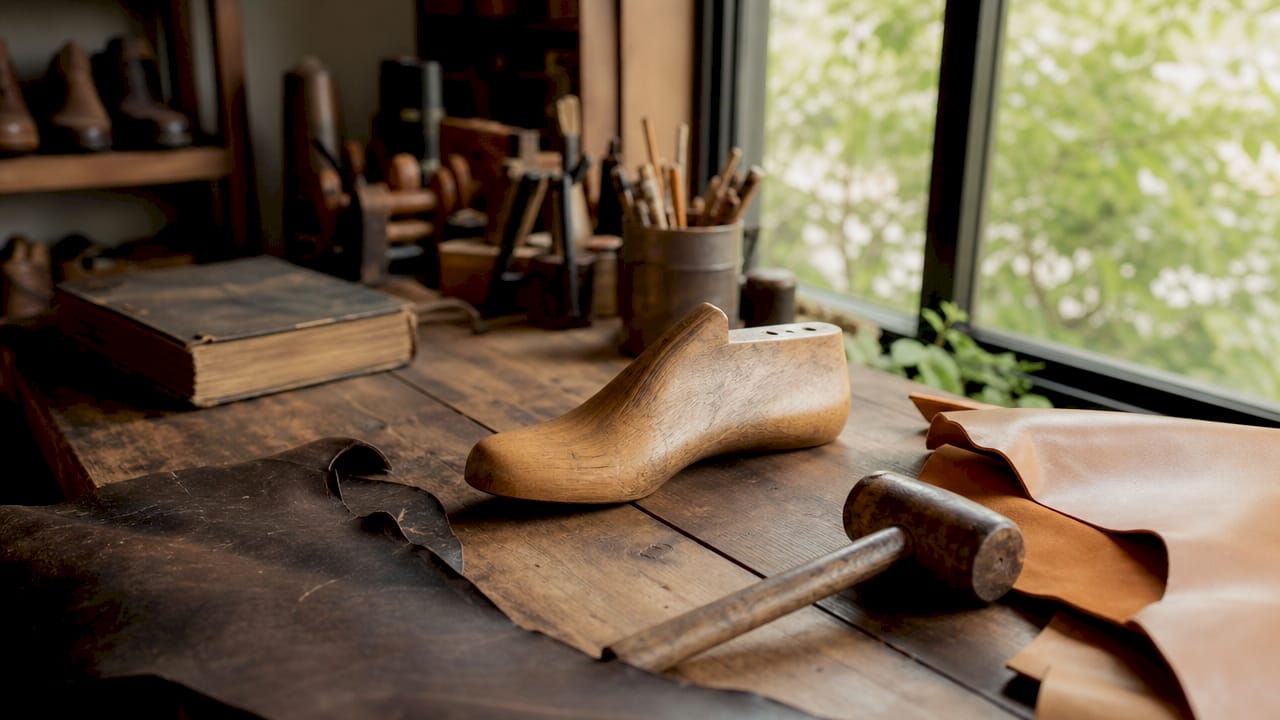
The last itself is a foot-shaped mould, traditionally carved from hardwood and now frequently made from high-density polyethylene or nylon. Lasts are not simple replicas of the human foot. They are designed to balance biomechanics and aesthetics, accounting for how the foot expands under load, how toes splay during walking, and what silhouette the designer intends. A last for a narrow Oxford dress shoe looks entirely different from one designed for a wide-fit walking shoe, even if both are sized identically.
The duration a shoe spends on the last varies dramatically by production method. Duration on the last ranges from minutes in mass production to weeks in bespoke shoemaking for permanent shape retention. That difference in dwell time directly affects how thoroughly the upper material conforms to the last’s geometry. Longer dwell times allow fibres to relax and set, producing a more stable, longer-lasting shape.
What is a shoe last and why is it vital to the lasting process?
The last is the shoemaker’s most guarded design tool. It simulates the human foot’s shape, dynamic expansion, and designer goals, making it the single most influential object in footwear construction. Changing the last changes everything: volume, toe spring, heel pitch, and arch profile all shift with it.
Lasts vary across several key dimensions:
- Material: Hardwood lasts are traditional and durable; high-density plastic lasts are lighter and allow precise computer-aided manufacturing tolerances.
- Style intent: A pointed-toe fashion last has a dramatically different forefoot than a rounded athletic last, even at the same length.
- Foot anatomy: Lasts account for heel width, instep height, ball girth, and toe box depth, each of which affects fit in a distinct area of the foot.
- Dynamic movement: Well-designed lasts simulate how the foot expands during walking, preventing the finished shoe from feeling tight after an hour of wear.
- Biomechanical balance: Lasts are modelled to support natural gait mechanics, not simply to look good on a shelf.
The relationship between last design and foot health is direct. A last with insufficient toe box depth forces the toes into compression, creating pressure points that cause blisters and long-term joint stress. A last with an incorrect heel pitch alters the wearer’s posture. Shoe brands that invest in last development produce footwear that genuinely fits; those that cut corners on last design produce shoes that look correct but feel wrong from the first wear.
Pro Tip: When buying shoes, ask whether the brand uses gender-specific lasts or simply scales a unisex last. Women’s feet have a different heel-to-ball ratio than men’s, and a properly designed last accounts for this difference.
How is the shoe lasting process performed?
Hand lasting
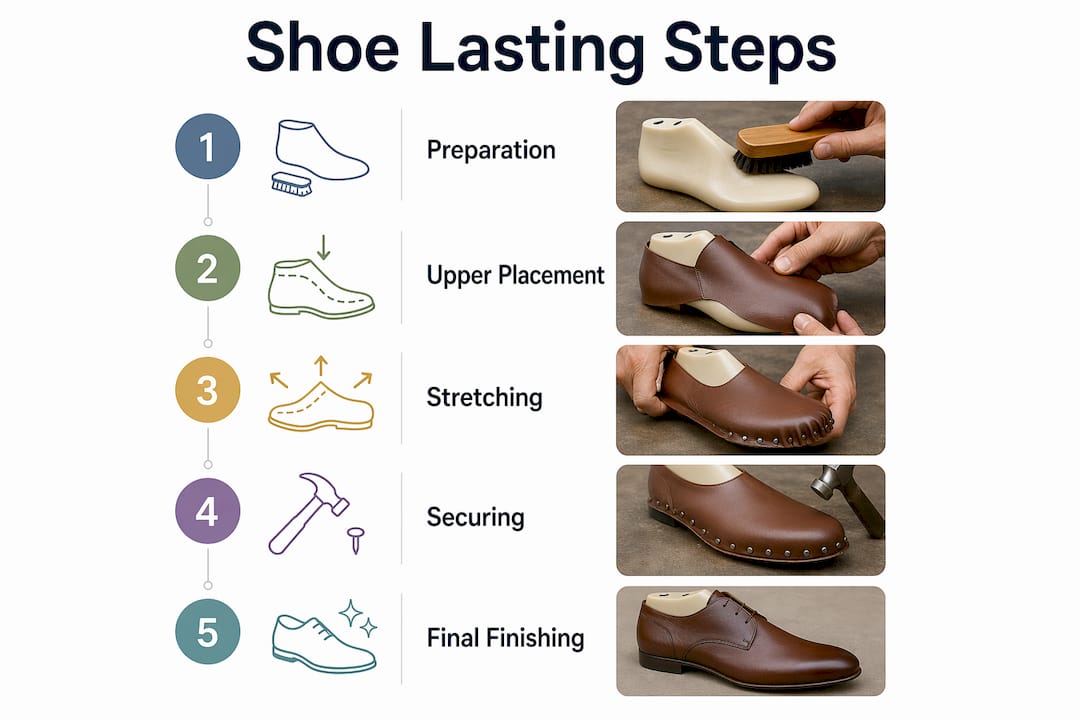
Hand lasting is the traditional method, practised in bespoke workshops and high-end cordwaining. The shoemaker positions the upper over the last, grips the material with lasting pincers, and pulls the upper taut before tacking it to the insole. The back edge of the upper is positioned approximately 9.5 mm below the last seat during drafting, a measurement that requires consistent judgement across every pair. The shoemaker reads the leather’s grain and stretch in real time, adjusting tension independently for the left and right shoe. Leather’s non-uniform stretch requires independent hand lasting for left and right shoes to produce a consistent, symmetrical fit.
Mechanised lasting
Modern factories use hydraulic or servo-driven lasting machines. Automated toe lasting typically takes 5–6 seconds under pneumatic pressures of 80–90 PSI, with arrays of 9–12 pincers gripping the upper simultaneously. Hot-melt adhesives bond the upper to the insole board under heat and pressure. The machine applies consistent force across every unit, removing human variability from the equation.
| Feature | Hand lasting | Mechanised lasting |
|---|---|---|
| Speed | Hours to days per pair | 5–6 seconds per operation |
| Tension control | Real-time, per-shoe adjustment | Pre-set machine parameters |
| Material sensitivity | High: reads leather grain individually | Moderate: relies on material consistency |
| Best suited for | Bespoke, surgical, and luxury footwear | Mass production and athletic footwear |
| Consistency | Variable across batches | High across large volumes |
Neither method is universally superior. Hand lasting produces better fit precision for individual customers. Mechanised lasting produces reliable consistency at scale. The best manufacturers understand when to apply each approach.
Pro Tip: If you are buying a shoe marketed as “hand lasted”, ask specifically whether the toe, sides, and heel are all lasted by hand, or only one section. Partial hand lasting is common and still valuable, but it is not the same as a fully hand-lasted construction.
What technical challenges affect lasting quality?
Lasting is not simply pulling material tight and gluing it down. The process involves complex physics and material science expertise to unify design, fit, and durability. Several technical factors determine whether a lasted shoe holds its shape or fails within months.
Tension distribution is the first challenge. Uneven pulling creates wrinkles at the toe or distortions at the waist. Poor lasting technique results in defects like wrinkles, distorted waists, and heel distortions that no finishing process can fix. These defects are permanent. No amount of polishing or pressing corrects a shoe that was lasted with uneven tension.
The lasting sequence matters as much as the tension itself. Lasting sequence, toe then sides then heel, is critical to maintain symmetry and prevent tension imbalance. Starting at the heel, for example, locks in tension before the forefoot is positioned correctly, causing the upper to pull asymmetrically across the last.
Material memory is the third major challenge. Leather and synthetic uppers have a natural tendency to return towards their original flat shape after stretching. This is called spring-back. Thermal profiling heats upper materials to between 70–110°C to permanently shape shoe fibres and prevent spring-back post-lasting. The heat breaks down the fibre structure temporarily, allowing it to reset in the lasted position. Insufficient heat produces a shoe that slowly loses its shape during wear.
Common lasting defects to watch for include:
- Toe wrinkles: Caused by insufficient tension at the forepart or incorrect last fit.
- Heel distortion: Results from lasting the heel before the forefoot is properly positioned.
- Waist collapse: Occurs when side lasting tension is uneven between the medial and lateral edges.
- Spring-back: The upper gradually lifts away from the insole, indicating inadequate thermal profiling or dwell time.
- Asymmetry: One shoe fits differently from the other, typically caused by inconsistent tension between left and right uppers.
Why is lasting essential for fit, comfort, and durability?
Lasting defines the shoe’s internal volume. It sets the arch height, the toe box depth, and the heel cup geometry. A shoe lasted accurately to its last produces consistent fit across every pair in a production run. A shoe lasted carelessly produces fit variation even within the same size.
Pressure points are the most immediate consequence of poor lasting. When the upper is not pulled evenly over the last, it creates ridges and tight spots that press against the foot during wear. Proper lasting sequence and tension control set the foundation for shoe structural integrity and appearance. A correctly lasted shoe distributes pressure evenly across the foot’s contact surface, reducing fatigue and preventing blisters.
Long-term durability is equally dependent on lasting quality. A shoe that was properly lasted and thermally profiled retains its shape through thousands of steps. The upper stays bonded to the insole, the heel cup holds its geometry, and the toe box maintains its volume. Shoe technologies transforming comfort and performance in modern footwear all depend on lasting accuracy as their foundation.
Pro Tip: Press your thumb firmly into the toe box of a shoe you are considering buying. A well-lasted shoe resists deformation and springs back cleanly. A poorly lasted shoe collapses easily and does not recover its shape.
How does lasting fit within modern shoe manufacturing techniques?
Modern footwear manufacturing treats lasting as a data-driven process. Factories with layered inspections and parameter controls outperform in quality and efficiency regardless of material cost. This means a mid-price shoe from a factory with rigorous lasting controls can outperform an expensive shoe from a factory that treats lasting as a secondary concern.
Advanced lasting machines now incorporate tracer cement systems that apply adhesive precisely along the lasting margin before the upper is pulled. Computerised controls set pneumatic pressure, dwell time, and temperature profiles for each material type. Thermal profiles and pneumatic pressure during lasting are precisely calibrated to transform fibre memory without damage. This level of control was impossible with purely manual methods.
Hand lasting retains a critical role in bespoke and surgical footwear. Orthopaedic shoes require lasting over custom lasts that replicate an individual patient’s foot geometry, including deformities and asymmetries. No machine can replicate the real-time judgement a skilled laster applies when working with an unusual foot shape. For understanding what a last on a shoe truly means in terms of fit and health outcomes, bespoke lasting provides the clearest example.
Sustainable material use is also reshaping lasting practices. Recycled polyester uppers, plant-based leathers, and bio-based adhesives all behave differently under tension and heat than traditional materials. Factories are recalibrating thermal profiles and pressure settings to accommodate these new inputs without compromising shape retention.
Key takeaways
Shoe lasting is the single manufacturing step that determines whether a shoe fits well, holds its shape, and supports the foot correctly over time.
| Point | Details |
|---|---|
| Lasting defines fit | The lasting process sets arch height, toe box volume, and heel cup geometry for every pair. |
| Lasting sequence matters | Toe, then sides, then heel is the correct order to prevent tension imbalance and asymmetry. |
| Thermal profiling prevents spring-back | Heating uppers to 70–110°C permanently sets fibre memory and stops shape loss during wear. |
| Hand lasting suits bespoke work | Real-time tension adjustment in hand lasting produces better fit precision for individual customers. |
| Poor lasting cannot be corrected | Wrinkles, distortions, and asymmetries caused by bad lasting are permanent defects. |
Lasting as science and craft: a personal view
I have spent years examining footwear construction, and lasting is the step that consistently separates genuinely good shoes from merely expensive ones. The materials, the sole, the stitching: all of these are visible and easy to evaluate. Lasting is invisible once the shoe is finished, which is exactly why it is so often underestimated by consumers.
What strikes me most is how lasting sits at the intersection of physics, material science, and manual skill. A factory worker operating a lasting machine is not simply pressing a button. They are calibrating pressure, temperature, and timing for each material batch. A bespoke laster is reading the leather’s grain, feeling the resistance in the pincer, and making dozens of micro-adjustments per shoe. Both are practising a discipline that took years to master.
My honest view is that consumers should ask more questions about lasting when buying footwear. Not every brand will answer, but the ones that do, and that can explain their lasting method with specificity, are almost always the ones producing shoes worth buying. Lasting is where a brand’s commitment to quality becomes either real or theoretical. Ydauk’s approach to footwear construction reflects exactly this kind of commitment, treating lasting not as a cost to minimise but as the foundation of every shoe they produce.
— Panagiotis
Ydauk’s approach to footwear construction
Understanding lasting makes it easier to evaluate the shoes you buy. Ydauk applies this knowledge directly to every shoe it produces, combining precise lasting techniques with materials selected for their performance under tension and heat.

The result is footwear designed to hold its shape, support the foot correctly, and remain comfortable across extended wear. Ydauk’s YDA shoe technology page details how lasting precision and proprietary construction methods work together to deliver fit and durability that goes beyond standard footwear. If you wear premium socks alongside well-constructed shoes, quality sock pairing also contributes to overall foot comfort and lasting shoe performance.
FAQ
What is shoe lasting in simple terms?
Shoe lasting is the process of stretching the upper over a foot-shaped mould called a last and bonding it to the insole to give the shoe its final shape. It is the step that transforms flat material into a three-dimensional, wearable shoe.
How long does shoe lasting take?
Duration varies by method. Automated lasting operations in factories take as little as 5–6 seconds per step, while bespoke hand lasting can keep a shoe on the last for several weeks to allow permanent shape retention.
What is the difference between hand lasting and machine lasting?
Hand lasting uses pincers and manual tension control, allowing real-time adjustment for each individual upper. Machine lasting uses hydraulic or servo-driven equipment with pre-set parameters, producing consistent results at high volume but with less sensitivity to material variation.
Why does lasting affect shoe comfort?
Lasting sets the internal geometry of the shoe, including arch height, toe box volume, and heel cup shape. Poor lasting creates pressure points and uneven fit, while accurate lasting distributes pressure evenly across the foot.
Can a badly lasted shoe be fixed?
Defects caused by poor lasting, such as wrinkles, asymmetry, and heel distortion, are permanent. No finishing process corrects a shoe that was lasted with incorrect tension or sequence.