
What Is Foot Pronation? 33% Affected & How Shoes Help
About one in three people experience excessive foot pronation, a common biomechanical condition that influences everything from daily comfort to long term foot health. Despite its prevalence, many UK consumers misunderstand what pronation actually means and how it impacts their choice of footwear. This guide clarifies the science behind foot pronation, explores its different types, debunks widespread myths, and shows you how selecting the right shoes can dramatically improve your comfort and reduce pain while maintaining your personal style.
Table of Contents
- Understanding Foot Pronation: Biomechanics And Types
- Types Of Pronation And Clinical Implications
- Effects Of Abnormal Pronation On Foot And Leg Health
- Common Misconceptions About Foot Pronation
Key Takeaways
| Point | Details |
|---|---|
| Foot pronation is natural | Inward rolling during walking absorbs shock and adapts to ground surfaces. |
| Abnormal pronation is common | Overpronation affects 28 to 33% of people, underpronation about 10 to 15%. |
| Not all pronation is harmful | Normal pronation supports healthy gait mechanics and balance. |
| Proper footwear reduces pain | Shoes with medial support and cushioning cut pronation related discomfort by up to 40%. |
| Style meets support | Modern footwear balances attractive design with functional foot health features. |
Understanding Foot Pronation: Biomechanics and Types
Foot pronation is a natural rolling movement that occurs during normal walking or running to help absorb shock and adapt to ground surfaces. When you take a step, your foot naturally rotates inward slightly to distribute impact forces across a broader area. This biomechanical action happens automatically and plays a vital role in protecting your joints from excessive stress.
The majority of pronation occurs during the loading response phase of gait when your foot first contacts the ground, typically within the first 15 to 20% of your stance. During this brief moment, your arch flattens slightly and your ankle rolls inward to create a flexible platform that adapts to uneven terrain and cushions your body weight.
Understanding footwear technology basics helps you appreciate how shoe design interacts with your natural foot mechanics. Pronation exists on a spectrum, and identifying where you fall helps guide footwear choices.
Three main pronation types characterize how your foot behaves:
- Neutral pronation: Your foot rolls inward about 15 degrees, maintaining ideal alignment and distributing weight evenly from heel to toe.
- Overpronation: Excessive inward rolling beyond 15 degrees causes your arch to collapse too much, shifting weight to the inner edge of your foot.
- Underpronation (supination): Insufficient inward roll keeps your foot rigid, concentrating impact forces on the outer edge and reducing shock absorption.
Each type influences how forces travel through your lower body during movement. Neutral pronation maintains balanced load distribution, while abnormal patterns create stress points that can lead to discomfort and injury over time. Recognizing your pronation pattern forms the foundation for selecting appropriate footwear that supports your unique biomechanics.
Types of Pronation and Clinical Implications
The prevalence of abnormal pronation patterns is surprisingly high across the UK population. Research indicates that overpronation affects approximately 28 to 33% of individuals, while underpronation impacts roughly 10 to 15%. These figures mean millions of people experience altered foot mechanics that can compromise their comfort and health.
Overpronation creates a cascade of biomechanical changes throughout your lower body. When your arch collapses excessively, your ankle rotates inward too far, causing your shin bone to twist and your knee to track incorrectly. This misalignment commonly leads to plantar fasciitis, where the connective tissue along your arch becomes inflamed and painful. You might also develop knee pain, shin splints, or Achilles tendonitis as your body struggles to compensate.

Underpronation involves insufficient inward roll and poor shock absorption, increasing stress on the outer foot and contributing to issues like stress fractures. Your foot remains too rigid during impact, failing to distribute forces effectively. This can result in lateral ankle sprains, iliotibial band syndrome, and increased pressure on your metatarsal bones.
Here’s how different pronation types compare:
| Pronation Type | Population Affected | Primary Health Risks |
|---|---|---|
| Neutral | 50 to 60% | Minimal risk with proper footwear |
| Overpronation | 28 to 33% | Plantar fasciitis, knee pain, shin splints |
| Underpronation | 10 to 15% | Stress fractures, ankle sprains, ITB syndrome |
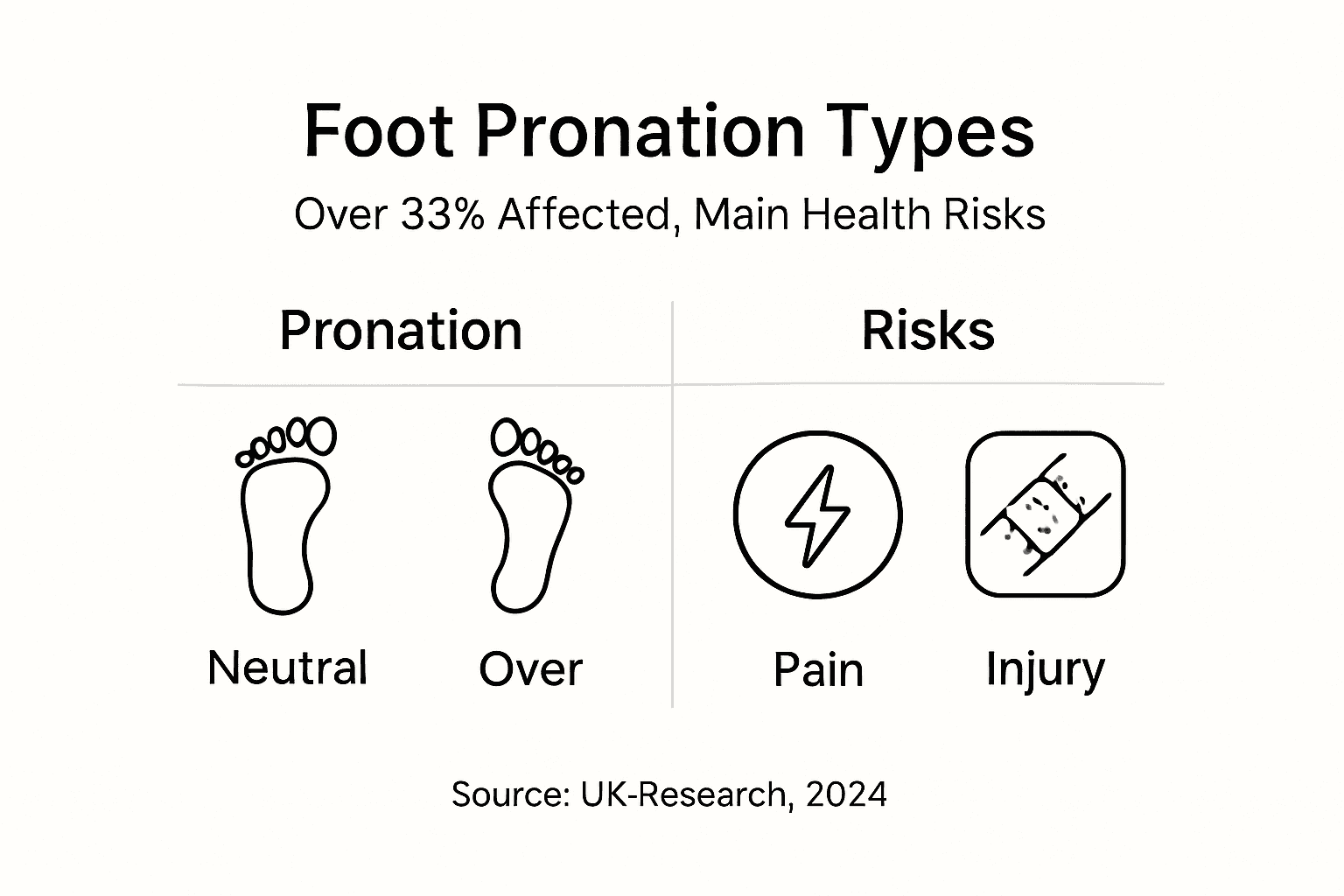
Choosing orthotic friendly footwear becomes especially important if you fall into either abnormal category. These shoes provide targeted support that counteracts your specific biomechanical challenges, reducing injury risk and improving daily comfort. Understanding which category describes your feet empowers you to make informed choices that protect your long term mobility.
Effects of Abnormal Pronation on Foot and Leg Health
Abnormal pronation doesn’t just affect your feet in isolation. Studies show that foot pronation abnormalities contribute to biomechanical chain effects causing knee, hip, and lower back pain, with gait angle changes affecting stability throughout your entire kinetic chain. When your foot rolls improperly, every joint above it must adapt, creating compensatory patterns that strain muscles, tendons, and ligaments.
Overpronation causes your tibia to rotate inward excessively, pulling your knee out of proper alignment. This internal rotation increases stress on the medial side of your knee joint, potentially leading to patellofemoral pain syndrome or even early onset arthritis. Your hip must compensate by rotating further inward as well, which can trigger hip flexor tightness and lower back discomfort as your pelvis tilts forward.
Underpronation creates opposite problems but equally troublesome outcomes. Your rigid foot fails to absorb shock effectively, transmitting impact forces directly up through your ankle, knee, and hip. This increases your risk of stress fractures in the metatarsals and tibial bones. The lack of natural cushioning also contributes to knee osteoarthritis over time.
Common injuries linked to pronation problems include:
- Plantar fasciitis from overstretched arch ligaments
- Achilles tendonitis due to altered tendon angles
- Posterior tibial tendon dysfunction from chronic overpronation stress
- Iliotibial band syndrome from compensatory hip mechanics
- Metatarsalgia caused by uneven weight distribution
- Stress fractures from repetitive high impact forces
Pro Tip: Pay attention to unusual wear patterns on your shoe soles. Excessive wear on the inner edge suggests overpronation, while outer edge wear indicates underpronation. Catching these signs early lets you address biomechanical issues before they cause pain.
The role of stability in footwear becomes critical when you understand these interconnected effects. Proper shoes interrupt the chain reaction, supporting your foot in neutral alignment and protecting every joint above it. Addressing pronation at the foundation prevents problems from cascading upward through your body.
Common Misconceptions About Foot Pronation
Many UK consumers hold inaccurate beliefs about pronation that lead to poor footwear choices and unnecessary worry. Approximately 60% of patients surveyed mistakenly believed pronation is inherently bad, but normal pronation is beneficial and necessary for healthy walking mechanics. Clarifying these misconceptions helps you make smarter decisions about your foot health.
Misconception 1: All pronation is harmful and must be corrected. This widespread belief causes many people to seek maximum support shoes even when their foot mechanics are perfectly normal. In reality, neutral pronation is essential for proper shock absorption and ground adaptation. Only excessive or insufficient pronation requires correction. Trying to eliminate natural pronation can actually create new problems by forcing your foot into an unnatural position.
Misconception 2: Pronation and flat feet are the same thing. People often confuse these two distinct concepts. Pronation describes a dynamic movement that occurs during walking, while flat feet refers to a static arch structure when standing still. You can have flat feet with neutral pronation, or high arches with overpronation. The movement pattern matters more than arch height for determining appropriate footwear support.
Misconception 3: Any supportive shoe fixes pronation issues. Many consumers believe that simply buying shoes labeled