
Types of leather boots: styles, leather and fit guide
TL;DR:
- Leather boots are primarily made from animal hide and designed for durability, style, and various uses. Choosing the right style and leather type depends on understanding their distinct functions, with full-grain leather offering the highest durability and aging gracefully. Proper care, sole construction, and fit are essential to maximize the longevity and performance of leather boots in different environments.
Leather boots are defined as footwear constructed primarily from animal hide, shaped and finished to provide durability, structure, and style across a wide range of uses. From the rugged work floors of industrial sites to the polished corridors of city offices, the right pair of leather boots depends entirely on understanding the differences between styles and materials. Brands like Red Wing, Clarks, and Allen Edmonds have built their reputations on specific boot constructions and leather choices. Getting that choice right means knowing what separates a Chelsea from a Chukka, and full-grain leather from nubuck before you spend a penny.
What are the main types of leather boots?
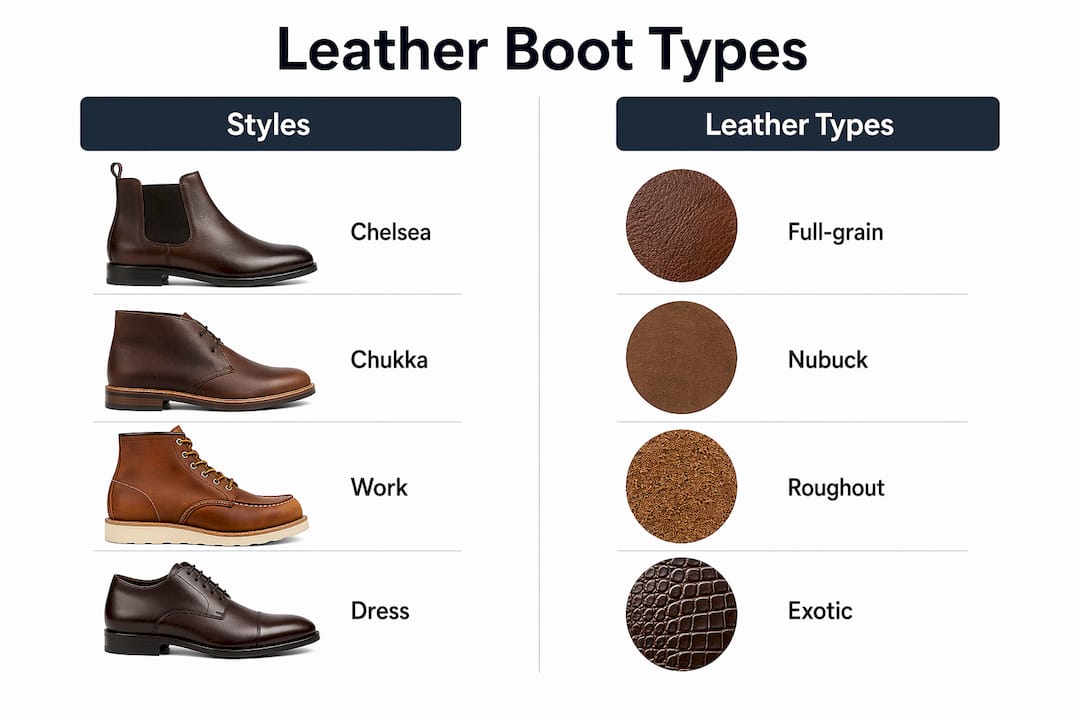
The most recognisable leather boot styles each serve a distinct purpose, and confusing them leads to buying boots that look wrong, feel wrong, or wear out too quickly for the job you need them to do.
Chelsea boots are ankle-height with elasticated side panels and no lacing. Originally designed for equestrian use in Victorian Britain, they have become the most versatile urban boot style available. Brands like Clarks and R.M. Williams produce Chelsea boots that move comfortably from a business meeting to a weekend market.
Chukka boots sit just above the ankle and feature two or three eyelets with open lacing. They are typically unlined, which makes them a strong choice for warmer months. The desert boot, a suede variant of the Chukka popularised by Clarks, is the casual version of the same silhouette.
Work boots are built for protection and endurance. Modern safety boots combine multiple protection categories, including composite toes, waterproofing, and slip resistance, in a single construction. Red Wing and Thorogood are the benchmark names here.
Dress boots extend to mid-calf or higher and are designed for formal wear. Allen Edmonds produces dress boots in smooth calfskin that pair with tailored trousers. Cowboy and Western boots occupy their own category entirely, with a distinctive heel, pointed toe, and shaft that rises to the knee.
Pro Tip: If you are buying your first pair of leather boots and want maximum versatility, a plain-toe Chelsea in dark brown full-grain leather will work across more occasions than any other single style.
How does leather type affect boot performance?
The leather used in a boot determines how it ages, breathes, resists water, and holds up under daily stress. Understanding the material is not optional knowledge for a serious buyer. It is the foundation of every good purchase decision.
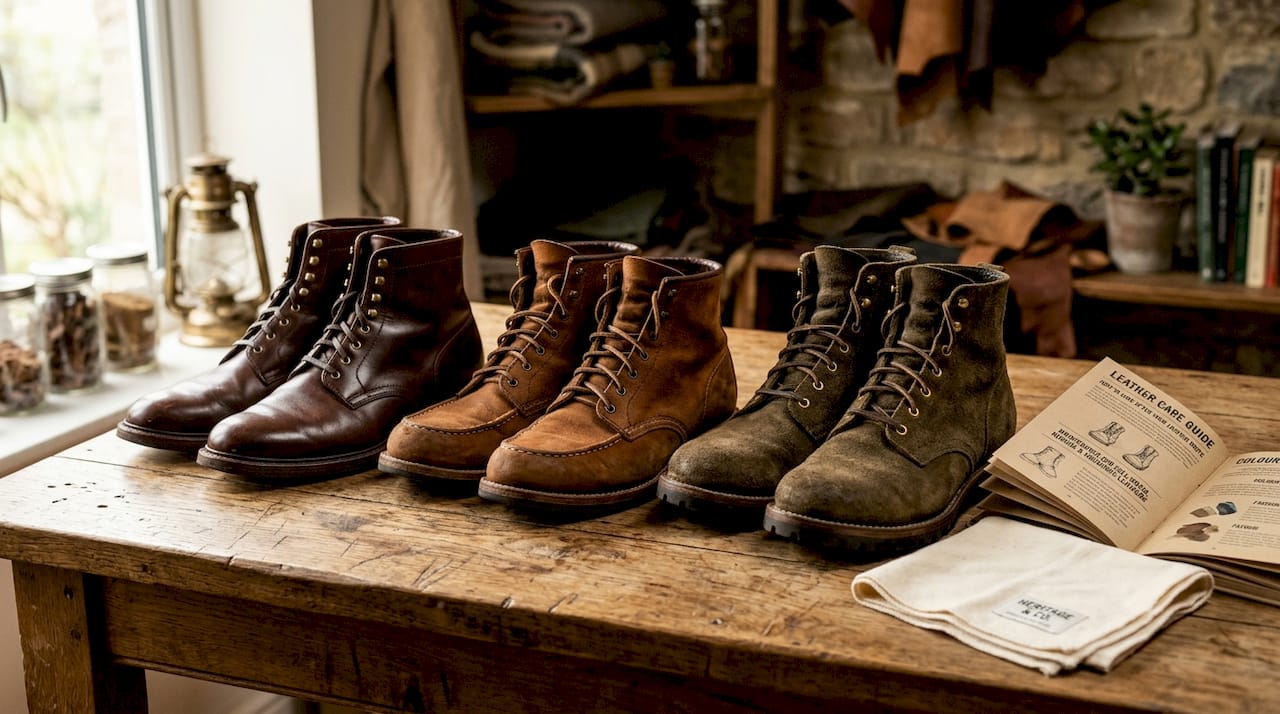
Full-grain leather is the industry standard for work and mountain boots because it retains the intact top grain layer, giving it the highest density and the longest lifespan of any hide. It develops a patina over time, meaning it actually improves in appearance with wear. This is the material Red Wing uses in its Heritage line and the reason those boots last decades.
Nubuck is full-grain leather that has been lightly buffed on the outer surface to create a velvety texture. It looks refined but requires more maintenance than smooth full-grain. Suede is cut from the inner split of the hide, which makes it softer but significantly less durable and more vulnerable to water damage.
Roughout leather is the flesh side of a full-grain hide, not to be confused with suede. It is far more durable than suede and burnishes naturally over time, making it ideal for rugged work and hiking boots. Many buyers mistake roughout for suede and underestimate it entirely.
Exotic leathers such as ostrich, caiman, and bison occupy a distinct niche. Ostrich is soft and flexible, caiman has a rugged armoured appearance, and bison offers extreme durability without complex surface patterns. These materials fulfil both aesthetic and functional needs in specialist markets.
| Leather type | Durability | Water resistance | Best use |
|---|---|---|---|
| Full-grain | Excellent | Good with conditioning | Work, dress, everyday |
| Nubuck | Good | Moderate | Smart casual, light outdoor |
| Suede | Moderate | Poor | Casual, dry conditions |
| Roughout | Very good | Moderate | Rugged work, hiking |
| Exotic (ostrich, caiman) | Excellent | Varies | Fashion, Western wear |
Pro Tip: For everyday leather boots that need to handle British weather, choose full-grain leather and apply a quality wax conditioner like Saphir Médaille d’Or every four to six weeks. It builds water resistance without clogging the pores of the hide.
For a deeper look at how different leather shoe materials compare across footwear categories, Ydauk’s buyer’s guide covers the full spectrum clearly.
How to choose the best leather boots for your needs
Choosing the right pair requires matching three variables: the boot style, the leather type, and the sole construction. Getting two out of three right still produces a boot that disappoints.
-
Define your primary use case. A boot worn five days a week on a construction site needs composite toe protection, waterproofing, and a slip-resistant outsole. A boot worn to the office needs a sleek silhouette, smooth leather, and a leather or rubber dress sole. Trying to find one boot that does both usually results in a boot that does neither well.
-
Prioritise sole construction for longevity. Goodyear welt and stitchdown constructions allow boots to be fully resoled, which vastly extends their lifespan. Cemented soles cannot be resoled. If you are spending serious money on leather boots, avoid cemented construction entirely. A Goodyear-welted boot from Red Wing or Tricker’s can be resoled four or five times over its life, making the higher upfront cost straightforward to justify.
-
Consider comfort technology. Hybrid boot designs incorporating EVA foam footbeds deliver comfort and flexibility without sacrificing the structural benefits of leather construction. Modern consumers increasingly favour this combination. Ydauk’s approach to footwear comfort technology explains exactly why EVA foam has become the standard for everyday wearability.
-
Match leather to climate. Full-grain leather handles wet British winters well when properly conditioned. Suede and nubuck are better reserved for drier seasons or occasional wear. Unlined leather-soled boots maximise airflow in summer, making them a practical choice for warmer months despite the common assumption that leather is always heavy and hot.
-
Check the fit at the widest point. Leather stretches lengthways very little but moulds to the width of your foot over time. Buy for width first, then length. A boot that pinches across the ball of the foot on day one will still pinch on day one hundred.
What are the best care practices for leather boots?
Leather boots last as long as you maintain them. Neglect shortens the life of even the finest full-grain hide. The good news is that a consistent routine takes less than ten minutes per week.
- Clean before conditioning. Remove surface dirt with a damp cloth or a soft brush before applying any product. Conditioning over dirt traps grime in the leather and accelerates wear.
- Condition regularly but not excessively. Over-conditioning softens the leather structure and can cause it to lose its shape. For full-grain boots, once every four to six weeks is sufficient under normal use.
- Waterproof with wax or spray. Wax-based products like Obenauf’s Heavy Duty LP provide the strongest barrier for work boots. Spray-based waterproofing suits dress boots and nubuck where a wax finish would alter the appearance.
- Store with cedar shoe trees. Cedar absorbs moisture and maintains the boot’s shape between wears. Storing boots without trees accelerates creasing and shortens the upper’s lifespan.
- Handle exotic leathers with care. Proper care of exotic leathers requires gentle brushing with a soft horsehair brush and avoiding harsh cleaners that damage delicate textures like ostrich quills. Over-conditioning is a particular risk with exotic hides.
Pro Tip: Never dry wet leather boots near a direct heat source. Heat causes the leather to dry out and crack rapidly. Stuff them with newspaper and let them dry at room temperature overnight.
Key takeaways
Choosing the right leather boots comes down to matching style, leather type, and sole construction to your specific use case, climate, and maintenance commitment.
| Point | Details |
|---|---|
| Style defines occasion | Chelsea and Chukka boots suit everyday and office wear; work boots and Western styles serve specialist needs. |
| Full-grain leads on durability | Full-grain leather outperforms nubuck, suede, and split leather for longevity and abrasion resistance. |
| Sole construction determines lifespan | Goodyear welt and stitchdown soles can be resoled; cemented soles cannot, making them a poor investment. |
| Comfort tech is now standard | EVA foam footbeds in leather boots deliver immediate comfort without compromising structure or breathability. |
| Maintenance protects your investment | Regular conditioning, proper waterproofing, and cedar shoe trees extend boot life by years. |
Why I think most people buy leather boots backwards
Most buyers start with aesthetics and work backwards to practicality. They see a pair of boots they like the look of, check the price, and buy. The leather type, the sole construction, and the intended use case are afterthoughts, if they are considered at all. That approach produces a wardrobe full of boots that look good in the shop and disappoint within six months.
After years of observing how footwear technology has evolved, what strikes me most is how the gap between traditional craftsmanship and modern comfort has closed dramatically. A Goodyear-welted boot with an EVA foam footbed is no longer a contradiction. It is the sensible default for anyone who wants boots that last a decade and feel good from day one. The latest footwear innovations have made that combination genuinely accessible.
The other thing I would push back on is the idea that exotic leathers are purely a fashion statement. Bison and caiman leathers genuinely outperform standard cowhide in specific conditions. The problem is that most people who buy them do not know how to care for them, so they degrade quickly and reinforce the misconception that exotic boots are fragile. They are not fragile. They are demanding.
My honest advice: buy fewer pairs, spend more per pair, and prioritise sole construction above everything else. A resoleable boot is a boot you will still be wearing in fifteen years.
— Panagiotis
Discover Ydauk’s approach to leather boot comfort
Ydauk combines traditional leather craftsmanship with modern comfort engineering, producing footwear that addresses the real-world demands of everyday wear. The YDA shoe technology integrates EVA sole construction and foot health principles into designs that do not sacrifice style for function. If you have been searching for leather boots that hold up to daily use, breathe properly, and support your feet over long hours, Ydauk’s collection is worth exploring. Their focus on durability, breathability, and anatomical fit makes them a strong choice for buyers who want boots that perform as well as they look.
FAQ
What are the most durable types of leather boots?
Full-grain leather boots with Goodyear welt or stitchdown sole construction are the most durable option available. These boots can be resoled multiple times, extending their lifespan well beyond that of cemented-sole alternatives.
What is the difference between suede and roughout leather?
Roughout leather is the reversed flesh side of a full-grain hide and is significantly more durable than suede, which is cut from the inner split of the hide. Roughout resists abrasion better and burnishes naturally over time, making it the stronger choice for rugged boots.
How do I choose between Chelsea and Chukka boots?
Chelsea boots suit smarter, more versatile occasions and work well with both trousers and jeans. Chukka boots are better suited to casual wear and warmer conditions, particularly in unlined suede or nubuck versions.
Are exotic leather boots worth the investment?
Exotic leathers like ostrich and caiman offer exceptional durability and distinctive aesthetics, but they require careful maintenance using soft brushes and gentle conditioners. With proper care, they outlast standard cowhide boots in both appearance and structural integrity.
What sole construction should I look for in leather boots?
Goodyear welt and stitchdown constructions are the gold standard because they allow full resoling. Avoid cemented soles if longevity is a priority, as they cannot be repaired once the sole wears through.