
Shoe size 40: UK and US conversions explained
TL;DR:
- EU size 40 roughly equals UK 6.5 for men and UK 7 for women, with a foot length of about 25 centimeters. Accurate sizing depends on measuring your foot in centimeters and considering brand-specific last designs. Ydauk provides precise foot-length guidance on product pages to ensure proper fit matching your measurements.
EU shoe size 40 approximately equals UK 6.5 for men and UK 7 for women. In US sizing, that corresponds roughly to US men’s sizes near 7 and US women’s around 9. The corresponding foot length is about 25 cm (about 9.84 inches).
These figures are starting points, not guarantees. Every brand cuts its shoes on a different last, so the centimetre measurement of your foot is always the more reliable anchor than the EU number alone.
- EU 40 → UK 6.5 (men’s) / UK 7 (women’s)
- EU 40 → US men’s sizes 7–7.5 / US women’s sizes 9–9.5
- Foot length: approximately 25 cm / 9.84 in
- Always measure both feet and use the larger measurement when matching to a chart
Table of Contents
- What does shoe size 40 equal in UK and US sizes?
- How to measure your foot at home for the right fit
- Why does a size 40 fit differently in different brands?
- UK shopping checklist for size 40 buyers
- How Ydauk publishes sizing information
- Key takeaways
- Why measurement beats conversion tables every time
- Useful sizing charts and retailer guides
- Ydauk: health-focused footwear built around your measurements
What does shoe size 40 equal in UK and US sizes?
The tables below give you the full picture for sizes either side of EU 40, so you can see where half sizes sit and how foot length maps across the range.
Men’s conversion chart
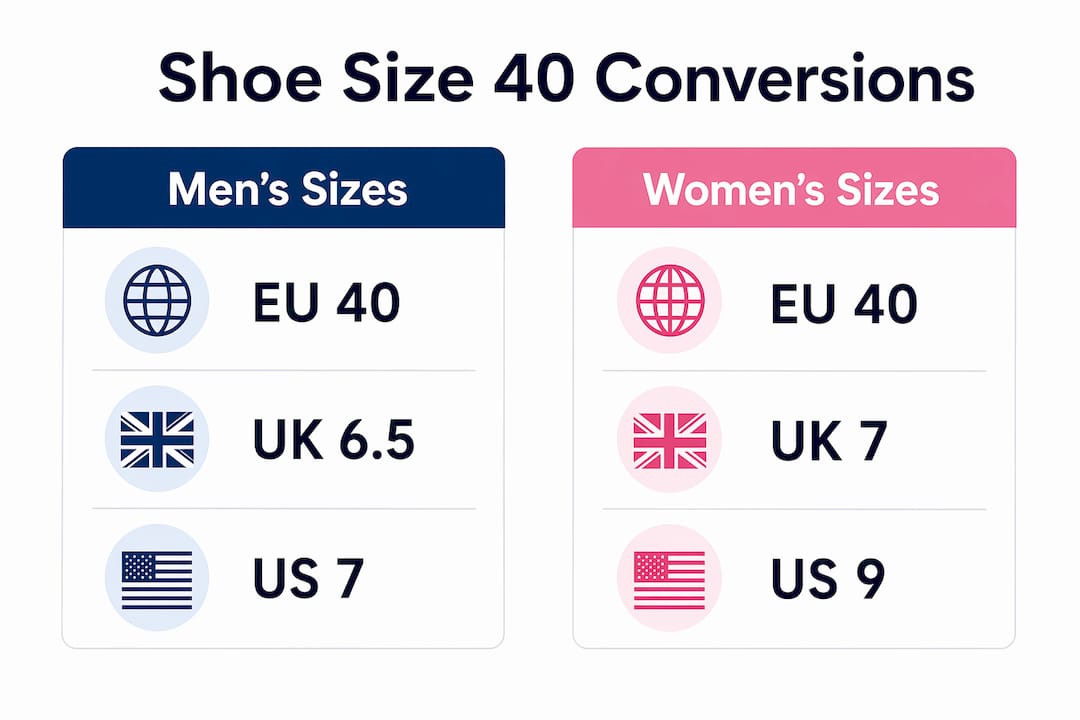
| EU | UK | US | Foot length (cm) | Foot length (in) |
|---|---|---|---|---|
| 39 | 6 | 6.5 | — | — |
| 39.5 | 6.5 | 7 | 24.— | — |
| 40 | 6.5 | 7–7.5 | approximately 25 | approximately 9.84 |
| 40.5 | 7 | — | 25.3 | — |
| 41 | — | — | 25.— | — |
Women’s conversion chart
| EU | UK | US | Foot length (cm) | Foot length (in) |
|---|---|---|---|---|
| 39 | 6 | —.5 | — | — |
| 39.5 | 6.5 | 9 | 24.— | — |
| 40 | 7 | 9–9.5 | approximately 25 | approximately 9.84 |
| 40.5 | — | — | 25.3 | — |
| 41 | — | — | 25.— | — |
EU sizes are unisex for length, but the US system runs on separate men’s and women’s scales, which is why the same EU 40 produces such different US numbers depending on gender. The UK scale sits closer to the men’s EU scale, so the gender gap is smaller there.
A few things worth knowing about half sizes:
- If your foot measures between 24.— cm and 25.3 cm, you may sit between EU 39.5 and 40. Try both if possible.
- Foot lengths for EU 40 vary between roughly 24.— cm and 25.3 cm across different brand charts, so a brand’s own cm column matters more than the EU number.
- For wider feet, a half size up often gives more room without adding unwanted length.
How to measure your foot at home for the right fit
Getting your centimetre measurement takes about two minutes and removes most of the guesswork. Use this step-by-step foot measurement guide:
- Place a sheet of A4 paper on a hard floor. Stand on it with your heel touching a wall.
- Mark the tip of your longest toe with a pencil held vertically. Do the same at the back of your heel.
- Measure the distance between the two marks in centimetres using a ruler.
- Repeat for the other foot. Feet are rarely identical.
- Use the larger measurement when matching to any size chart.
For a shoe size in cm reading of around 25 cm, EU 40 is the standard starting point. If you land at 25.3 cm or above, consider EU 40.5 before committing.
Pro Tip: Measure at the end of the day. Feet swell by up to half a size during normal daily activity, so an evening measurement reflects the largest your foot typically gets. Wear the socks you plan to use with the shoes.

Best-practice guidance consistently recommends this end-of-day approach, particularly for trainers and boots where fit under load matters most.
Why does a size 40 fit differently in different brands?
The EU sizing system is built on the Paris Point, where each size increment equals roughly 6.67 mm of foot length. That sounds precise, but it only governs the length label. Width, arch height, toe box shape, and heel cup depth are all determined by the manufacturer’s last, which is the foot-shaped mould the shoe is built around.

Manufacturers use different lasts and internal sizing standards, so a labelled EU 40 in one brand can feel noticeably roomier or tighter than the same label in another. Some brands design specifically for narrow foot profiles; others build for a wider, more voluminous fit. Neither is wrong. They just suit different feet.
Common product-page phrases decoded:
- “Runs small”: size up by half a size or one full size from your usual EU number.
- “True to size”: your measured cm should match the chart directly.
- “Narrow fit” or “slim last”: if you have a wider foot, consider the next half size or look for a wide-fit option.
- “Generous fit”: you may be able to size down, particularly for dress shoes.
Pro Tip: Check customer reviews specifically for fit comments. Phrases like “ordered my usual size and it was perfect” or “had to go half a size up” from reviewers with similar foot measurements are more useful than any conversion chart.
Brand variation is often intentional. Consulting retailer-specific sizing pages before buying is one of the most reliable ways to avoid a return.
UK shopping checklist for size 40 buyers
Buying size 40 footwear online from a UK retailer involves a few extra steps that most shoppers skip, then regret.
- Check the brand’s own cm chart first. Generic EU-to-UK tables are a starting point; the brand’s chart is the authority.
- Read the “fit” notes on the product page. Many UK retailers (including Foot Locker UK) include last-specific guidance alongside the size chart.
- Confirm the returns window before ordering. UK consumer law gives you 14 days to return most online purchases, but some retailers extend this. Free returns are not guaranteed, so check before you buy.
- Compare prices across international sites carefully. Prices on non-UK sites may exclude VAT, which is currently 20% in the UK. A shoe listed at £80 ex-VAT becomes £96 at checkout.
- Contact customer support with your measurements. Give them your foot length in centimetres, your width (narrow/standard/wide), and the intended use (everyday wear, sport, formal). A photo of your foot outline on paper alongside a ruler can also help.
- Check whether the site ships from outside the UK. Post-Brexit, orders from EU retailers above £135 may attract import duties, adding unexpected cost.
How Ydauk publishes sizing information
Ydauk lists foot-length guidance directly on product pages, so you can match your centimetre measurement to the specific shoe rather than relying on a generic EU number. The Technology of YDA Shoes page also explains how YDA footwear is designed around foot health principles, which affects how the last is shaped and how the shoe fits across different foot types.
Returns support is available for customers who find the fit is not right, which makes it practical to order and check fit at home before committing.
Key takeaways
EU 40 equals UK 6.5 (men’s) or UK 7 (women’s), with a foot length of approximately 25 cm. Your measured centimetres, not the EU label, should drive every sizing decision.
| Point | Details |
|---|---|
| Core conversion | EU 40 approximately equals UK 6.5 (men’s) / UK 7 (women’s); US men’s sizes 7–7.5 / US women’s sizes 9–9.5. |
| Foot length anchor | Approximately 25 cm is the typical foot length for EU 40; use your own cm measurement to confirm. |
| Measure correctly | Measure both feet at end of day in socks; use the larger reading to match the chart. |
| Brand variation | A size 40 fits differently across brands due to different lasts; always check the brand’s cm column. |
| Ydauk sizing | Match your centimetres to the product-specific chart on each Ydauk listing for the most accurate fit. |
Why measurement beats conversion tables every time
The conversion tables in this article are genuinely useful, but they are not the final word. Every chart, including this one, is an approximation built on averages. The Paris Point system standardises length increments, but it says nothing about how a shoe wraps around your specific foot shape.
The readers who get sizing right consistently are the ones who measure in centimetres, check the brand’s own chart, and read fit notes from real customers. The ones who return shoes most often are the ones who assume their EU 40 is universal. It is not, and no chart can make it so. Use the tables here to narrow the field, then use your measurements to close the decision.
Useful sizing charts and retailer guides
A short list of authoritative resources for verifying your EU 40 conversion before buying:
- ASOS Men’s Shoe Size Chart — product-specific charts updated per brand; useful for confirming fit notes alongside the EU number.
- Foot Locker UK Size Guide — covers EU, UK, and US conversions with brand-level notes; one of the clearest UK-focused resources available.
- KnowSize EU 40 guide — tabular breakdown of EU 40 across multiple systems including AU and JP sizing.
- Veronica Beard Women’s Size Guide — a real-world example of how a brand’s chart can differ from generic tables (EU 40 → US 9 for women’s).
- Rogerson Shoes Size Guide — UK-focused, includes cm measurements alongside UK and EU sizes.
Always prefer the product-specific chart over a generic conversion table. Customer reviews mentioning fit are the next best signal, particularly comments from buyers who share their foot length or width.
Ydauk: health-focused footwear built around your measurements
Most shoe brands ask you to trust a number. Ydauk asks you to start with your centimetres.
Ydauk is a UK footwear brand built around YDA Technology, which combines foot health principles with everyday style. Each product listing includes foot-length guidance so you can match your measured cm directly to the shoe, rather than guessing from a generic EU label. If you have been reading this article because a size 40 has let you down before, that product-level precision is exactly what makes the difference.
Visit the Technology of YDA Shoes page to understand how YDA footwear is designed, then check the sizing details on any product listing to find your fit. Customer support is available if you want to confirm your size before ordering.