
The most comfortable diabetic footwear: a UK guide
The most comfortable diabetic footwear is a well-fitting shoe with a wide, deep toe box, a low stable heel, a secure fastening, and a seam-free interior that redistributes pressure and reduces friction. That is not a marketing claim; it is the clinical consensus from the NHS, Diabetes UK, and podiatry specialists across the UK. The right shoe does not just feel good; it actively protects skin that may not be able to feel damage until it is serious.
The five features that define genuinely protective, comfortable shoes for diabetes:
- Wide, deep toe box — prevents pressure on the toes and reduces the risk of blisters and ulcers
- Low, stable heel (ideally no higher than 3 cm) — distributes weight evenly and reduces forefoot loading
- Secure fastening (laces, Velcro, or adjustable straps) — holds the foot in place without constriction
- Seam-free or minimal-seam interior — eliminates friction points that can cause skin breakdown
- Pressure-redistributing, cushioned sole — absorbs shock and reduces peak pressure under the foot
Your immediate next step depends on your risk level. If you have neuropathy, a history of ulcers, or any change in foot shape, book a podiatry appointment rather than shopping first. For everyone else, attending your annual NHS diabetes foot screening is the gateway to understanding your risk and whether retail footwear is sufficient or prescription shoes are needed.
Pro Tip: Before any shoe purchase, run your hand inside the shoe and feel for internal seams, ridges, or rough stitching. A shoe that feels smooth to the touch on the outside can still have hidden seams that cause blisters in people with reduced sensation.
Key takeaways
The most comfortable and protective diabetic footwear combines a wide toe box, secure fastening, seam-free interior, and cushioned sole — and the right choice depends entirely on your clinical risk level.
| Point | Details |
|---|---|
| Core features matter most | Wide toe box, low stable heel, secure fastening, and seam-free interior are the non-negotiable foundation. |
| Fit must be checked carefully | Measure both feet with your usual socks, later in the day, and walk for several minutes before deciding. |
| Daily inspection is essential | Check feet every day for cuts, redness, or blisters; inspect inside shoes before every wear. |
| NHS screening is the gateway | Your annual diabetic foot check determines your risk level and triggers podiatry referral for prescription footwear if needed. |
| Ydauk for low-to-moderate risk | Ydauk’s YDA Technology range addresses the clinical checklist for people without active ulcers or significant neuropathy. |
Table of Contents
- Which shoe types suit people with diabetes, and what should you avoid?
- How do you check whether a shoe fits safely?
- Socks, insoles and orthoses: what actually makes a difference?
- Who qualifies for NHS-prescribed footwear, and how does the pathway work?
- Daily foot care routine and the red flags that need urgent attention
- How to break in new shoes safely, and when to replace them
- Buying diabetic footwear in the UK: what to bring and where to look
- How Ydauk’s footwear technology addresses diabetic comfort
- The part of diabetic footwear advice most people miss
- Ydauk: footwear built around the clinical checklist
- Sources
Which shoe types suit people with diabetes, and what should you avoid?
Not every comfortable shoe is a safe shoe for diabetic feet. The distinction matters because reduced sensation means you may not feel damage until it has already occurred.
Suitable footwear categories:
- Wide-fit or extra-wide trainers with cushioned, shock-absorbing soles and adjustable lacing
- Supportive walking shoes with a firm heel counter, roomy toe box, and breathable upper
- Soft leather shoes with a structured sole and secure fastening; leather moulds to the foot over time without creating pressure points
- Orthopaedic or therapeutic models designed with removable insoles to accommodate custom orthoses
- Extra-wide, supportive slippers for limited indoor use only, provided they have a firm sole and heel support; standard flat slippers are not appropriate
Styles to avoid for regular wear:
- Backless shoes and mules — the foot slides forward, increasing toe pressure
- Slingbacks — no heel security means the foot shifts with every step
- Flimsy slip-ons and ballet pumps — lack structure and allow the foot to move inside the shoe
- Heeled shoes that are too high — shift weight onto the forefoot, increasing pressure at the ball of the foot
- Pointed-toe styles — compress the toes regardless of how soft the upper material is
- Shoes with prominent internal seams or decorative stitching on the inside
Podiatry guidance from Oxford Health NHS Foundation Trust is explicit on this: secure fastenings and a stable heel are non-negotiable features, not optional upgrades. The reasoning is straightforward. A shoe that allows the foot to slide creates friction; friction on skin with poor circulation or reduced sensation leads to blisters, then ulcers, then a clinical emergency.
For a broader overview of types of diabetic footwear that map to these categories, Ydauk’s blog covers the retail options in practical detail.
How do you check whether a shoe fits safely?
Fit is the single most important variable in diabetic footwear. A shoe with every correct feature still causes harm if it is the wrong size or shape for your foot.
Fitting checklist:
- Measure both feet with your usual diabetic or seam-free socks on; feet are rarely identical in size, so fit to the larger one
- Measure later in the day when feet are at their largest due to natural swelling
- One finger’s width of space between your longest toe and the end of the shoe; less than that and toe pressure is likely
- Heel hold — the heel should sit firmly in the cup with no slipping when you walk; lift your heel slightly and the shoe should resist
- Width check — the widest part of your foot should sit comfortably within the widest part of the shoe without bulging over the sole
- Run your hand inside the shoe before wearing; feel for seams, rough stitching, or ridges along the toe box and sides
- Walk for several minutes in the store; pressure points often only appear after a few minutes of movement, not when standing still
When in doubt between a longer size and a wider fitting, choose the wider fitting. A shoe that is too long creates a different set of pressure problems as the foot slides forward. Many people with diabetes benefit from shoe width guidance that explains why width matters more than length for pressure distribution.
Removable insoles are a practical advantage here: they let you replace the factory insole with a custom orthotic without losing the shoe’s structure. Adjustable fastenings mean you can accommodate foot swelling across the day without changing shoes.
Pro Tip: If you wear prescribed orthoses, bring them to every shoe fitting. The orthosis changes the effective internal volume of the shoe, and a shoe that fits without it may be too tight once the orthotic is in place.
Socks, insoles and orthoses: what actually makes a difference?
The shoe is only part of the system. What goes inside it matters almost as much.
Socks
Seam-free socks are not a luxury for people with diabetes; they are a clinical recommendation. A standard sock seam running across the toe box creates a ridge that, in a person with neuropathy, can cause a pressure sore without any sensation of discomfort. Look for socks labelled seam-free or toe-seam-free, made from moisture-wicking fibres such as bamboo, merino wool, or technical synthetics. Cotton holds moisture against the skin, which softens it and increases blister risk. The American Diabetes Association reinforces this: moisture-wicking socks and daily sock changes are part of the standard prevention protocol.
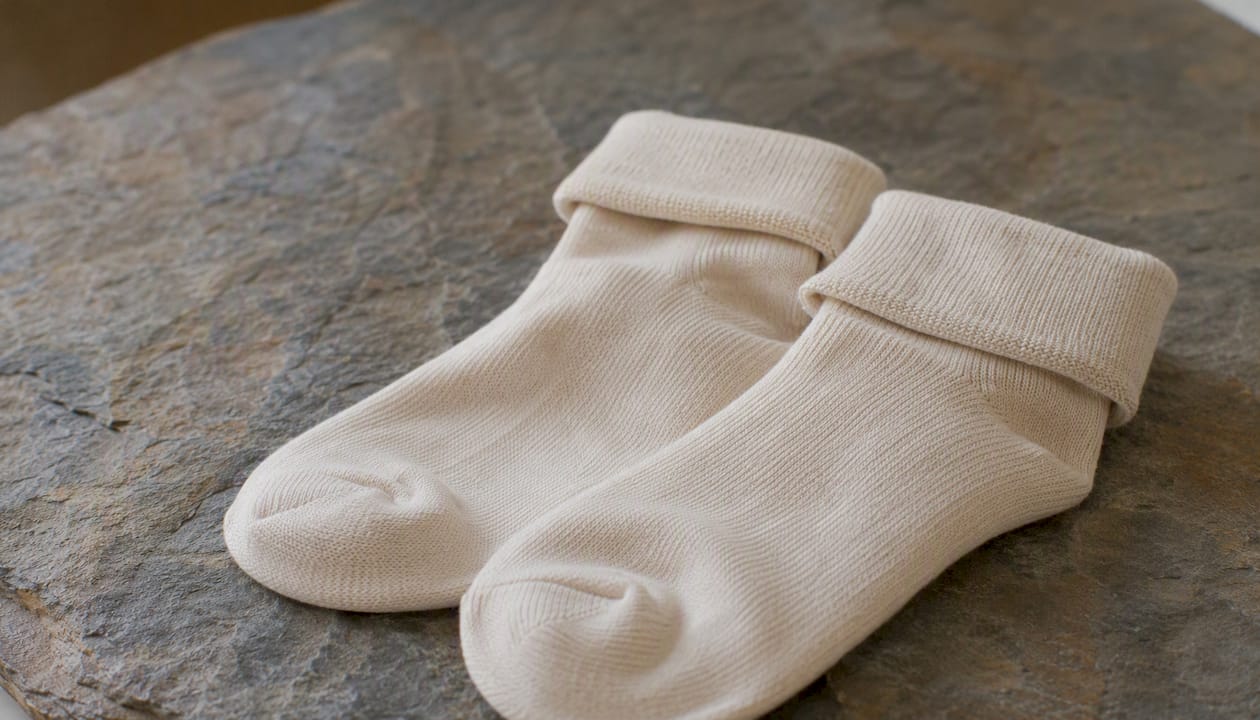
Fit matters too. Socks that are too tight restrict circulation; socks that are too loose bunch inside the shoe and create friction. Avoid socks with tight elasticated tops, which can impair blood flow to already-compromised feet.
Insoles
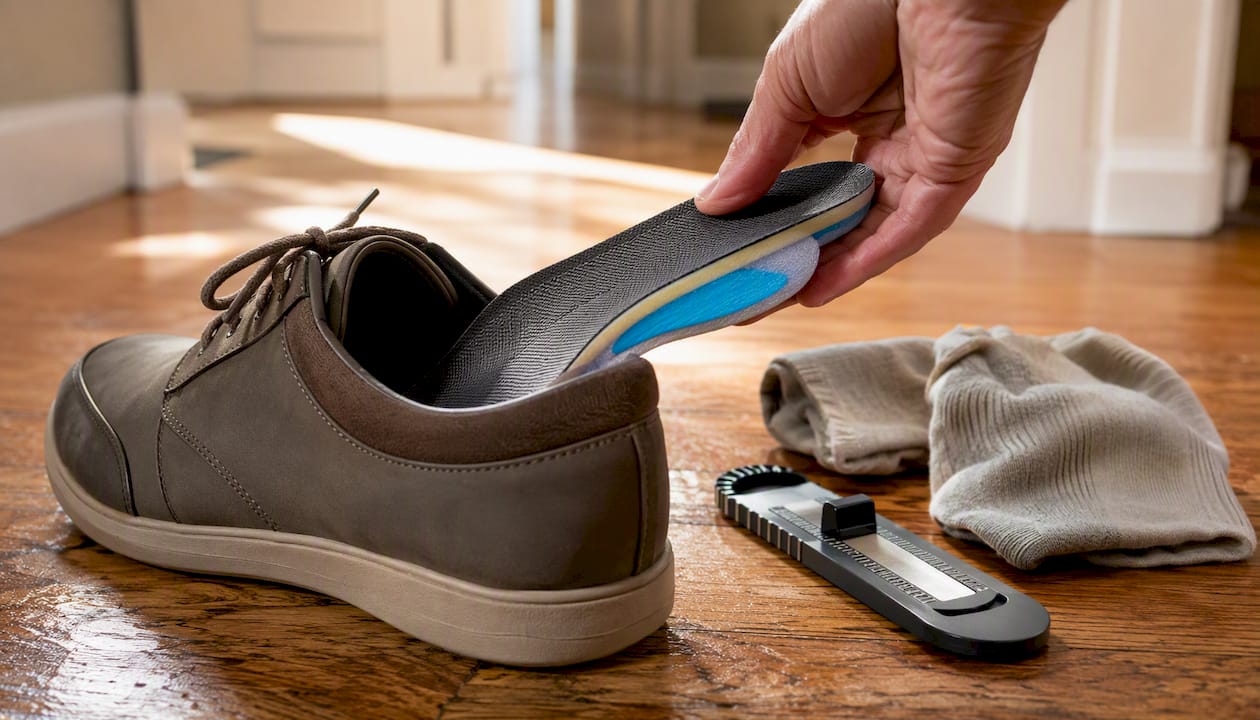
Cushioned removable insoles serve two purposes: shock absorption and pressure redistribution. The factory insole in most shoes is thin and offers minimal protection. Replacing it with a gel or foam insole rated for diabetic use adds meaningful cushioning under the heel and forefoot, the two areas that take the highest impact loads during walking. Replace insoles every six months or sooner if they show visible compression or flattening.
Orthoses
Prescription orthoses are a different category entirely. These are custom-moulded devices, made from a cast or 3D scan of your foot, designed to correct biomechanical loading and offload specific pressure points. StatPearls clinical guidance is clear that for patients with neuropathy, deformity, or a history of ulceration, individualised offloading through orthoses is part of the limb-preservation strategy, not an optional add-on.
Off-the-shelf cushioned insoles are appropriate for low-to-moderate risk feet. Bespoke orthotics are indicated when there is a structural foot problem, a history of ulcers, or when standard insoles have not prevented recurrent pressure injuries.
Pro Tip: Ask your podiatrist whether your current shoes have enough internal depth to accommodate an orthotic. Many standard shoes are too shallow once a bespoke device is added, which negates the benefit of both.
Who qualifies for NHS-prescribed footwear, and how does the pathway work?
Prescription footwear is not available to everyone with diabetes, but the qualifying criteria are broader than many people realise.
Clinical features that typically qualify you for prescribed footwear or orthoses:
- Loss of protective sensation (peripheral neuropathy confirmed on clinical testing)
- Foot deformity such as Charcot foot, prominent metatarsal heads, or significant bunions
- Current or previous diabetic foot ulcer
- Poor peripheral circulation (peripheral arterial disease)
- History of lower-limb amputation
StatPearls describes footwear selection for high-risk patients as part of an interprofessional limb-preservation strategy involving podiatry, vascular, and diabetes care teams working together.
How the NHS pathway works:
- Attend your annual NHS diabetic foot check (part of your standard diabetes care plan)
- The clinician stratifies your risk: low, moderate, or high
- Moderate and high-risk patients are referred to the local foot protection team or podiatry service
- A podiatrist conducts a full biomechanical and vascular assessment
- Based on that assessment, the podiatrist may prescribe custom orthoses, therapeutic footwear, or both
- Prescribed footwear is fitted and adjusted; follow-up appointments confirm it is performing correctly
RDASH NHS podiatry guidance provides region-specific information on local foot protection services and how to access them. Your GP can also make a direct referral to podiatry if you have concerns between annual checks.
Prescribed footwear is made to accommodate specific foot shapes and orthoses, with materials and construction that retail shoes cannot replicate. For high-risk feet, the difference between retail and prescription is clinically significant.
Daily foot care routine and the red flags that need urgent attention
Daily inspection and wearing protective footwear consistently are the two actions that most reliably prevent diabetic foot complications. The NHS is direct on this: check your feet every day, including the soles and between the toes, and always wear shoes rather than going barefoot, even indoors.
Daily routine:
- Inspect feet in good light, using a mirror for the soles if needed; look for cuts, blisters, redness, swelling, or skin changes
- Wash with lukewarm water (test the temperature with your elbow, not your foot)
- Dry carefully, paying particular attention to the skin between the toes where moisture accumulates
- Apply moisturiser to the heels and soles, but not between the toes
- Change socks daily; put on clean, seam-free socks before shoes
- Check inside shoes before putting them on, every time
Red flags requiring prompt podiatry or urgent care:
- Any cut, blister, or wound that has not healed within a few days
- Redness, warmth, or swelling in any part of the foot
- Discolouration, particularly darkening or blackening of the skin
- Persistent pain or, conversely, a new area of numbness
- Signs of infection: pus, increasing redness, fever
- Any open sore or ulcer
Corn plasters and chemical callus removers are not safe for people with diabetes; the active acids can damage skin that cannot signal distress. See a podiatrist for callus and corn management instead.
How to break in new shoes safely, and when to replace them
New shoes should be introduced gradually. Even a shoe that fits correctly in the shop can create friction on skin that has not yet adapted to its specific contact points. MedlinePlus patient guidance recommends wearing new shoes for 1–2 hours a day during the first 1–2 weeks, checking feet afterwards for any redness or pressure marks.
Practical break-in steps:
- Wear new shoes for no more than one to two hours on the first day
- After removing them, inspect your feet for red marks, blisters, or areas of warmth
- If no problems appear, increase wearing time by 30–60 minutes each subsequent day
- Do not wear new shoes for a full day until you have completed at least one week of progressive wear
- Check inside the shoe before each wear for any debris, rough areas, or internal damage
Signs that shoes need replacing:
- The sole feels noticeably compressed or flat underfoot
- Uneven wear on the outer sole, indicating altered gait or loss of stability
- The heel counter has softened and no longer holds the heel firmly
- Visible cracking, separation, or damage to the upper or sole
- Internal lining has worn through, exposing seams or rough surfaces
Rotating between two pairs of shoes extends the life of both and allows each pair to decompress and dry fully between wears. Insoles typically need replacing more frequently than the shoes themselves; check them every six months regardless of how the shoe looks externally. Ydauk’s guidance on diabetic footwear tips covers break-in and maintenance steps in more detail.
Buying diabetic footwear in the UK: what to bring and where to look
The most important thing to bring to any shoe fitting is information: your usual socks, any orthoses you currently wear, and recent podiatry notes if you have them. Without these, even a skilled fitter cannot give you an accurate assessment.
What to bring:
- The socks you wear daily (seam-free, diabetic-specific if you use them)
- Any prescribed orthoses or insoles
- Notes from your most recent podiatry appointment, including any width or depth recommendations
- Both feet measured standing, ideally later in the day
Where to buy:
- NHS podiatry pathway — for moderate and high-risk patients; prescribed footwear is fitted by a podiatrist and covered on the NHS; access via your annual foot check or GP referral
- High-street specialist fitters — stores with trained fitters who can measure width as well as length and stock extra-wide or deep fittings; ask specifically whether staff are trained in diabetic footwear fitting
- Online retailers — viable for low-risk feet when you know your exact size and width; prioritise retailers with a generous returns policy and clear width-fitting information; RDASH NHS footwear guidance can help you identify what to look for
Cost expectations:
Retail diabetic or wide-fit footwear in the UK typically ranges from around £40 for basic wide-fit trainers to over £150 for orthopaedic or therapeutic models. Prescribed footwear through the NHS carries no direct cost to the patient. Custom orthoses on the NHS are similarly covered when clinically indicated, though waiting times vary by trust.
To find your local foot protection service, search NHS.uk for “diabetic foot care” with your postcode, or ask your GP or diabetes nurse for a direct referral.
How Ydauk’s footwear technology addresses diabetic comfort
For people at low-to-moderate risk, without active ulcers or significant neuropathy, a well-engineered retail shoe can meet the clinical checklist. Ydauk’s YDA Technology is built around the features that podiatrists identify as foundational: wide fit, removable insoles, minimal-seam linings, and pressure-redistributing soles.
How YDA Technology maps to the clinical checklist:
- Wide and deep toe box construction to reduce pressure on the toes and forefoot
- Removable insoles that allow accommodation of prescribed orthoses without losing shoe structure
- Seamless or minimal-seam interior linings to reduce friction risk
- Cushioned, shock-absorbing soles designed to redistribute pressure across the plantar surface
- Adjustable fastenings for a secure, adaptable fit across varying foot widths and swelling levels
Healthline’s consumer guidance makes the point clearly: not everyone with diabetes needs therapeutic prescription shoes; many people benefit from well-fitting, wide, cushioned retail footwear when it is matched correctly to their foot shape and risk level. Ydauk’s range is positioned for that group.
For readers who want to understand the technical detail behind these features, identifying shoe technology benefits for diabetic footwear explains how specific construction choices translate into pressure and friction reduction.
Pro Tip: If you are considering Ydauk footwear and you have any history of neuropathy, ulcers, or foot deformity, speak to your podiatrist first. A podiatrist can confirm whether a retail option is appropriate for your specific risk level or whether you need the NHS prescription pathway instead.
The part of diabetic footwear advice most people miss
Most guidance on comfortable shoes for diabetes focuses on features: toe box, heel counter, seams. That is correct, but it misses the more important point. The shoe is only as good as the risk assessment behind the choice.
People at low risk with no neuropathy and no foot deformity have real flexibility. A well-fitting wide trainer from a reputable brand, worn with seam-free socks and checked daily, can be entirely appropriate. The clinical literature supports this. The mistake is assuming that what works at low risk also works at moderate or high risk, and that is where retail footwear, however well-engineered, reaches its limit.
The other thing most articles understate is the daily inspection habit. Footwear choice matters, but the person who checks their feet every evening and catches a blister before it becomes an ulcer is doing more for their foot health than any shoe can achieve alone. The shoe reduces risk; the inspection catches what the shoe misses.
Ydauk: footwear built around the clinical checklist
If you are at low-to-moderate risk and looking for retail footwear that genuinely reflects the clinical checklist rather than just claiming to, Ydauk is worth a close look. The YDA Technology range is built around wide fit, removable insoles, seamless linings, and pressure-redistributing soles — the same features NHS podiatrists and Diabetes UK identify as the foundation of safe diabetic footwear.

Browse the technology page to see how specific construction choices map to the features covered in this guide, then contact Ydauk’s customer support team to discuss which model suits your foot shape and width. If you have neuropathy, a history of ulcers, or any active foot problem, please see a podiatrist before purchasing retail footwear.
Sources
The following authoritative sources provide official guidance, regional pathways, and clinical background for diabetic foot care in the UK:
- How to look after your feet | Diabetes UK
- Diabetic Foot Care - StatPearls - NCBI Bookshelf
- Foot care: patient instructions – MedlinePlus
- Podiatry – Oxford Health NHS Foundation Trust
- Footwear advice for people with diabetes – RDASH NHS
- Diabetes Foot Care: Tips for Healthy Feet & Preventing Complications — American Diabetes Association
To find your local NHS foot protection service, visit NHS.uk and search for “diabetic foot clinic” with your postcode, or ask your GP or diabetes nurse for a direct referral to podiatry.
This article provides general information about diabetic footwear and foot care. It is not a substitute for professional medical or podiatric advice. If you have neuropathy, foot ulcers, circulatory problems, or any active foot condition, consult a qualified podiatrist or your diabetes care team before making footwear decisions.