
Diabetic foot care checklist: choose and care for shoes
Before you put on any pair of shoes today, run through these five checks: heel height no greater than around 2.5 to 3 cm, correct fit in length and width, a secure fastening such as laces or Velcro, a hand-sweep inside the shoe for sharp objects, and natural soft uppers with clean seam-free socks. That is the core of any practical foot care checklist for diabetics, and everything else in this guide builds on those five points.
Avoid slip-ons, backless shoes, and slippers. They lack the structure to hold your foot securely, which increases rubbing and the risk of a fall. Even at home, wear supportive footwear with a fastening.
Pro Tip: Always run your hand fully inside a shoe before putting it on, not just at the toe. A small stone or folded insole edge near the heel can cause a pressure sore you may not feel if you have neuropathy.
Key takeaways
The single most protective habit in this guide is the daily hand-sweep inside your shoes before wearing them, combined with a shoe that fits correctly and has a secure fastening.
| Point | Details |
|---|---|
| Heel height limit | Keep heels at or below 2.5–3 cm to reduce forefoot pressure. |
| Get both feet measured | Foot shape changes over time; always measure at a reputable retailer, not from memory. |
| Prefer laces or straps | Secure fastenings prevent sliding and friction that cause blisters. |
| Inspect the interior every time | Run your hand inside before each wear to catch stones, debris, and torn linings. |
| Repair or replace promptly | Damaged soles, collapsed heels, or rough linings must be fixed before the shoe is worn again. |
| Ydauk for everyday wear | Ydauk shoes are designed around wide fit, cushioned soles, and soft uppers that match the checklist criteria. |
Table of Contents
- What should you check every time you put on or remove shoes?
- How do you choose the right shoes for diabetic feet?
- How do you keep shoes and insoles safe to wear?
- When should you repair or replace your shoes?
- What socks and accessories reduce risk for people with diabetes?
- When should you see a podiatrist or orthotist about your footwear?
- Why a repeated checklist matters more than any single purchase
- Everyday supportive shoes built around foot health
- Sources
What should you check every time you put on or remove shoes?
Every single time you take off your shoes, check both the footwear and your feet. That one habit catches problems before they become wounds.
Run through this sequence:
| Check | What to do | Why it matters |
|---|---|---|
| Hand-sweep inside | Slide your whole hand around the interior, including the heel | Finds stones, debris, or rough seams you cannot feel through the sole |
| Sole inspection | Look at the underside for holes, cracks, or embedded objects | A pierced sole lets sharp objects reach your foot |
| Insole check | Lift the insole and look underneath | Worn or displaced insoles create pressure points |
| Seam and lining | Feel along every seam inside | Rough or torn linings cause rubbing with every step |
| Foot inspection | Look at your feet for redness, blisters, or marks before dressing | Catches irritation caused by the previous wearing |
If you find a stone, pin, or any sharp object, remove it and check the interior lining for damage before wearing the shoe again. A hole in the lining means the shoe needs repair or replacement, not just a quick brush-out.
New shoes need particular attention. Bedfordshire Hospitals NHS Trust advises wearing new footwear indoors for 20–30 minutes initially, then checking for any redness or marks before gradually increasing wearing time. If a mark is still visible after 20 minutes of rest, the shoe is not right for your foot.
How do you choose the right shoes for diabetic feet?
Three rules cover most of the risk: fit, fastening, and materials. Get those right and you have eliminated the most common causes of diabetic foot wounds.
Fit: length, width, and depth
The Royal College of Podiatry is clear that shoes must be wide, deep, and long enough, and that poorly fitting shoes are among the most common causes of foot wounds. Never rely on a size you have worn for years. Feet change shape with age and with diabetes, so get both feet measured at a reputable retailer or podiatry service each time you buy. Always try on both shoes, because most people have one foot slightly larger than the other.
- There should be roughly a thumb’s width between your longest toe and the end of the shoe.
- The shoe should not pinch at the widest part of the foot.
- Your heel should sit firmly without slipping when you walk.
- Try shoes on at the end of the day when feet are at their largest.
Heel height
Keep heel height at or below around 2.5 to 3 cm. Higher heels shift your body weight forward onto the forefoot, increasing pressure on the ball of the foot and the toes. For people with diabetes, that extra pressure raises the risk of ulcers at exactly the points most vulnerable to poor circulation.
Fastening
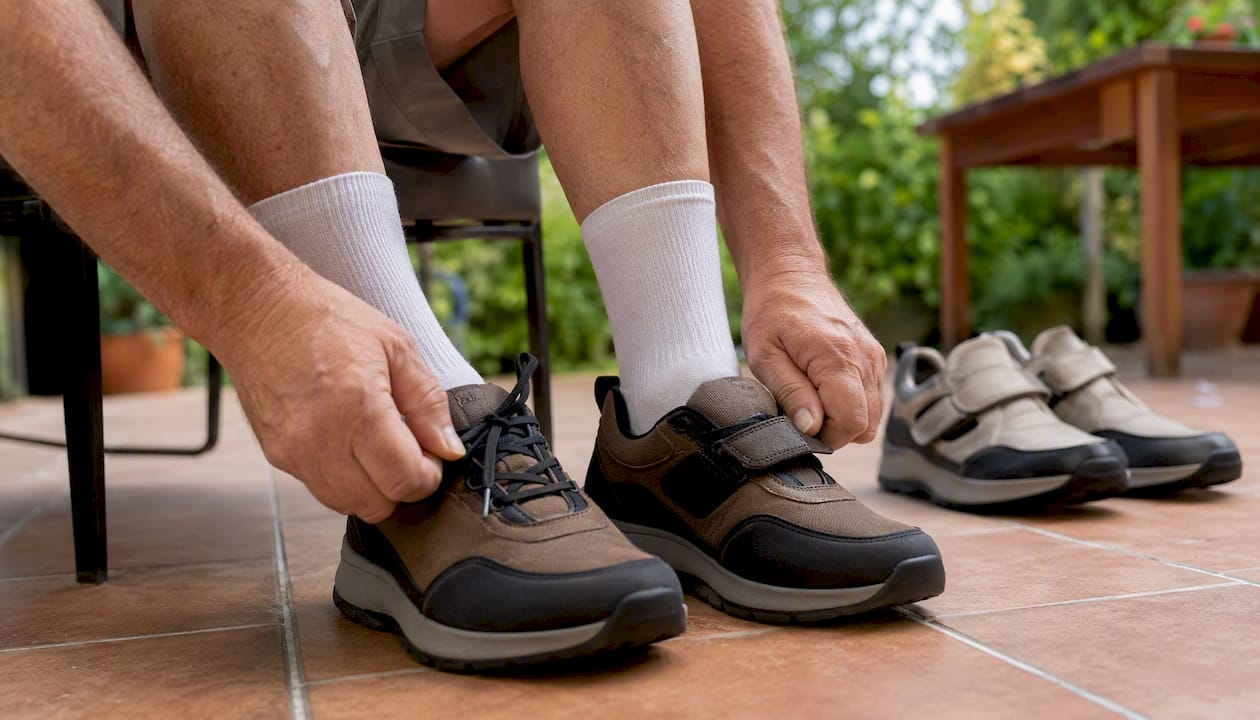
Laces, Velcro straps, or buckles hold the foot in place and prevent it sliding forward inside the shoe. Sliding is what causes friction and blisters. Slip-on styles cannot be adjusted to your foot’s exact shape on any given day, which matters when feet swell.
Materials
Natural soft uppers such as leather adapt to foot shape, reduce friction, and help manage moisture. Stiff synthetic materials do not give in the same way, which means pressure points stay fixed rather than redistributing. For a detailed look at what qualifies footwear as diabetic-friendly, the features to prioritise include depth, a wide toe box, and a cushioned sole.
Pro Tip: Ask the retailer to measure your foot length and width with a Brannock device or equivalent. Many high-street shops will do this free of charge, and it takes two minutes. It is far more reliable than guessing from your last shoe size.
How do you keep shoes and insoles safe to wear?
Regular maintenance preserves both the fit and the protective function of your footwear. A shoe that has dried out, compressed, or developed a rough interior is no longer doing its job, even if it looks fine from the outside.
Cleaning and drying
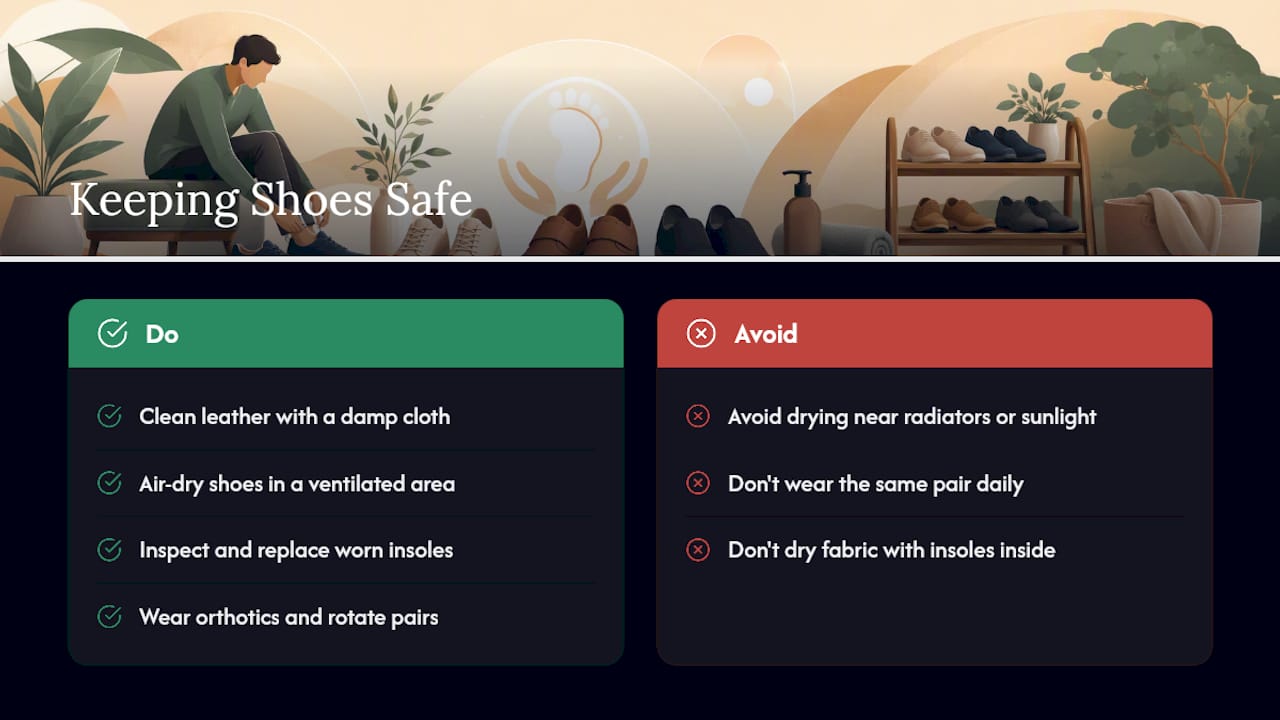
Clean leather uppers with a damp cloth and a leather-appropriate conditioner. Avoid placing shoes near a radiator or in direct sunlight to dry, as heat distorts the shape and dries out the material. Let them dry naturally in a ventilated area. For fabric uppers, remove the insoles before drying and allow both to air separately.
Insole care
Remove insoles regularly to inspect the underside and the shoe interior beneath them. Replace insoles when they become compressed, torn, or visibly worn. If you have been prescribed orthotic insoles, always wear them as directed. Prescribed insoles are shaped to your foot and redistribute pressure in ways a standard insole cannot replicate.
Rotation
If you have been issued two pairs of orthotic shoes, rotate them. Wearing the same pair every day compresses the cushioning faster and means you have no backup if one pair needs repair. Two pairs also allow each shoe to dry fully between wearings, which reduces the risk of fungal infection.
When should you repair or replace your shoes?
Stop wearing a shoe the moment you notice any of the following:
- A hole or thin patch in the sole that could allow objects to penetrate.
- Rough, torn, or creased lining inside the shoe.
- A heel counter that has collapsed or feels floppy.
- Uneven sole wear that tilts your foot to one side.
- Any seam that has come loose and now rubs against the skin.
For orthotic-supplied footwear, return it to the issuing clinic rather than a commercial cobbler. A standard cobbler cannot replicate the prescription-specific modifications, and an incorrectly repaired shoe may cause more harm than a worn one. Practitioners normally issue two pairs precisely so one can be repaired while the other is in use.
If you have neuropathy and cannot feel your feet reliably, do not continue wearing a damaged shoe “just for today.” Damage that causes no pain can still cause a wound.
For privately purchased shoes, replace them when the damage cannot be fully corrected. A resoled shoe with a torn lining is still a hazard.
What socks and accessories reduce risk for people with diabetes?
Choose seam-free socks in the correct size and change them daily. That single habit removes one of the most common sources of friction for people with reduced foot sensation.
Tight elastic tops cut off circulation at the ankle. Bulky seams sit across the toes and, for someone with neuropathy, can cause a pressure sore that goes unnoticed for days. Holes in socks create a ridge that acts like a seam. None of these feel dangerous, but over a full day of walking they add up.
For additional protection, thin padded innersoles, toe protectors, or padded heel cups can reduce localised pressure. These should fit inside your shoe without making it tighter. If adding an accessory means the shoe no longer fits correctly, the accessory is creating a new problem rather than solving one. Ask your podiatrist which products suit your specific foot shape and risk level before buying.
Hosiery materials matter too. Moisture-wicking fibres such as merino wool or specialist diabetic-sock blends keep feet drier than standard cotton, which reduces the risk of fungal infection and skin breakdown.
When should you see a podiatrist or orthotist about your footwear?
Contact your podiatrist or GP promptly if you notice any of the following:
- A new ulcer, blister, or open wound on your foot.
- Unexplained redness, warmth, or swelling in any part of the foot.
- Marks or pressure sores left by your shoes after a normal day’s wear.
At your appointment, ask specifically:
- “Can you measure both my feet and confirm my current shoe size?”
- “Do I need custom orthotics, and if so, what repair pathway applies?”
- “Are my current shoes suitable for my risk level?”
- “Should I be referred to an orthotist for prescribed footwear?”
NICE guidance recommends that adults with diabetes have their feet screened at diagnosis and at least once a year afterwards. That annual check determines your risk level and the appropriate follow-up pathway, from standard podiatry advice through to multidisciplinary foot care services for higher-risk patients. If your clinician suspects Charcot arthropathy or severe infection, NICE sets out urgent referral timelines that your GP or podiatrist should follow.
For guidance on shoe fit specific to diabetic foot complications, including width and depth considerations, the Ydauk resource library covers the practical detail worth reading before your next appointment.
Why a repeated checklist matters more than any single purchase
The conventional wisdom around diabetic footwear tends to focus on the buying decision: get the right shoe once and you are protected. That framing misses the point. A well-chosen shoe becomes a hazard the moment a stone gets inside it, the insole compresses, or the lining tears. The shoe you bought six months ago is not the shoe you are wearing today.
The daily check is where most of the protection actually comes from. Foot wounds in people with diabetes are linked to increased risk of heart attack, stroke, amputation and early death, which is a stark reminder that footwear is not a minor lifestyle consideration. The orthotist and podiatrist repair workflow exists precisely because the clinical team understands that a shoe’s condition changes over time and that repairs must preserve the original prescription.
Following the checklist in this guide supports that clinical care rather than replacing it. It keeps your footwear in the condition your clinician intended, and it flags problems early enough for a repair rather than a wound.
Everyday supportive shoes built around foot health
Choosing shoes that already meet the checklist criteria saves time and reduces guesswork. Ydauk designs everyday footwear around the principles that matter most for foot health: a wide toe box, cushioned soles for pressure redistribution, and soft uppers that adapt rather than resist. The YDA shoe technology page explains the specific design features behind each pair and how they address the pressure and friction risks covered in this guide.

Compare any pair against the checklist before buying: heel height, fit, fastening, and materials. If you have been prescribed orthotic footwear by your NHS team, that prescription takes priority. For everyday wear alongside prescribed shoes, or for lower-risk patients seeking a supportive option, browse the Ydauk range and check the technology behind YDA shoes to see how each feature maps to the guidance above.
Sources
- The Royal College of Podiatry – footwear advice to reduce the risk of amputation
- Bedfordshire Hospitals NHS Trust – footwear for people with diabetes
- Diabetes My Way – footwear advice
- Northern Care Alliance – orthotics footwear diabetic patients
- NICE guidance – diabetic foot problems: prevention and management
This article is general information, not a substitute for advice from a qualified doctor. Consult a qualified healthcare professional about your own circumstances before acting on anything here.