
Best health-oriented footwear brands for UK shoppers
For UK shoppers who want support-first shoes, YDA leads the shortlist because it combines removable orthotic-friendly footbeds with measured stability features designed specifically around foot health. For runners, Brooks and ASICS are the podiatrist-backed choices. For all-day standing, Vionic, Birkenstock and Dansko consistently appear in specialist clinic recommendations. For budget-conscious buyers, Skechers and New Balance offer accessible cushioning with orthotic-compatible removable insoles.
Quick best-for picks, curated by Panagiotis with reference to podiatrist-recommended footwear guidance:
- YDA — Support-first shoppers wanting measurable stability and a removable orthotic-friendly footbed with published technology documentation.
- Brooks — Runners and walkers who need cushioning paired with guided-motion stability; frequently cited by podiatrists for shock absorption.
- HOKA — Maximum cushioning and impact protection, with stability variants for higher-mileage use.
- New Balance — Wide-fit and orthotic users; broad sizing range with removable insoles across most models.
- ASICS — Structured cushioning via GEL technology for runners seeking stability on longer distances.
- Vionic — Everyday and dress styles with a patented orthotic-grade footbed built in from the factory.
- Birkenstock — Deep, contoured cork-latex footbeds that mould to the wearer’s foot shape over time.
- Dansko — Occupational rocker-sole clogs for nurses, teachers and service workers on long shifts.
- Ecco — Lightweight, durable dress-casual shoes with supportive midsoles and a long wear life.
- Skechers — Accessible memory-foam cushioning for long hours on your feet, at a lower price point.
- Nike — Performance and lifestyle range with some stability and cushioned models for sporty shoppers.
- Crocs — Lightweight foam footwear for standing roles where easy cleaning and slip resistance matter most.
Table of Contents
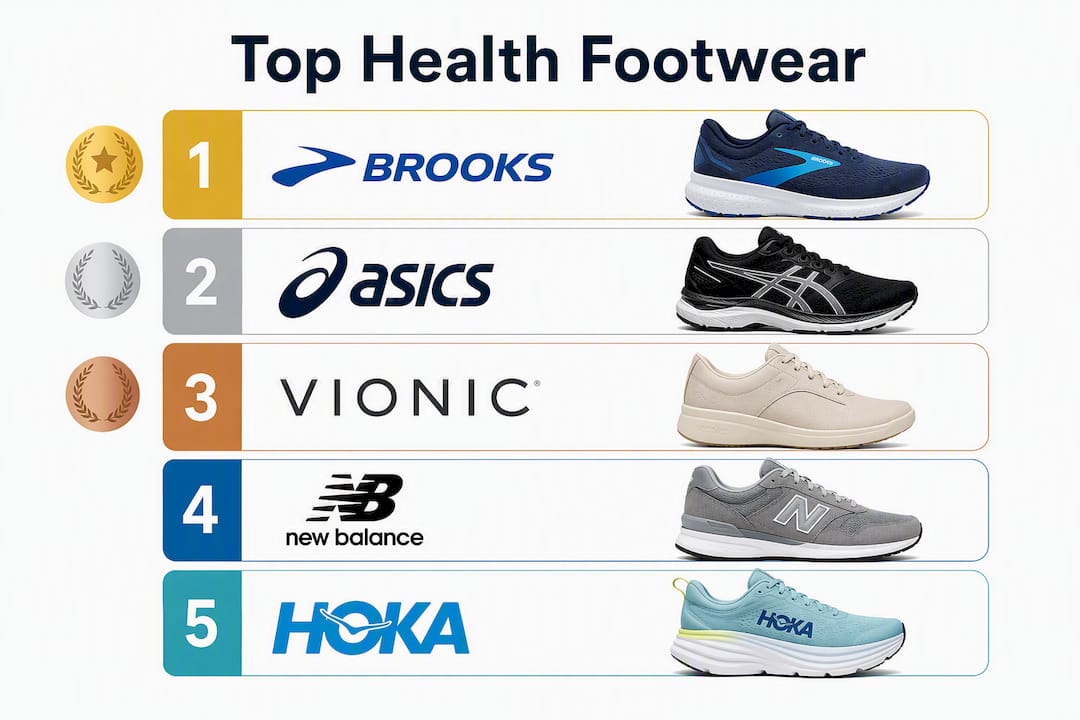
- Which health-oriented footwear brands come out on top?
- What does each brand actually offer for foot health?
- How do you choose the right health-oriented shoe?
- What do experts say about supportive footwear and durability?
- How we selected and rated these brands
- Which brand should you try first?
- Key takeaways
- The case for choosing less, but choosing better
- Ydauk’s health-first footwear: where technology meets everyday support
- Selected further reading and sources used in this guide
Which health-oriented footwear brands come out on top?
| Brand | Best for | Arch support / stability | Cushioning level | Removable insole / orthotic-friendly | Price band | Widths / sizing notes | UK availability | Durability / lifespan |
|---|---|---|---|---|---|---|---|---|
| YDA | Support-first shoppers; orthotic compatibility | Measured stability features; medial support | Moderate–high | Yes — removable footbed designed for orthotics | Mid | Standard; check product pages | ydauk.com (direct) | Designed for lasting wear; technology-led construction |
| Brooks | Runners and walkers needing cushioning + stability | High; guided-motion platforms | High | Yes — most models | Mid–High | Standard and wide options | Running stores; online retailers | 500–800 km typical running lifespan |
| HOKA | Maximum impact protection | Moderate–high; stability variants available | Very high | Yes — most models | Mid–High | Standard; some wide | Major sports retailers; online | Good; oversized sole wears gradually |
| New Balance | Wide feet; orthotic users | Moderate–high | Moderate–high | Yes — across most models | Low–High | 2E, 4E and narrow options | Sports retailers; department stores | Good; varies by model |
| ASICS | Structured running cushioning | High; stability lines (Kayano, GT series) | High | Yes | Mid–High | Standard and wide | Sports retailers; online | 500–800 km for running models |
| Vionic | Everyday and dress with built-in orthotics | High; orthotic-grade footbed | Moderate | Built-in orthotic footbed (not removable in most styles) | Mid | Standard | Online; selected UK footwear retailers | Good for everyday use |
| Birkenstock | Deep moulded everyday support | High; contoured cork-latex footbed | Moderate | Fixed contoured footbed; some styles accept orthotics | Low–Mid | Narrow and regular | Department stores; online | Very high; cork footbed lasts years |
| Ecco | Supportive dress-casual | Moderate–high | Moderate | Yes — many models | Mid–High | Standard | Department stores; online | Very high; known for durability |
| Skechers | Long hours standing; budget cushioning | Low–moderate | High (memory foam) | Yes — most models | Low–Mid | Wide options available | Widely available; own stores; online | Moderate; memory foam compresses faster |
| Dansko | Occupational long shifts | High; rocker sole and stable footbed | Moderate | Yes — removable footbed | Mid | Standard | Online; specialist retailers | High; occupational-grade construction |
| Nike | Sporty lifestyle; some stability models | Low–moderate (varies by model) | Moderate–high | Yes — most models | Low–High | Standard; some wide | Widely available; own stores; online | Moderate; varies significantly by model |
| Crocs | Lightweight standing roles; easy cleaning | Low | Low–moderate | Limited; some models accept thin orthotics | Low | Wide fit standard | Widely available; own stores; online | Moderate; foam degrades with heavy use |
Three common shopper types, interpreted from the table:
- Runners should focus on Brooks, ASICS or HOKA. All three offer high cushioning, stability options and removable insoles, and all are stocked by major UK sports retailers.
- All-day standers (retail, healthcare, hospitality) get the most from Dansko’s rocker sole, Vionic’s built-in orthotic footbed, or Skechers’ memory-foam cushioning at a lower price.
- Orthotic users need a removable insole with enough depth to accommodate a custom device. YDA, New Balance, Brooks and Ecco all offer this; check the insole cavity depth on the product page before ordering.
Pro Tip: If you are unsure where to start, pick one brand from the table that matches your primary activity, order from a retailer with a free returns policy, and test the shoes with your own orthotics or insoles before committing.
What does each brand actually offer for foot health?
YDA builds its shoes around a published YDA technology framework that centres on removable orthotic-compatible footbeds and measured stability. The footbed is designed to be lifted out cleanly, so a custom orthotic drops straight in without the usual trimming or guesswork. Available direct from ydauk.com; mid price band. Best for shoppers who want documented, technology-led support rather than a brand name. Not the right pick if you need a wide specialist running shoe with hundreds of kilometres of proven mileage data.
Brooks is one of the most consistently cited brands in podiatry clinic recommendations for running and walking. Its GuideRails stability system controls excess movement at the heel rather than forcing a rigid correction, which suits a wide range of gait patterns. Removable insoles are standard. Available at most UK running specialists and online. Mid to high price band; running models typically last for several hundred kilometres before cushioning compresses.
HOKA built its reputation on oversized, maximally cushioned soles. The trade-off is that the rocker geometry takes a few wears to feel natural. Stability variants (the Arahi and Gaviota lines) add a firmer medial section without sacrificing the signature softness. Stocked at major UK sports retailers. Mid to high price band.
New Balance stands out for its sizing breadth: 2E and 4E wide fittings are available across many models, which matters enormously if standard widths cause bunion pressure or toe-box pinching. Removable insoles are the norm. Low to high price band depending on the line. Available at sports retailers and department stores across the UK.
ASICS centres its health credentials on GEL cushioning pods and a structured stability range (the GT and Kayano series). The GT-2000 and Kayano lines are regularly recommended by podiatrists for overpronation. Removable insoles throughout. Mid to high price band; stocked at most UK sports retailers.
Vionic takes a different approach: the orthotic-grade footbed is built into the shoe rather than sitting on top of a generic insole. That means you get consistent arch support in a flat, sandal or trainer without needing to carry a separate device. The footbed is not removable in most styles, so it is not the right choice if you use a custom orthotic that needs to replace the factory insole. Mid price band; available online and at selected UK footwear retailers.
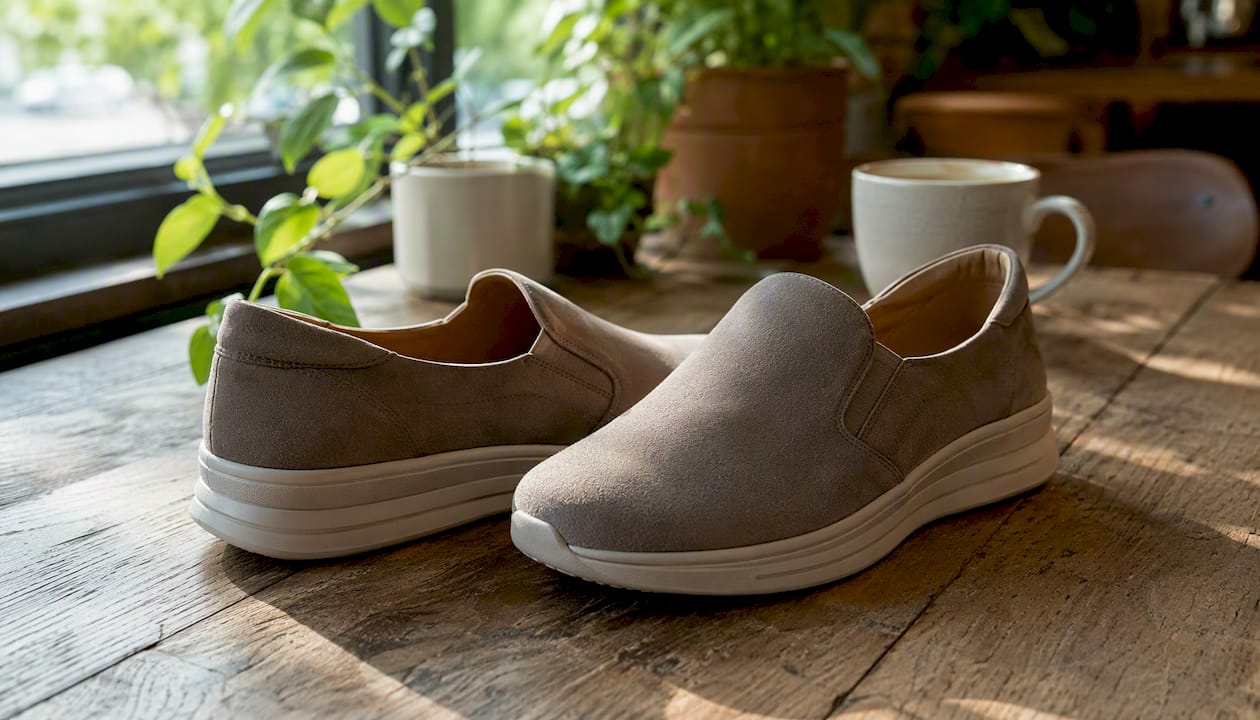
Birkenstock uses a cork-latex footbed that gradually conforms to the wearer’s foot shape. The deep heel cup and raised toe bar encourage a more natural gait. The footbed is fixed, but some open styles can accommodate a thin custom orthotic underneath the strap. Low to mid price band; widely available at UK department stores and online. The cork footbed lasts years with basic maintenance.
Ecco is the quieter name on this list, but its durability is genuinely impressive. The direct-injected polyurethane sole bonds tightly to the upper, resisting delamination that plagues cheaper shoes. Supportive midsoles and removable insoles feature across the dress-casual range. Mid to high price band; available at department stores and online. A good choice for people who want a smart-looking shoe that holds its structure through daily commuting.
Skechers is the accessible entry point. Memory-foam insoles provide immediate cushioning, though the foam compresses faster than denser EVA or polyurethane alternatives. Removable insoles are standard across most lines, and wide-fit options are easy to find. Low to mid price band; available at Skechers’ own UK stores, department stores and online. Best for people who need comfort quickly and are not yet ready to invest in a premium orthotic-compatible shoe.
Dansko is built for occupational use. The rocker-bottom sole reduces forefoot pressure during long stationary shifts, and the removable footbed accepts custom orthotics. Less common in UK high-street stores, but available through online specialist retailers. Mid price band. If you are a nurse, teacher or chef spending eight-plus hours on a hard floor, Dansko’s design rationale is hard to argue with.
Nike has a vast range, and some models (the React Infinity Run, for example) are designed with injury-reduction in mind. The challenge is consistency: health-supportive features vary widely across the catalogue, so you need to research individual models rather than trusting the brand name alone. Removable insoles are standard. Low to high price band; widely available across the UK.
Crocs are polarising, but for roles that require lightweight, slip-resistant footwear that can be wiped clean, they serve a specific purpose. The foam construction offers minimal arch support, and the footbed does not accept most custom orthotics. Low price band; widely available. Best treated as a secondary pair for short-duration standing rather than a primary health shoe.
How do you choose the right health-oriented shoe?
The single most important rule: fit and orthotic compatibility come before brand prestige. A well-known brand in the wrong size or with a footbed that blocks your custom orthotic will cause more harm than a lesser-known shoe that fits correctly. Shoe fit directly influences podiatric health across a range of conditions, from plantar fasciitis to metatarsalgia.
Objective checks to run before you commit
- Heel counter firmness. Press the back of the shoe inward. A firm counter that resists compression provides rearfoot stability; a soft, collapsible one does not.
- Toe-box width. Your toes should lie flat with roughly a thumb’s width of space beyond the longest toe. Pinching at the fifth toe is a red flag.
- Bend test. Flex the shoe at the ball of the foot. It should bend there, not at the midfoot. A shoe that folds in the arch offers no midfoot support.
- Removable insole check. Lift the insole out. If it tears or is glued in, the shoe will not accept a custom orthotic. Check the cavity depth: most custom orthotics need at least 4–5 mm of clearance.
- Heel drop. A lower drop (4–8 mm) suits neutral and forefoot strikers; a higher drop (10–12 mm) suits heel strikers and those with Achilles sensitivity. Check the brand’s product page for the exact figure.
- Fit with your own socks and orthotics. Always try shoes with the socks and orthotics you actually wear. A shoe that fits perfectly barefoot may be too narrow once your orthotic is in.
Questions to ask before you buy
- Does the retailer offer free returns or a home trial period?
- What is the warranty on the sole and upper?
- Is the model in stock at a UK retailer, or will it ship from overseas with a long wait?
- What are the exact dimensions of the removable footbed cavity?
- Is a wide-fit version available in the same model?
Pro Tip: When switching from a heavily cushioned shoe to a minimalist or lower-drop model, transition gradually — wear the new pair for 30 minutes on the first day, then add 15–20 minutes daily. Foot and lower-leg muscles need time to adapt, and rushing the process is a reliable route to injury.
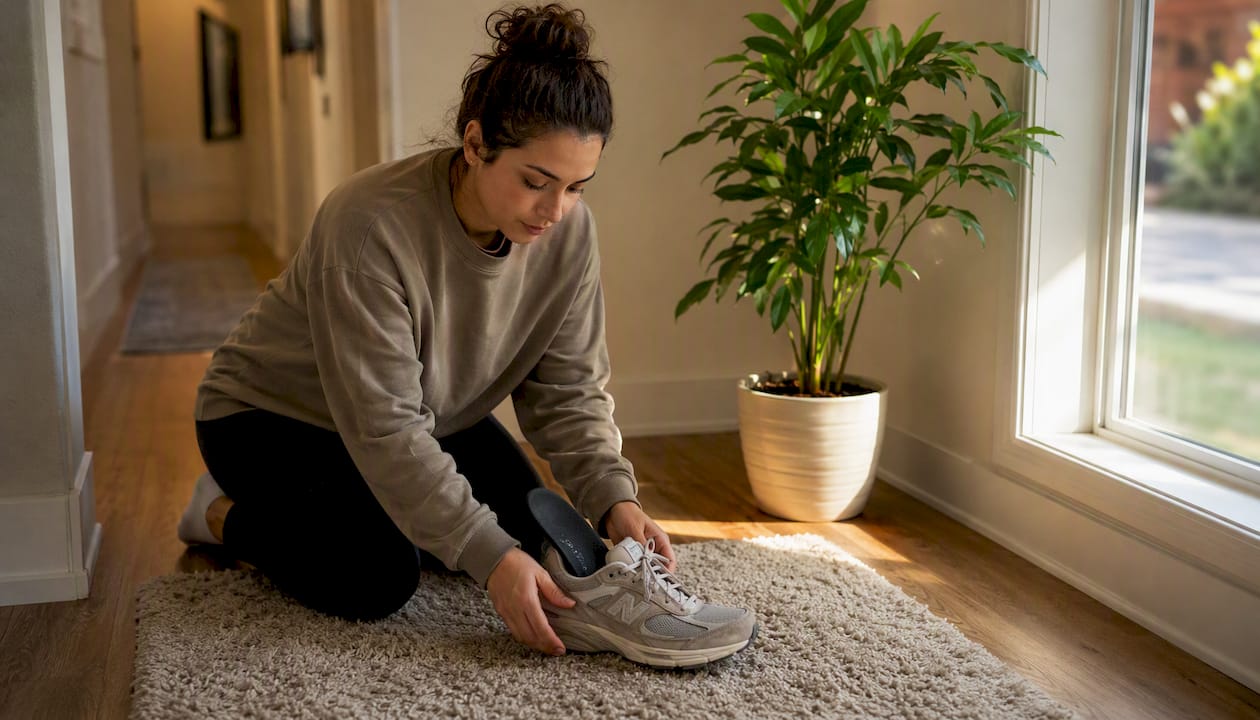
For home testing: wear the shoes indoors on a hard floor for 20–30 minutes, then on carpet. Insert your orthotics and walk for a further 10 minutes. If the heel slips, the toe box pinches, or the arch feels wrong with your orthotic in place, return them.
What do experts say about supportive footwear and durability?
Podiatrists broadly agree on one point: arch support reduces strain that travels upward to the ankles, knees and lower back. A shoe that supports the foot’s medial arch does not just protect the foot; it changes load distribution across the entire lower limb.
Foot specialists categorise their recommendations by function: Brooks, ASICS and HOKA for performance and stability; Vionic, Birkenstock and Dansko for everyday support; specialist therapeutic brands for clinical needs. That taxonomy is useful because it stops shoppers from comparing a running shoe against a dress sandal on the same axis.
The 3-shoe rule
Rotating between at least three pairs of shoes allows cushioning materials to decompress and dry between wears, reducing bacterial growth and extending functional lifespan. This is not a marketing claim: the University Foot and Ankle Institute recommends it explicitly as a practical hygiene and durability measure. For UK shoppers, a practical rotation might be: one pair for walking or running, one for work or standing, and one for casual daily wear. Each pair recovers between uses, and you get a clearer read on when each one is wearing out.
When is a shoe spent?
Replace shoes when cushioning no longer provides rebound and when outsole wear becomes uneven — worn cushioning loses shock absorption and raises injury risk.
Running shoes typically last 500–800 km. Everyday supportive shoes last longer but still degrade. Press your thumb firmly into the midsole: if it does not spring back, the foam is compressed and no longer absorbing impact. Flip the shoe over and look at the outsole. Uneven tread wear, particularly on the lateral heel or medial forefoot, signals that the shoe is no longer providing the stability it was designed for.
Pro Tip: When checking a shoe in-store for orthotic compatibility, ask the sales assistant to remove the factory insole and measure the cavity depth with a ruler. Most custom orthotics require 4–5 mm of clearance. If the cavity is shallower, the orthotic will sit proud of the heel counter and cause heel slip.
For a deeper look at how cushioning technologies affect long-term foot health, including material comparisons and lifespan data, the YDA blog covers the technical detail clearly.
How we selected and rated these brands
Transparency matters here: Ydauk publishes this guide and sells footwear. YDA is included in the comparison and evaluated on exactly the same criteria as every other brand.
Selection criteria, in order of weighting:
- Orthotic-friendly features and removable insole. The single highest-weighted criterion. A shoe that cannot accept a custom orthotic is immediately less useful for a significant portion of the population.
- Measured stability and arch support. Brands with documented stability features (medial posts, guided-motion platforms, contoured footbeds) ranked above those with generic cushioning only.
- Evidence of podiatrist recommendation. Brands appearing in specialist clinic recommendation lists or peer-reviewed footwear research received higher confidence scores.
- UK availability. Only brands available to UK shoppers through UK retailers or direct online shipping were included. Availability was checked against major UK sports retailers, department stores and brand websites.
- Price band. Represented as low, mid or high; no brand was excluded on price alone, but price band is noted so readers can filter by budget.
- Materials and durability. Construction quality, sole bonding method and known lifespan data were considered where available.
- Sizing and width options. Brands offering multiple widths scored higher for accessibility.
The “best for” label in the table reflects the primary use case where a brand’s health features are strongest, not an overall ranking. “Recommended” means the brand consistently appears in podiatry and specialist editorial lists for that use case. Support and orthotic compatibility were weighted above style, price and brand recognition throughout.
Which brand should you try first?
For most UK shoppers, the decision comes down to three profiles.
If you are a runner or regular walker, start with Brooks or ASICS. Both offer stability models with removable insoles, both are stocked at UK running specialists, and both appear consistently in podiatrist recommendation lists. HOKA is worth adding if impact protection is your primary concern.
If you stand all day for work, Dansko’s rocker sole is the most mechanically sound choice for reducing forefoot pressure over a long shift. Vionic is the better option if you want built-in arch support in a shoe that looks less clinical. Skechers covers the budget end of this category adequately.
If you use custom orthotics, prioritise the removable insole check above everything else. YDA, New Balance, Brooks and Ecco all offer the cavity depth most orthotics need. Try one pair from a retailer with free returns, insert your orthotic on day one, and walk for 30 minutes before deciding.
One practical next step: pick the brand that matches your primary use case from the table above, find a UK retailer with a free returns policy, and test a single pair at home with your own socks and orthotics before buying a second pair.
Key takeaways
The most important principle in choosing health-oriented footwear is this: fit and orthotic compatibility outweigh brand reputation, and rotating at least three pairs extends both lifespan and hygiene.
| Point | Details |
|---|---|
| Fit beats brand prestige | A correctly fitted, orthotic-compatible shoe from any brand protects your feet better than a prestigious name in the wrong size. |
| Rotate at least three pairs | Rotating between three pairs allows cushioning to decompress and dry, extending functional lifespan and reducing bacterial build-up. |
| Replace on compression, not time | Replace shoes when the midsole no longer rebounds under thumb pressure or when outsole tread wears unevenly, regardless of age. |
| See a podiatrist for chronic issues | If you have chronic foot pain, diabetes or neuropathy, get a gait assessment before investing in specialist footwear. |
| Ydauk for tech-led orthotic support | YDA shoes feature removable orthotic-compatible footbeds and documented stability technology, making them a strong starting point for support-first shoppers. |
The case for choosing less, but choosing better
There is a tendency in footwear marketing to treat cushioning as a proxy for health. More foam, more protection. It is a persuasive shortcut, and it is not entirely wrong. But it misses the more important variable: whether the shoe actually fits your foot and accommodates the support device your foot needs.
The brands that consistently appear in podiatry clinic lists are not there because they spend the most on marketing. They are there because their designs solve a specific mechanical problem: they hold the rearfoot stable, they allow the forefoot to flex at the right point, and they give a custom orthotic somewhere to sit. That is a narrow brief, and it is worth holding to it when you are standing in a shop surrounded by attractive options.
The other thing worth saying plainly: no shoe fixes a structural foot problem. A good shoe manages load and reduces strain while you are wearing it. The moment you take it off, the underlying biomechanics return. That is not a reason to avoid investing in quality footwear. It is a reason to think of it as one part of a broader approach that might also include physiotherapy, gait analysis, or a podiatry consultation, particularly if you are dealing with something chronic.
Ydauk’s health-first footwear: where technology meets everyday support
Most footwear brands add comfort features to an existing design. Ydauk builds from the foot outward: the YDA technology framework centres on a removable orthotic-compatible footbed and measured stability features that are documented publicly, not just claimed in marketing copy. That transparency is the practical difference for a shopper who needs to know whether their custom orthotic will actually fit.
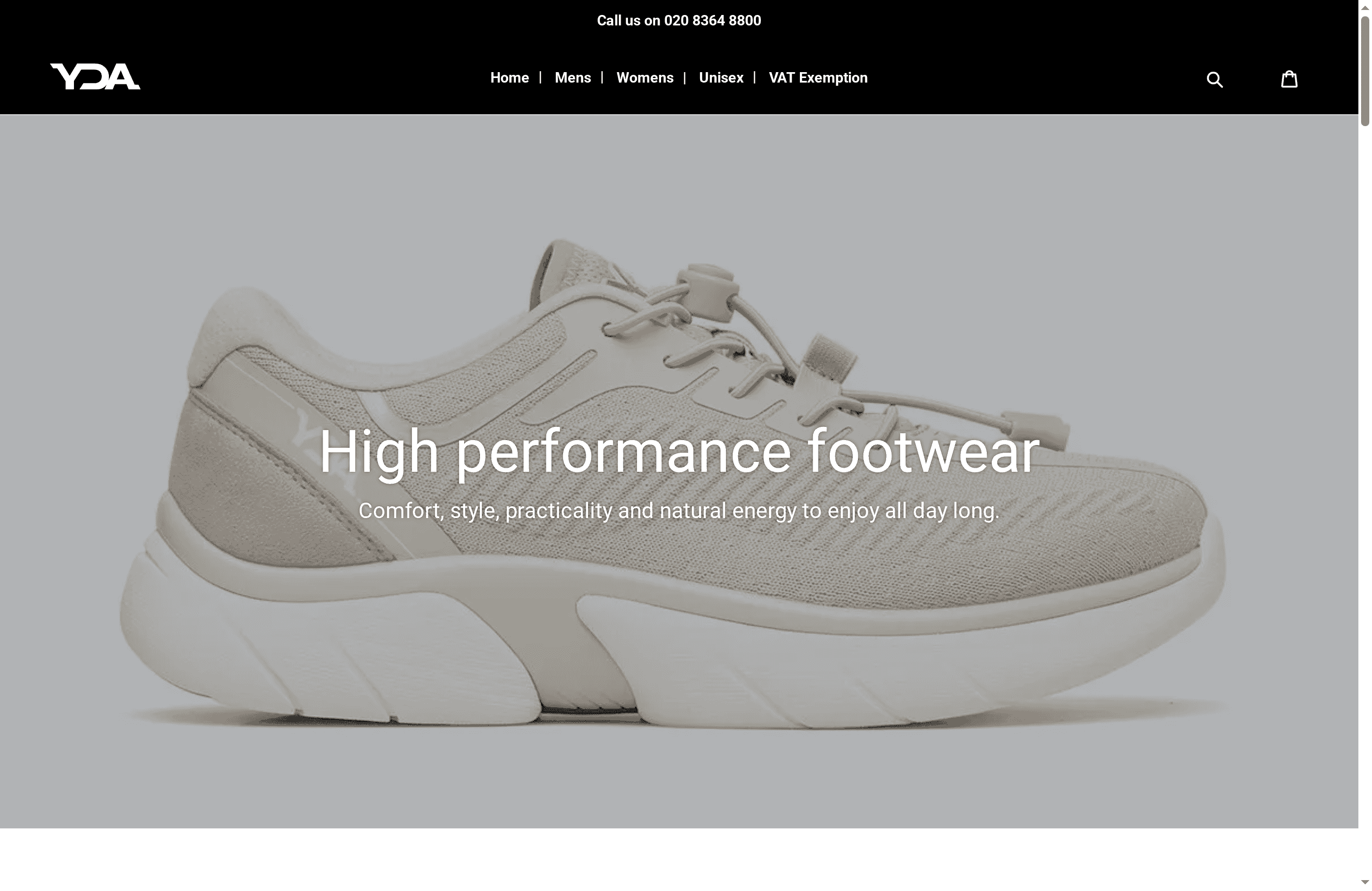
For UK shoppers who want a health-first shoe with documented technology rather than a generic comfort claim, the YDA collection is the logical starting point. Visit the YDA technology page to read the full specification, then browse the collection to find the model that fits your activity and foot type. If you have questions about orthotic compatibility or sizing, the contact number on the site connects you directly with the team.
Selected further reading and sources used in this guide
- These Are the Healthiest Shoes, According to Scientists — Time magazine synthesis of research on minimalist versus supportive footwear; useful for understanding when each approach suits different foot types.
- The best flats with arch support, according to podiatrists — NBC News Select; includes Dr Gregory Alvarez’s commentary on how arch support affects whole-body alignment.
- Footwear and Foot Health: Unveiling the Role of Proper Shoe Fit — Peer-reviewed scoping review (MDPI Applied Sciences) covering shoe fit across diverse populations and podiatric conditions.
- 17 best arch support shoes for long days on your feet — Condé Nast Traveler editorial list covering Vionic, Birkenstock, Dansko and running brands for standing professions.
- Role of stability in footwear — Ydauk blog — Detailed explanation of how stability features affect foot alignment and pain; supports the stability claims in this guide.
- Spa pedicure: foot care and maintenance — Consumer-facing resource on foot hygiene and care; relevant context for the rotation and hygiene points in this guide.