
2.75% average gain: what energy efficient shoes mean for runners
Energy-efficient running shoes typically cut metabolic cost by around 2% to 4%, translating into a real but modest race-time gain for most runners. The pooled evidence puts the average saving closer to 2.75%, although not every runner responds the same way. Fit, biomechanics, and mileage on the shoe all shape whether you feel that benefit, and the advantage fades as the midsole wears down.
TL;DR:
- Energy-efficient shoes typically reduce metabolic demand by about 2.75%, but individual responses can vary from nothing to over 4%.
- The main benefits depend on foam resilience, plate stiffness, and sole geometry working together rather than any single technology.
- The advantages in running economy are most noticeable during races and key training sessions, not daily mileage, due to durability limitations.
- After approximately 300 to 450 kilometers, the foam’s efficiency benefits diminish, requiring rotation with more durable trainers to maintain gains.
- Switching to high-tech shoes should be done gradually to avoid overuse injuries linked to altered loading patterns.
Table of Contents
- Advantages of energy efficient shoes: the numbers that matter
- What “energy efficient” or “energy return” actually means
- How foams, plates and geometry create efficiency gains
- What the research says about running economy and race times
- Joint loading, injury risk, and what changes when you switch shoes
- When the benefits start to fade
- How to choose the right energy-efficient shoe for you
- What these shoes won’t do for you
- Why the marketing gets this wrong more often than the science does
- Try a shoe built around this balance
- Sources
Advantages of energy efficient shoes: the numbers that matter
A few figures explain almost everything worth knowing before you buy:
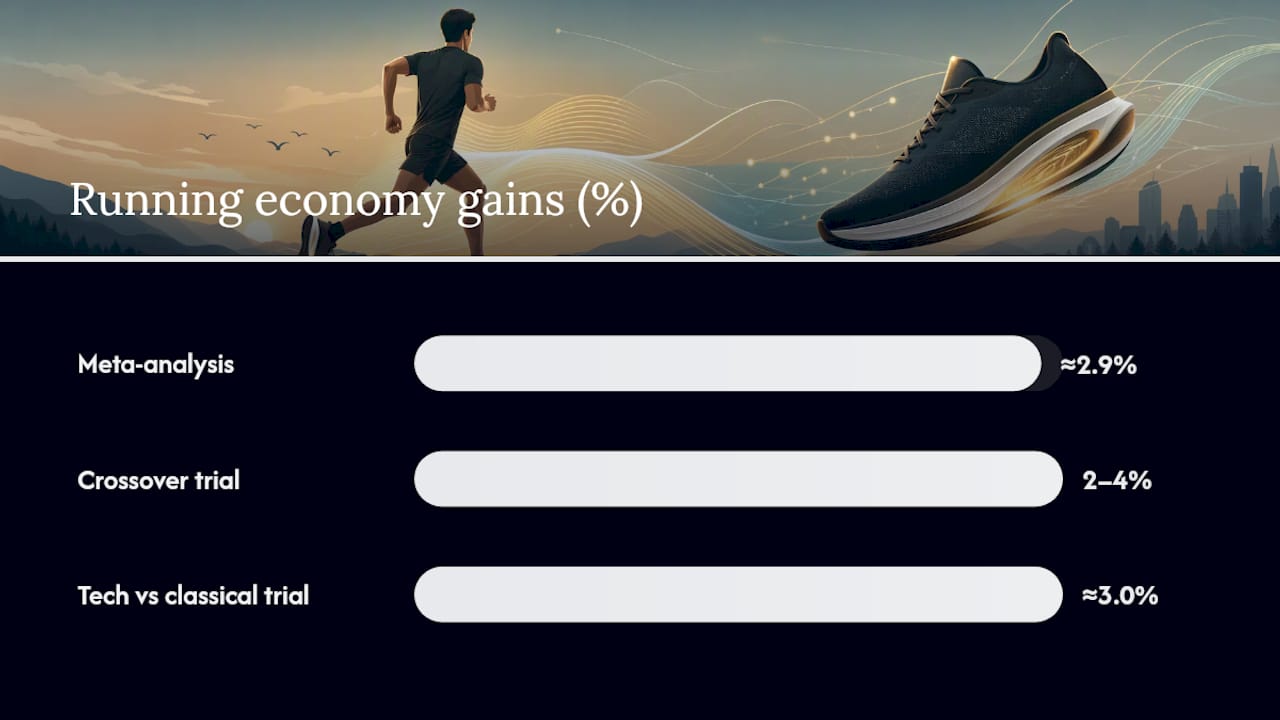
- Pooled analysis across multiple trials shows plated footwear reduces metabolic demand by roughly 2% to 3%, with a mean around 2.75%.
- Individual randomised crossover trials have measured running economy gains of 2% to 4% in recreational runners, even at slower training speeds.
- Both club runners and elite athletes see benefits. The gains aren’t reserved for the fast crowd.
Pro Tip: Treat the 2.75% figure as a group average, not a promise. Some runners see nothing, others see well over 4%. The only way to know your number is to run in the shoe.
For everyday training, comfort should outrank marginal economy gains. Save the highest-return models for races or key sessions, where a percentage point or two actually shows up on the clock.
What “energy efficient” or “energy return” actually means
“Energy return” gets thrown around loosely in shoe marketing, and it’s a misleading way to think about efficiency. A shoe doesn’t hand you free energy. What it does is lose less of the energy your body already puts into each stride.
Three terms are worth separating:
- Energy return – the proportion of energy absorbed by the midsole on landing that gets given back during toe-off.
- Resilience – a material property describing how efficiently a foam recovers its shape after compression, rather than dissipating that energy as heat.
- Energy dissipation – the energy lost to heat, vibration, and material deformation instead of being returned to help propel you forward.
Minimising dissipation matters more than maximising raw energy return. A midsole can post an impressive bench-top energy-return percentage and still perform poorly on a runner’s foot if the timing of that returned energy doesn’t line up with toe-off, or if the foam behaves differently under repeated dynamic loading than it does in a static lab test. The research on advanced footwear technology is fairly blunt about this: bench figures often overstate the usable mechanical energy a runner actually experiences.
Four design levers determine how a shoe manages energy:
- Foam resilience – how much of each footstrike’s energy the midsole material returns rather than absorbs.
- Longitudinal bending stiffness (often from a plate) – how much the sole resists bending at the toe joint, which changes lever mechanics at push-off.
- Rocker geometry – the curved sole profile that shifts your centre of pressure forward and reduces the metabolic work your ankle and calf have to do.
- Stack height and mass – the cushioning depth and overall shoe weight, both of which interact with the other three factors.
None of these levers work in isolation. A highly resilient foam in a flat, unshaped sole delivers far less benefit than the same foam paired with the right geometry, and that interaction is exactly why the best-performing shoes combine several technologies rather than betting everything on one.
How foams, plates and geometry create efficiency gains
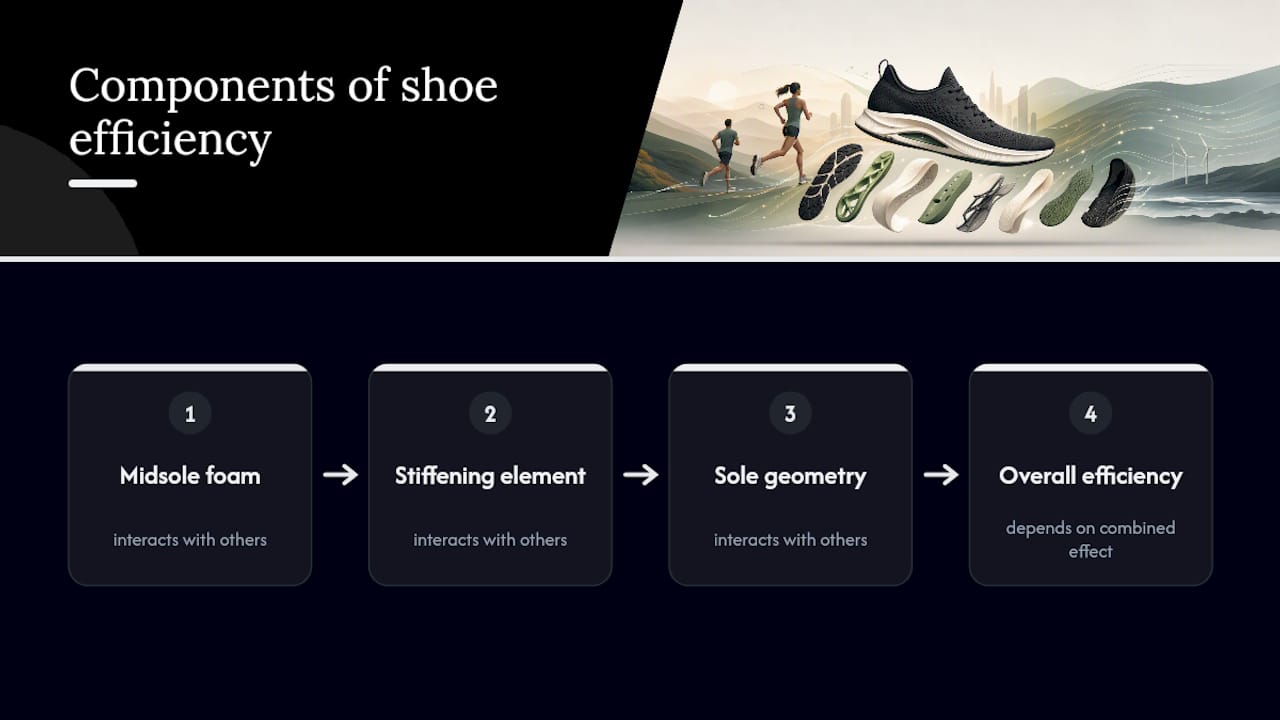
Every energy-efficient shoe on the market leans on some combination of three things: what the midsole is made of, whether it has a stiffening element, and how the sole is shaped. Understanding how these interact explains why some shoes deliver noticeable gains and others, despite similar spec sheets, don’t.
Midsole foams: PEBA, TPU, and the resilience trade-off
PEBA (polyether block amide) foams have become the default choice for premium racing shoes because they combine low density with high resilience. Compared with older EVA compounds, PEBA returns more of the energy absorbed on landing rather than dissipating it as heat. That is the core reason modern racing shoes feel noticeably “livelier” underfoot than trainers from a decade ago.
The catch is durability. Research into advanced footwear technology shows PEBA’s advantage over more conventional foams can shrink substantially after several hundred kilometres of running, as the cell structure that gives the foam its bounce gradually breaks down. TPU-based foams tend to sit in between: less bouncy than top-tier PEBA but usually longer-lasting, which is why many everyday trainers use TPU or TPU/EVA blends rather than pure PEBA.
Plates and stiffening elements
Carbon fibre plates (and increasingly nylon or fibreglass composites) increase what’s known as longitudinal bending stiffness, or LBS. A stiffer sole resists bending at the ball of the foot, which changes how your foot and ankle interact with the ground during push-off. Some researchers describe this as a “teeter-totter” or lever effect, where the plate helps redirect load more efficiently through the stride.
Plate curvature matters as much as plate presence. Studies looking at how plate geometry interacts with midsole properties found that curved plates tend to produce larger running economy gains than flat ones, and that the benefit depends on how well the plate’s stiffness is matched to the specific foam surrounding it. A carbon plate dropped into the wrong foam can do very little, or even work against you.
Sole geometry and timing
Stack height and rocker shape aren’t cosmetic choices. A pronounced rocker, where the sole curves upward at both the heel and the toe, shifts your centre of pressure forward through the stance phase and reduces the muscular work your calf and ankle need to do to roll over the foot. Combined with a tall, soft midsole, this geometry helps time the release of stored energy so it arrives closer to the moment your foot actually needs it, rather than dissipating before toe-off.
Why mass still counts, and where the simple rule breaks down
A long-standing rule of thumb in exercise physiology holds that roughly every 100 grams added to a shoe costs about 1% in running economy. That rule works reasonably well for conventional trainers. It becomes far less predictive for advanced footwear technology (AFT) shoes, because the foam and plate can offset added mass with genuine mechanical efficiency gains elsewhere. A shoe that’s slightly heavier than a rival can still outperform it if the foam and geometry are doing more useful work.
This is really the whole story of energy-efficient shoe design: no single component, tested alone on a bench, tells you how a shoe will feel or perform on a runner’s foot. Foam, plate, and geometry work as a system, and isolating one variable in a lab test can produce numbers that don’t hold up on the road.
What the research says about running economy and race times
Running economy, the amount of oxygen your body uses to maintain a given pace, is the standard measure researchers use to quantify shoe performance. Lower oxygen cost at the same speed means you’re using less energy to run just as fast, which is the physiological basis for every efficiency claim these shoes make.
The pooled meta-analysis found plated footwear reduced running economy demand by a mean of roughly 2.9%, with moderate certainty in the underlying evidence. A separate randomised crossover trial measured 2% to 4% improvements in recreational runners, and crucially found those gains held even at slower training speeds, not just at race pace. That matters because a lot of early AFT research focused on faster elite-level running; this trial confirmed that club runners jogging steady miles see a comparable benefit.
A separate trial measuring technologically advanced running shoes against classical designs recorded oxygen uptake around 3.0% lower, alongside a drop in perceived effort and heart rate, even when spatiotemporal measures like stride length and cadence barely changed. In other words, runners felt the benefit and their bodies used less oxygen to get it, without necessarily running any differently.
What does 2% to 4% actually mean on race day? Here’s how that translates for typical finishing times, assuming the improvement carries through proportionally to pace:
These are illustrative conversions, and individual response varies substantially. Research on footwear individualisation notes that biomechanics, ground contact time, and body mass all mediate how much benefit a given runner extracts from the same shoe, with some showing no measurable change and others exceeding 4%.
Before trusting a new pair for race day, run a simple check: wear them for several easy runs and several tempo efforts, and pay attention to whether your perceived effort at a familiar pace feels lower than usual. If your normal “comfortably hard” pace suddenly feels easier for the same heart rate, that’s a reasonable proxy for a genuine economy gain, even without a lab.
Joint loading, injury risk, and what changes when you switch shoes
Reduced metabolic cost isn’t the only physiological change these shoes produce. The same trial that measured oxygen savings also tracked skeletal loading, and the results are worth taking seriously in both directions.
The Scientific Reports trial found cumulative tibial loading per kilometre was around 12% lower in technologically advanced shoes compared with classical running shoes. Lower cumulative loading per kilometre is a meaningful finding for anyone worried about stress fractures, since tibial stress injuries are closely tied to accumulated load over time rather than any single stride.
That’s the encouraging half of the picture. The less discussed half is that altered loading patterns and stiffer plates have coincided with reports of other stress injuries in runners who’ve moved to AFT shoes quickly, including navicular stress reactions in some case reports. The likely explanation isn’t that the shoes are inherently more dangerous. It’s that a meaningful mechanical change, combined with runners increasing volume or intensity too fast because the shoes feel easier, creates exactly the conditions that produce overuse injuries.
- Reduced cumulative tibial loading is a genuine, measured benefit, not a marketing claim.
- New injury patterns tend to trace back to rapid changes in training load, not the shoe technology itself.
- Any switch to a stiffer, more efficient shoe should be treated as a training variable, not a free pass to add mileage immediately.
Pro Tip: Introduce a new energy-efficient model gradually, the same way you’d introduce any change in training load. Two or three easy runs first, then build up long runs and speed sessions over a couple of weeks rather than racing in a brand-new pair straight out of the box.
When the benefits start to fade
Energy-efficient shoes don’t stay energy-efficient forever. The foams responsible for the biggest gains, particularly PEBA, are also among the first to lose their edge with repeated compression.
Research into AFT mechanisms indicates PEBA’s advantage over more durable foams like EVA can attenuate meaningfully somewhere in the 300 to 450 kilometre range, depending on the specific compound and how the shoe is used. That’s a fairly short lifespan for a shoe that might cost as much as, or more than, a standard trainer.
A few practical signs tell you a shoe is losing its efficiency edge before you hit a specific number:
- The midsole feels noticeably firmer or “dead” underfoot compared with when the shoe was new.
- Visible compression lines or creasing appear across the forefoot or heel.
- Perceived effort at your usual training pace creeps up, even though nothing else in your routine has changed.
- The upper still looks fine, which is why relying on outward appearance alone is a mistake.
The sensible approach, and the one most experienced coaches and elite athletes already follow, is rotation. Reserve your highest-return model for races and key sessions, and put your daily mileage into a more durable trainer. That keeps your race-day shoe fresh for when the marginal gain actually counts, and saves you from replacing an expensive pair every few months.
How to choose the right energy-efficient shoe for you
Picking a shoe from this category isn’t about finding the single “best” model. It’s about matching a shoe’s characteristics to your goals, your body, and how much you’re willing to spend on rotation.
- Define the shoe’s job first. Decide whether you’re buying for race day, tempo sessions, or daily mileage. A shoe built to maximise energy return for a 10K rarely makes a sensible daily trainer, mostly because of the durability trade-off already covered above.
- Factor in body mass and gait. Heavier runners and those with a more pronounced heel strike tend to load midsole foam faster, which shortens the window before efficiency gains fade. If that’s you, lean toward slightly more durable foam blends for training and save the softest compounds for racing.
- Consider injury history honestly. Runners with a past stress fracture or tendon issue should treat a switch to a stiffer, more efficient shoe as a gradual transition, not an instant upgrade, given what’s known about altered loading patterns.
- Run the 10 to 20 minute test. Before committing, wear a candidate shoe for a short easy run and note three things: perceived effort at a familiar pace, any new pressure points or rubbing, and how your legs feel in the hours afterwards. Selecting shoes based on genuine feel rather than spec sheets alone catches problems a lab test never will.
- Weigh comfort against marginal gains for training shoes. A 1% efficiency edge means little if the shoe causes blisters by mile eight. Save peak-efficiency models for the days efficiency actually decides the outcome.
- Get a gait assessment if you’re unsure. Anyone who has struggled with recurring injuries, or who simply doesn’t know their own biomechanical profile, benefits more from a proper gait analysis and selection guide than from chasing another percentage point on a spec sheet. Female runners in particular sometimes find that switching to shoes designed around their specific biomechanics resolves fit issues that generic unisex sizing never addressed.
Pro Tip: If you only own one energy-efficient pair, buy it for racing, not training. The gains matter most when the clock is running, and you’ll get far more mileage satisfaction from a durable daily trainer the rest of the week.
What these shoes won’t do for you
A few myths persist around this category, and clearing them up will save you money and disappointment.
- They don’t guarantee speed. A 2.75% average gain is exactly that, an average. Individual biomechanical response varies enough that some runners feel nothing.
- High energy return isn’t the same as long-term comfort. A shoe can post excellent bench numbers and still feel harsh or unstable over a long run.
- Lighter isn’t automatically better for the planet. Shaving weight can cut a shoe’s manufacturing footprint, but if it shortens the shoe’s usable life, the sustainability trade-off can cancel out the saving. Reparable, modular construction tends to deliver better long-term outcomes than pure lightweighting.
- A lab energy-return percentage isn’t the whole story. Timing, plate curvature, and how the foam behaves under repeated dynamic load all shape what a runner actually experiences, which is exactly why identical spec sheets can produce very different shoes.
Why the marketing gets this wrong more often than the science does
It doesn’t. The research consistently points to interaction effects, plate curvature matched to foam type, geometry timing energy release with your stride, mass trade-offs that behave differently in AFT shoes than in ordinary trainers, as the real driver of performance, not any single spec.
What gets underestimated most is variability.
The other thing worth saying plainly: durability isn’t a footnote, it’s part of the value calculation. A shoe that delivers brilliant economy for 300 kilometres and then quietly stops delivering it is not the same product at kilometre 350 as it was on day one, even if it looks unchanged. Runners who treat these shoes as consumables for racing, and invest in something sturdier for the bulk of their training, tend to get more genuine benefit out of the technology than those who buy one expensive pair and expect it to do everything. Ydauk builds its footwear technology around exactly that balance, foam that performs, geometry that lasts, rather than chasing a single flattering lab number.
— Panagiotis
Try a shoe built around this balance
Some footwear designs follow the same principle this evidence points to: energy efficiency only means something when it’s paired with comfort you can actually run in day after day, not just a headline foam or a flashy plate. Models aim to combine a resilient midsole with support that holds up beyond the first few dozen kilometres, so the benefit doesn’t disappear the moment the newness wears off.
If you want to understand exactly how the foam, geometry, and construction work together, the Technology of YDA Shoes page breaks down the engineering behind every pair without the marketing gloss. Runners ready to compare specific models can also browse the current range of energy-efficient options to find a shoe matched to their training load and race goals. Start there, check the specification against your own mileage plans, and pick the pair built for the running you’re actually doing.
Sources
- Plated footwear systematic review and meta-analysis (Frontiers / sports-and-active-living)
- Impact of advanced footwear technology on running economy at slower running speeds (Sports Medicine - Open)