
3 Evidence Backed Factors Making Shoes Non Slip on the Shop Floor
Slip resistance is not one clever trick hidden in a rubber sole. It is the product of three things working together: an outsole compound that grips the specific surface you walk on, a tread geometry that clears water, oil or dust out from under your foot, and independent friction testing that proves it. A “non-slip” label means little without a published coefficient of friction (COF) or a recognised standards mark such as ISO 20345 or a GRIP star rating behind it.
TL;DR:
- Slip resistance depends on outsole compound, tread design, and verified friction testing, not just labels or superficial appearance.
- Softer rubber compounds offer better grip on wet, smooth indoor surfaces, while nitrile rubber resists oils and solvents, with hardness trade-offs affecting behavior.
- Tread patterns with channels, siping, and wedge shapes crucially evacuate water and oil, with geometry explaining nearly 88% of slip performance in tests.
- TO assess if shoes remain slip-resistant, verify lab-measured COF or standard certifications, not just visual wear or superficial markings.
- Proper shoe maintenance, including cleaning channels and avoiding temporary anti-slip sprays, extends grip and safety lifespan.
Table of Contents
- What makes non-slip shoes grip: outsole materials and hardness
- How tread geometry helps shoes evacuate water and oil
- How is slip resistance measured, and what do the ratings mean?
- Choosing shoes for water, grease, dust or ice
- How can you tell if your shoes are still non-slip?
- Simple care habits that keep tread working
- Checking manufacturer claims: what YDA publishes and what to ask for
- A practical buying order for slip-resistant shoes
- Where to find tested, high-performance soles
- Sources
- FAQ
What makes non-slip shoes grip: outsole materials and hardness
The compound is where grip either happens or doesn’t. Softer rubbers flex into the microscopic texture of a wet tile or vinyl floor, keeping real contact between shoe and surface even when a thin film of water tries to separate them. Push the hardness too far in the name of durability, and that same sole rides on top of the liquid instead of through it, which is exactly how a shoe that looks aggressive on the shelf turns out to be treacherous on a spill.
Material choice also depends on what is actually on the floor:
- Natural or soft rubber performs well on wet, smooth indoor surfaces because it conforms to micro-texture.
- Nitrile rubber resists swelling and softening from oils, fuels and many solvents, which standard rubber compounds cannot handle.
- Polyurethane blends often trade some outright grip for lighter weight and longer wear life, useful where abrasion is the bigger daily threat.
- Harder compounds generally last longer underfoot but sacrifice the conformability that keeps a sole in contact with a slick surface.
None of this can be judged by looking at a sole or squeezing it in-store. Ask the retailer or manufacturer for the actual COF value and design data behind the shoe, because hardness and grip trade off in ways that aren’t visible to the eye.
How tread geometry helps shoes evacuate water and oil
A perfect compound on a flat, featureless sole will still fail on a wet floor. Grip needs somewhere for the liquid to go, and that’s the job of tread geometry. Research into outsole design has found that surface area, heel shape and hardness together explain roughly 87 to 88% of the friction performance measured across tested designs, which tells you geometry carries as much weight as the rubber itself.
- Channels and grooves, typically cut to a depth of around 3 to 5mm in tested slip-resistant designs, act like tyre tread, pushing water or oil sideways and out from under the foot instead of trapping it.
- Siping, the thin slits cut across lugs, opens and closes on contact to bite into wet or smooth surfaces without needing an aggressive lug shape.
- Wedge-style soles with fine multidirectional patterns often outperform deep, blocky lugs on smooth indoor floors, where lugs can actually reduce the contact area that matters.
- Heel beveling, the slight rounding or angling at the back of the heel, softens the moment of heel strike, spreading load gradually instead of letting the heel edge dig in and skid.
Pro Tip: Deep lugs are brilliant on mud and loose ground but often worse than a fine wedge pattern on wet tile, because there’s less rubber actually touching the floor at any moment.
How is slip resistance measured, and what do the ratings mean?
The coefficient of friction is the number that turns “feels grippy” into something you can verify. It measures the resistance between sole and surface under controlled conditions, and a higher COF under wet or contaminated conditions means a genuinely lower slip risk, not just a manufacturer’s claim.
- ISO 20345/20347 set basic and additional slip-resistance requirements for occupational footwear, including the SRA, SRB and SRC ratings for performance on ceramic tile with detergent, steel with glycerol, or both.
- GRIP testing, used in the UK, simulates more lifelike floor conditions than the basic standards and awards a star rating, which the Health and Safety Executive notes tends to reflect real-world performance more closely than a pass/fail minimum.
- ASTM F3445 and F2913 are the American reference tests for whole-shoe and outsole-material slip resistance, increasingly cited alongside SRO ratings for oily-surface performance.
- Oil resistance is not the same as slip resistance. A sole can resist degrading in contact with oil while still sliding across it; look for a specific SRO or oily-surface rating rather than assuming “oil resistant” covers grip.
Published lab data from a predictive model tested across 58 footwear designs found that outsole area, heel shape and hardness explained about 87% of the friction variation measured under canola-oil contamination, using robotic testing rigs rather than human trial. That is the kind of evidence worth asking for over a marketing sticker that just says “slip resistant.”
Choosing shoes for water, grease, dust or ice
The right outsole depends entirely on what’s underfoot, and a shoe built for one contaminant can underperform badly on another.
- Wet indoor floors: favour soft rubber with a high actual contact area, or a siped wedge sole rather than deep lugs.
- Oily or greasy floors: look for nitrile or another oil-resistant compound, paired with channelled tread and a specific SRO or oily-surface certification.
- Dust, grit and loose debris: self-cleaning lug shapes and deeper channels stop material packing in and flattening your grip.
- Ice and cold outdoor work: dedicated winter compounds stay flexible at low temperatures, and in genuinely icy conditions, a traction device fitted over the shoe outperforms tread alone.
- Mixed indoor/outdoor sites: a moderate lug depth with siping offers a reasonable compromise, though it will underperform a specialist sole on any single surface.
Before buying, answer five quick questions about your own day: is the floor usually wet, oily, dusty or dry? Is contamination constant or occasional? Do you move between surfaces? Is the risk indoors, outdoors or both? And how often does the floor actually get cleaned? The YDA guide to slip-resistant shoe types breaks these scenarios down further.
How can you tell if your shoes are still non-slip?
Start by asking for the paperwork. Reputable sellers can show a published COF value or ISO certification, and if a retailer can’t produce either, treat “non-slip” as a marketing phrase rather than a fact.
- Check tread depth against how the shoe looked new. Packed, shallow or shiny channels can’t evacuate liquid the way they once did.
- Look closely at the heel bevel. Field imaging from wear studies shows this edge rounds off with use, and once it’s smooth, heel-strike grip drops noticeably.
- Press a fingernail into the rubber. A compound that’s hardened with age and UV exposure won’t conform to a surface the way it did when new.
Pro Tip: A rough, controlled test on a wet tile at home tells you something, but it’s no substitute for lab-measured COF. Use your own check as an early warning, not a verdict.
The simple rule: replace the shoes once channels stop clearing water on contact or the heel edge has visibly rounded, whichever comes first.
Simple care habits that keep tread working
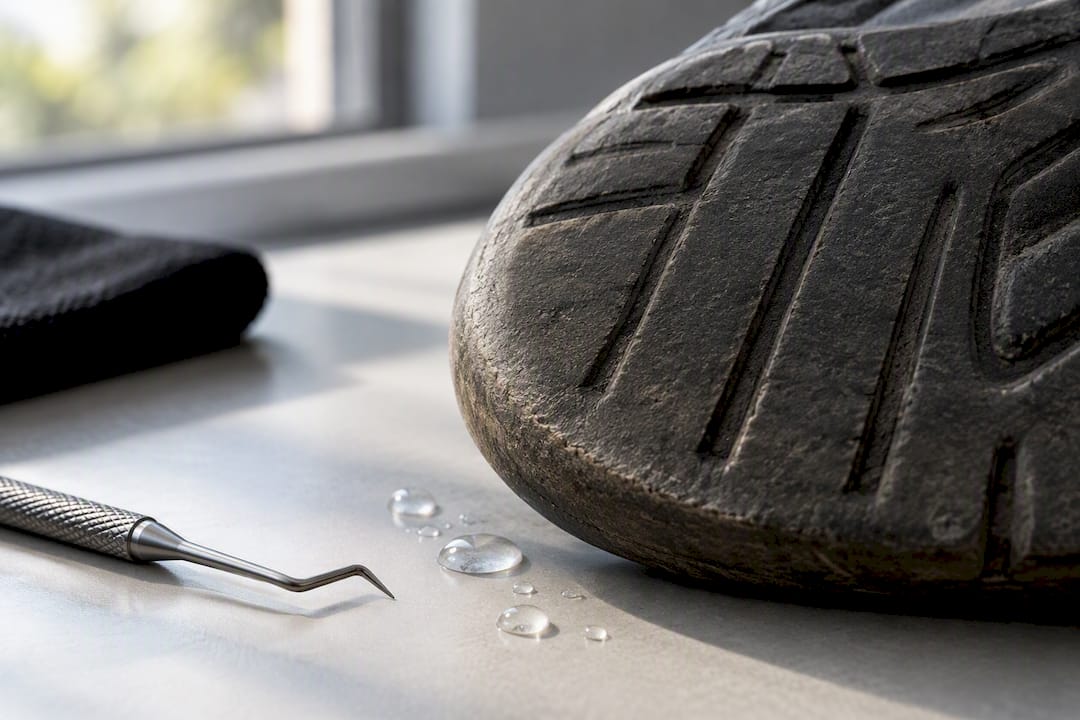
Grip fades faster than most people expect if treads are left packed with grime.
- Clear channels regularly with a stiff brush, particularly after work on dusty or muddy ground, so grooves can still do their job.
- Avoid DIY anti-slip sprays on safety footwear used in genuinely high-risk settings; they wear off unevenly and give a false sense of security.
- Store shoes away from direct heat and prolonged chemical exposure, both of which harden rubber and shorten its useful life.
- For workplaces with real fall risk, commission a proper traction test rather than relying on visual inspection alone.
Professional resoling or certified replacement is the safer route once tread geometry itself has degraded, rather than trying to restore grip with a coating.
Checking manufacturer claims: what YDA publishes and what to ask for
Ydauk’s YDA Technology pages set out the specific foot-health and stability features built into its footwear range, giving you a starting point for checking what a shoe is actually engineered to do rather than taking a label at face value.
- Review the technology and product pages directly for the specific claims made about grip, stability and comfort.
- Ask any retailer, including Ydauk, for the outsole’s COF value and any relevant certification before buying for a workplace setting.
- Cross-reference marketing language against the standards covered above. “Slip resistant” should point to SRA, SRB, SRC or an equivalent test, not just a product description.
- Treat customer reviews and comfort claims as useful context, not a replacement for lab-verified friction data.
A practical buying order for slip-resistant shoes
If you’re choosing footwear for a genuinely slippery job, work through it in this order: match the sole to your actual surface and contaminant first, then check for a real certification or COF figure, then look at the compound, then the tread geometry, and only then weigh comfort and weight. Get that sequence backwards and you end up with a comfortable shoe that slides on the one surface that matters. Footwear is also only one layer of protection. The NIHR and NIOSH trials referenced earlier are consistent on this point: good shoes reduce slips, but they work best alongside proper floor cleaning and hazard management, not instead of it.
— Panagiotis
Where to find tested, high-performance soles
Ydauk sells high-performance footwear built around YDA Technology, the brand’s own approach to combining stability, comfort and energy efficiency in everyday shoes.
Rather than guessing from a product photo, the technology pages set out what each design is claimed to do underfoot, so you can weigh those claims against the standards covered above before you buy. If you want to see the current range, including options built for people managing foot conditions such as diabetes, browse Ydauk’s footwear collection and check the individual product pages for the detail behind each pair. For anyone shopping for daily-wear shoes rather than a specific job’s worth of PPE, that’s the more useful starting point than a generic search for “non-slip.”
Sources
- NIOSH research on footwear traction and design parameters
- Predictive modelling of footwear traction based on outsole features (NIOSH)
- ISO standard for occupational footwear
FAQ
How can you tell if shoes are actually non-slip?
Look for a published COF value or a recognised standard mark such as ISO 20345’s SRA, SRB or SRC rating, rather than trusting the word “non-slip” alone. Inspect tread depth and heel bevel condition too, since worn treads lose grip long before a shoe looks obviously damaged.
Can you make normal shoes non-slip?
Aftermarket sprays and grip pads can offer a temporary improvement on smooth-soled shoes, but they don’t replicate the engineered channels, siping and compound hardness of purpose-built slip-resistant footwear. For genuine workplace risk, certified footwear with a tested outsole is the more reliable route.
What’s the difference between anti-slip and non-slip shoes?
In practice, the two terms are used interchangeably in most retail contexts and neither is legally defined. What matters is whether the shoe carries an actual slip-resistance rating, such as an SRA/SRB/SRC mark or a GRIP star rating, rather than which of the two words appears on the box.
What brands are considered non-slip shoes?
Slip resistance depends on the specific model’s outsole compound and tread design rather than the brand as a whole, so it’s worth checking each shoe’s rating individually. Ydauk’s high-performance range publishes technology details for readers who want to review the design behind a specific pair before buying.
Does oil-resistant mean the same as slip-resistant?
No. Oil resistance describes how well a compound withstands degrading on contact with oil, while slip resistance describes how well it grips while oil is present. A shoe can be one without being the other, so oily-floor work needs a specific SRO or oily-surface certification alongside an oil-resistant compound.