
Measure 23.3–23.5 cm: Size 37 usually fits US women's 6.5
An EU size 37 generally equals a US women’s size around 6.5, though some brand charts round it to a 6 or a 7. That gap matters because sizing systems don’t share a single formula, so the safest anchor point is foot length: roughly 23.3 to 23.5 cm, or about 9.2 to 9.25 inches. Match that number to your own measurement before trusting any single conversion table.
TL;DR:
- Foot length between 23.3 and 23.5 cm generally corresponds to a US women’s size 6.5, but some brands may size slightly differently.
- Measuring your feet in the late afternoon while standing with full weight provides the most accurate size, especially when shopping online.
- Brand-specific last shapes can cause size discrepancies, so checking each brand’s chart is more reliable than generic conversion tables.
- Width differences significantly affect fit, with standard, wide, and narrow options altering shoe comfort even at the same length.
- Size 37 in women’s shoes typically aligns with a US men’s 5 and a children’s size 6.5, useful for cross-category sizing comparisons.
Table of Contents
- Size 37 in US women’s shoes: quick conversion chart and rules of thumb
- How to measure your feet at home for an accurate size 37 fit
- Why brand charts differ and how to fit size 37 correctly
- What width means for your size 37 fit
- Which brands and shoe types run true to size 37
- How size 37 lines up with men’s and children’s US sizing
- Fixing size conversion mismatches when you shop online
- YDA UK perspective: sizing, foot health and why correct fit matters
- How Ydauk helps you find the right size 37 fit
- Sources
Size 37 in US women’s shoes: quick conversion chart and rules of thumb
The number 6.5 is the figure you’ll see most often for EU 37, and it’s backed by conversion data pulling from over 450 brands, which places EU 37 at US women’s 6.5 with a foot length near 23.3 to 23.5 cm. But that’s a midpoint, not a guarantee, because some running and sports brands nudge the same length into a US 6.
A few things explain why the same shoe can feel like two different sizes:
- Some brands treat EU 37 as a rounded-down US 6, others round up to 6.5 or even 7, depending on where they set their half-size breakpoints.
- If your measured foot length sits right on a boundary (say, exactly 23.3 cm), sizing up half a size usually gives more comfort over a full day than sizing down.
- EU sizing is based on Paris Points, a unit equal to two-thirds of a centimetre, while US sizing uses its own last-based scale. The two systems were never designed to align perfectly, which is why conversion tables always carry a small margin of error.
Saucony’s own chart is a useful case study here: it lists US 6 as equivalent to EU 37, with US 6.5 landing at EU 37.5. That’s a half-size shift from the more common EU-37-equals-US-6.5 rule, and it’s exactly the kind of discrepancy that catches shoppers out when they buy on conversion alone.
How to measure your feet at home for an accurate size 37 fit
Skip the guesswork and measure properly. It takes five minutes and saves you a returns label.
- Grab a sheet of paper larger than your foot, a pen, and a ruler or tape measure.
- Do this in the late afternoon or evening. Feet swell throughout the day, and measuring after activity or later in the day reduces the chance of buying shoes that feel tight by evening.
- Stand on the paper with your full weight on that foot, keeping your heel against a wall or straight edge behind you.
- Mark the point at your heel and the tip of your longest toe. For most people that’s the big toe, but check, because it isn’t always.
- Measure the distance between the two marks in millimetres or centimetres.
- Repeat for both feet, since most people have one foot slightly longer than the other, and the larger measurement should decide your size.
- Match your longest measurement against the chart above. If you land at 23.3 to 23.5 cm, US 6.5 is your starting point.
If your measurement sits awkwardly between two sizes, or you have a foot condition that affects shape or width, a shop fitting is worth the trip. A Brannock Device, the metal foot-measuring plate you’ll recognise from shoe shops, captures length, width, and arch length in one reading and remains the standard tool professionals rely on.
Pro Tip: Measure with the socks or insoles you’ll actually wear the shoes with. A thick winter sock can add several millimetres, which is enough to push you from a comfortable 6.5 into a tight 6.
Why brand charts differ and how to fit size 37 correctly
Every brand builds its shoes on a “last”, the foot-shaped mould used to shape the shoe. Two brands can both claim to make a EU 37, yet one last is narrower through the toe box and another is more generous through the arch. That’s why checking a brand’s specific size chart, rather than relying on a universal EU-to-US conversion, remains the single most effective way to avoid a wrong-size return.
A few fit adjustments worth knowing:
- Size up half a size if you have a narrow toe box design, plan to wear thick socks, or use orthotic insoles that take up internal volume.
- Stick with the chart size if the shoe already runs true to size according to other buyers’ feedback, or if you’re between half sizes and the brand doesn’t offer them.
- Use insoles or heel grips to correct minor gaps rather than buying a second pair in a different size, particularly if one foot is only a few millimetres larger than the other.
- Check the returns policy before you buy, especially with online-only retailers, so a wrong size doesn’t become a wasted purchase.
Measurement in practice: shops that pair a numeric size with a centimetre or millimetre reading, rather than a bare “size 37”, consistently see fewer mis-sized returns, because the foot-length figure gives shoppers a fixed reference point that doesn’t shift between brands.
What width means for your size 37 fit
Length gets all the attention, but width decides whether a correctly sized shoe actually feels right. Two people with identical 23.4 cm feet can need completely different shoes if one has a narrow foot and the other a wide one.
Width is usually marked with a letter code: B is standard for women’s shoes, D or 2E runs wide, and A or N runs narrow. Not every brand offers width options, and many mass-market shoes are built on a single “average” width last, which is part of why a EU 37 that fits your length can still pinch across the ball of the foot or feel loose at the sides.
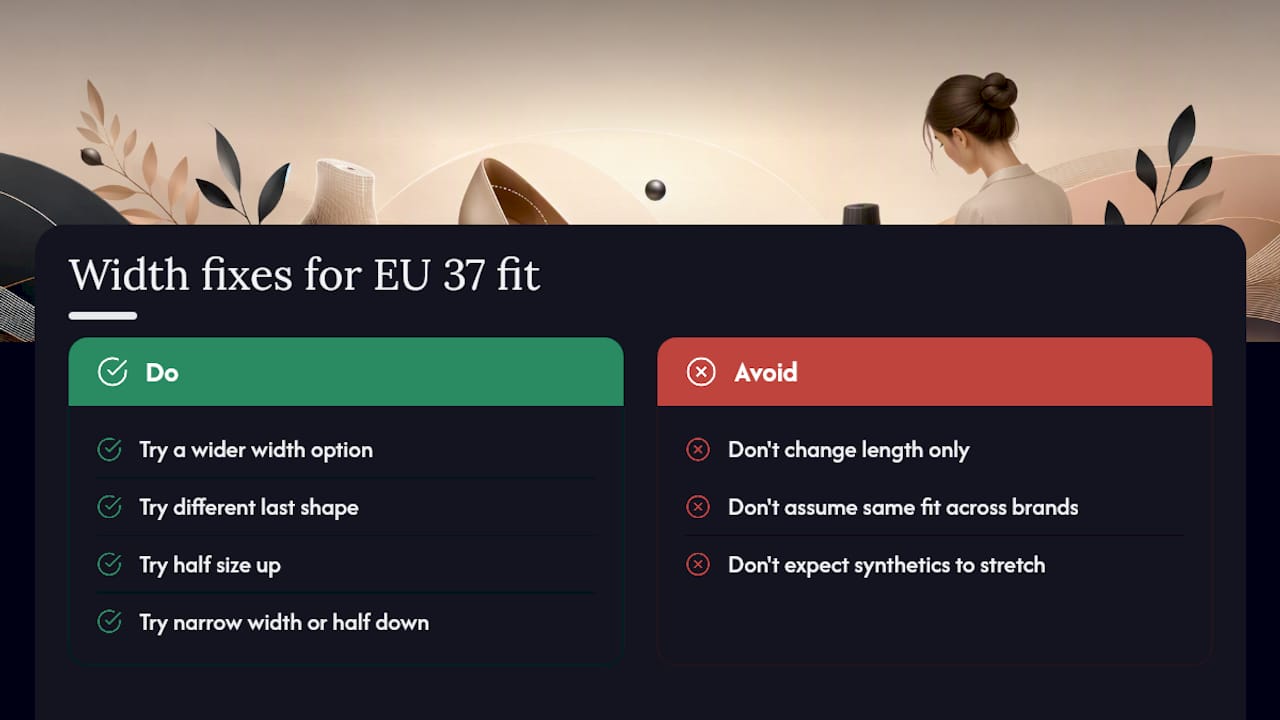
If you’ve measured your foot length correctly and land at a solid US 6.5, but shoes in that size consistently feel tight across the widest part of your foot, the fix usually isn’t a different length. It’s a wider width option, a different last shape, or a half size up to buy extra room across the forefoot while a snugger heel cup keeps the shoe from slipping. Conversely, if a US 6.5 feels like your foot is swimming from side to side, a narrow width or a half size down with a wider toe box might solve it better than chasing a smaller number.
Materials matter too. Leather stretches slightly with wear; synthetic uppers and mesh generally don’t. That’s worth factoring in when a shoe measures correctly on paper but still feels marginal in the shop.
Which brands and shoe types run true to size 37
Size 37 sits close to the middle of the standard adult women’s range, which makes it one of the most consistently stocked sizes across categories. Trainers, ballet flats, and everyday casual shoes tend to have the deepest availability at this size, since manufacturers concentrate production around the sizes that sell fastest.
Running shoes and other performance footwear are where you’ll see the most variation. Athletic brands often build slightly roomier toe boxes to accommodate foot swelling during exercise, which is part of why some running shoe charts place a EU 37 closer to a US 6 rather than 6.5. Dress shoes and heeled styles, by contrast, are frequently cut narrower and shorter through the last, so a EU 37 heel might fit more like a US 6 in length while still needing extra width room.
Boots are their own category. Because boots are worn with thicker socks and need room for ankle movement, many boot-specific charts run a half size larger than the brand’s standard shoe chart. If you already know your foot measures 23.3 to 23.5 cm, a EU 37 boot listing might still be worth trying in both 6.5 and 7 if the retailer allows easy exchanges.
How size 37 lines up with men’s and children’s US sizing
US sizing splits into separate men’s, women’s, and children’s scales, and the gaps between them are consistent enough to be useful if you’re shopping across categories, buying for a teenager, or checking unisex stock.
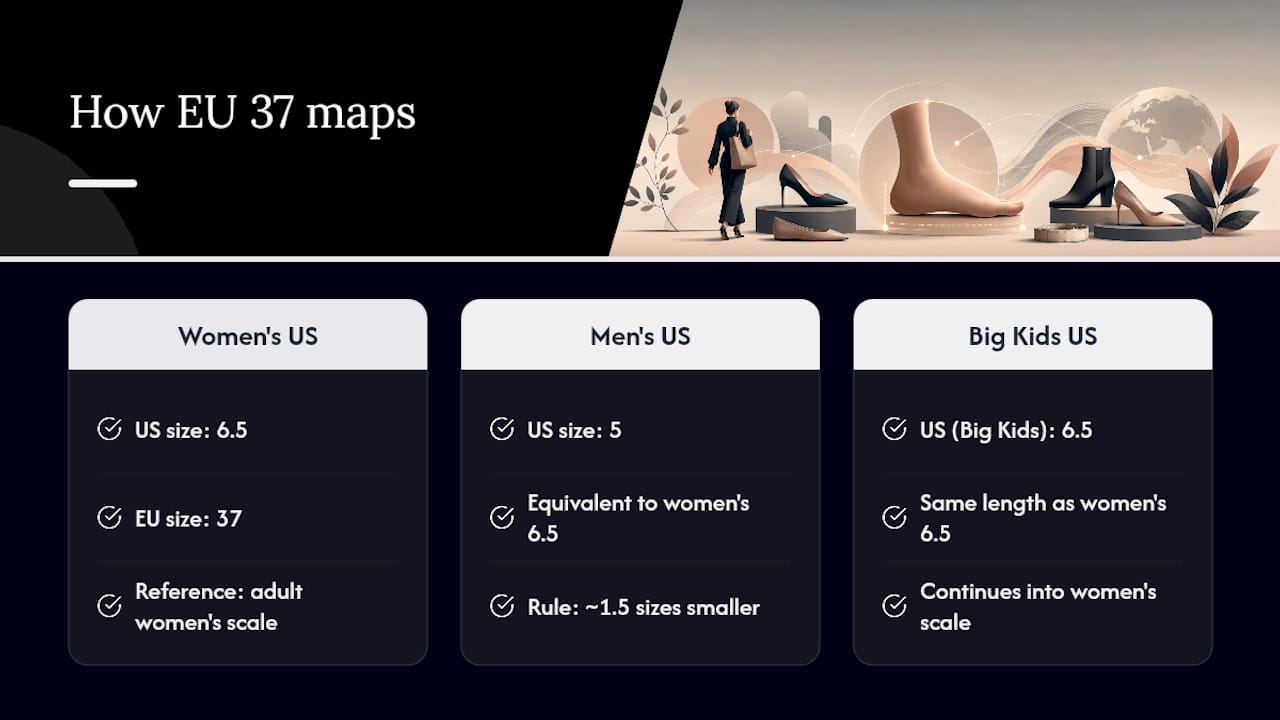
A US women’s 6.5 (your EU 37 equivalent) generally corresponds to a US men’s size 5. The rule of thumb used across most American sizing charts is that men’s sizes run about 1.5 sizes smaller than the equivalent women’s number for the same foot length, so a women’s 6.5 and a men’s 5 are built on roughly the same last.
On the children’s side, US big kids’ size 6.5 is functionally the same length as adult US women’s 6.5, since children’s sizing simply continues numerically into the adult women’s scale at that point rather than using a separate formula. That’s genuinely useful if you’re shopping for a teenager whose feet have finished growing but who still fits comfortably in youth styles. It’s also why some unisex sneaker releases list both a “youth 6.5” and a “women’s 6.5” as identical stock.
Fixing size conversion mismatches when you shop online
Online shopping removes the one thing that makes sizing simple: trying the shoe on before you commit. When a EU 37 listing doesn’t specify a foot length in centimetres, treat the numeric conversion as a starting estimate, not a guarantee.
Cross-reference the listing against the brand’s own size chart on YDA UK’s women’s conversion guide rather than a generic EU-to-US table, since brand-specific charts account for that manufacturer’s particular last shape. If the listing gives a foot length in millimetres or centimetres, match that number directly against your own measurement instead of the size label. It’s the single most reliable data point you have.
Read the reviews for fit comments before you buy, specifically looking for phrases like “runs small” or “true to size”, which tend to be more reliable than the size chart alone because they come from people who’ve actually worn the shoe. Check the return window and whether return shipping is free, particularly for international orders where a wrong-size return can take weeks to resolve. And where a retailer offers half sizes, order the half size up when your foot measurement sits close to a boundary, since a slightly loose shoe is easier to fix with an insole than a tight one is to stretch.
YDA UK perspective: sizing, foot health and why correct fit matters
Getting a EU 37 right isn’t just about comfort on day one. Ill-fitting shoes, even by half a size, contribute to blisters, bunions, and long-term postural strain, which is why foot health sits at the centre of how Ydauk thinks about sizing rather than treating it as an afterthought to style.
That focus matters even more for anyone wearing specialised footwear, including supportive designs or diabetic-friendly styles, where a fit that’s slightly off can cause pressure points that a healthy foot would simply shrug off. Precision counts more, not less, when the shoe is doing extra work for your feet.
If your measurement puts you on the boundary between sizes, or you’re buying supportive footwear for the first time, it’s worth checking a brand-specific chart and, where needed, speaking to customer support before ordering. A size number on a label is only ever a starting point.
— Panagiotis
How Ydauk helps you find the right size 37 fit
Once you’ve measured your feet and landed on your equivalent US size, the next step is checking that number against the actual shoe you’re buying, not just a generic conversion table. Ydauk’s product pages list size-specific details alongside the underlying footwear technology built into every pair, so you can see how support, cushioning, and fit work together rather than guessing from a size number alone.
If you’re unsure whether your measured foot length puts you closer to a 6.5 or a 7, contacting customer service can help you with sizing before ordering, which is especially important with supportive or health-focused styles where half a size makes a real difference underfoot. Measure both feet this evening, note the longer one in centimetres, check it against the product’s size chart, and reach out if anything still feels uncertain. Getting the number right the first time is a lot less hassle than a returns box.
Sources
For deeper conversion tables, Size.ly’s shoe size recommender covers over 450 brands. For at-home measurement steps, Shoe Carnival’s sizing guide walks through the paper-and-pen method. For width and last differences by retailer, Maker of Jacket’s women’s size guide offers a useful comparison point.
- Shoe Size Converter and Comparison: 450+ brands in US, UK, EU
- Goldsmith Podiatry blog: Celebrate National Measure Your Feet Day
- How to measure shoe size at home: 2026 sizing chart guide | Shoe Carnival