
Prevent Blisters in New Shoes With a Practical 7 to 14 Day Break In
Fit comes first. Once a shoe fits properly, control moisture with the right socks, protect likely hot spots with tape or hydrocolloid patches, and break the shoes in over 7 to 14 days rather than wearing them for a full day straight away. Do a short trial walk before any long outing, and if pain persists past two weeks, the shoe is wrong for your foot, not just stiff.
TL;DR:
- Proper shoe fitting is crucial, and shoes should be broken in gradually over 7 to 14 days, especially for rigid materials like synthetics.
- Hot spots can be identified early through redness, warmth, or tenderness, and should be protected with appropriate dressings such as hydrocolloid patches or moleskin.
- Moisture-wicking socks, seamless designs, and foot powders help prevent blisters by reducing moisture and friction during activity.
- Insufficient break-in time or persistent hot spots indicate a poor shoe fit, requiring either adjustment or a different shoe altogether.
- Immediate blister care involves stopping further friction, keeping the blister intact, and using dressings to prevent infection and promote healing.
Table of Contents
- How do you identify and protect hot spots?
- Which socks actually stop blisters from forming?
- What does a realistic 7 to 14 day break-in schedule look like?
- Can insoles, lacing or heel grips fix a poor fit?
- Do blow dryers, freezers and thick socks actually work?
- What should you do the moment a blister forms?
- What do podiatrists and health bodies actually recommend?
- A practical note on prioritising comfort over stubbornness
- Sources
- FAQ
How do you identify and protect hot spots?
A hot spot announces itself before a blister does. Look for a patch of redness, a warm feeling, or a spot that feels tender to the touch after even ten minutes of walking. Catching this early is, according to podiatry guidance, most of the battle: proactive treatment at the hot-spot stage prevents the majority of blisters that would otherwise form.
Not every barrier suits every spot. Here’s how the three main options compare:
- Moleskin: thick, cushioning fabric with a felt-like surface; best for broad areas like the heel or the ball of the foot, and it stays put through a long day.
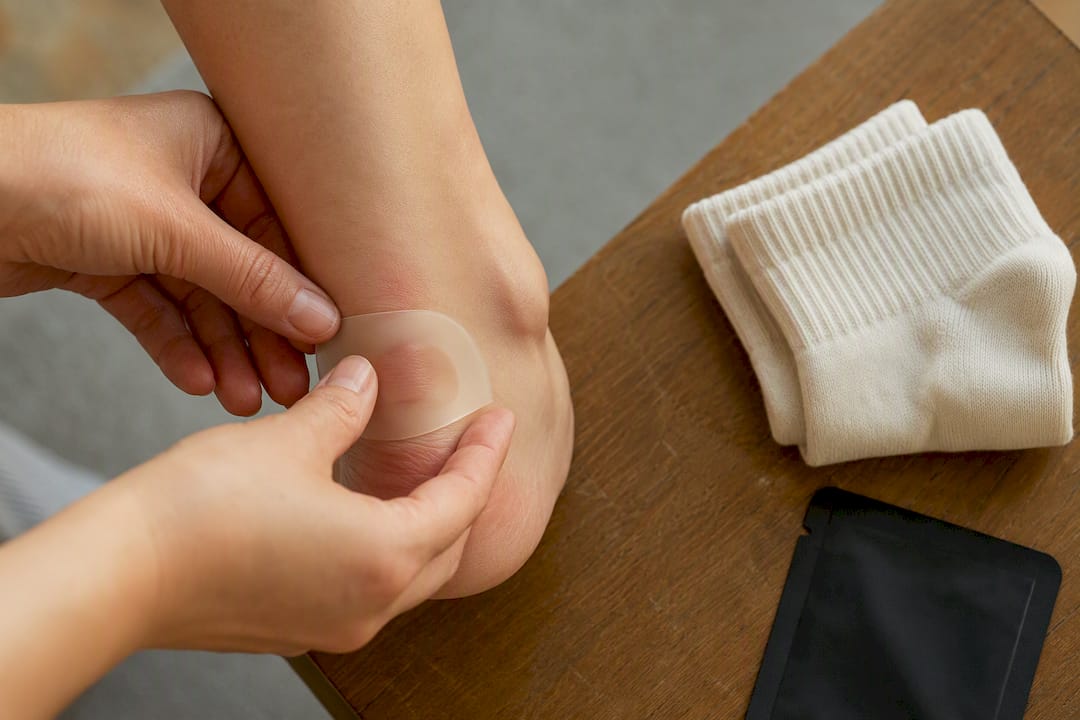
- Hydrocolloid patches: gel-based dressings that mould to the skin and actually support healing underneath; ideal once a hot spot has already turned tender or pink.
- Athletic tape: thin and low-profile, so it works well between toes or on narrow ridges where thicker patches bunch up, though it needs reapplying more often.
Apply any of these to clean, dry skin, smooth out air bubbles, and press the edges down firmly so they don’t peel during movement. Walk for five minutes afterwards to check the patch hasn’t shifted or bunched before committing to a longer wear.
Pro Tip: Cut hydrocolloid patches slightly larger than the sore spot itself. A patch with too little margin lifts at the edges within an hour, and a lifted edge causes more rubbing than no patch at all.
Which socks actually stop blisters from forming?
Cotton is the sock you want to avoid. It absorbs sweat and holds onto it, which softens the skin (a process called maceration) and increases the shear forces that cause blisters in the first place. Podiatry guidance recommends swapping cotton for moisture-wicking materials such as merino wool or synthetic blends instead.
A few practical habits make a real difference here:
- Try a thin liner sock under a thicker outer sock if you’re prone to friction on the heel or toes.
- Choose seam-free socks if you have particularly sensitive skin or diabetic feet.
- Dust feet with foot powder or use an antiperspirant on sweat-prone areas before wearing new shoes.
- Swap socks midway through a long day if your feet run hot, and let shoes air out fully between wears rather than back-to-back days.
What does a realistic 7 to 14 day break-in schedule look like?
Rushing a new pair into all-day wear is the single most common cause of blisters. Clinicians describe a structured progression that gradually asks more of the shoe, and of your feet, over roughly two weeks:
- Days 1 to 3: wear the shoes indoors for 1 to 2 hours at a time, on carpet or a clean floor, doing normal light tasks.
- Days 4 to 7: extend to outdoor walks of 3 to 4 hours, ideally on the kind of surface you’ll actually be using the shoes for.
- Days 8 to 10: mix in a longer outing, standing or walking for most of a half day, checking hot spots at each break.
- Days 11 to 14: move to full-day wear, keeping tape or patches on any spot that flared up earlier in the week.
Keep a quick note (a phone memo works fine) of exactly where and when a hot spot appeared. That pattern tells you whether a shoe needs another week of gradual wear or whether it’s simply the wrong shape for your foot.
Stiffer materials need more patience than soft ones. Leather typically softens and moulds within the standard 7 to 14 days; rigid synthetics often need the full fortnight and sometimes longer, since some lower-grade synthetic uppers don’t stretch safely at all.
Pro Tip: If a hot spot appears in the exact same location three sessions running, stop extending the schedule and address the mechanical cause instead. Repetition in the same spot usually means a fit problem, not a break-in problem.
Can insoles, lacing or heel grips fix a poor fit?
Sometimes, yes. Moving a familiar, well-worn insole into a new pair changes only one variable at a time, rather than asking your foot to adapt to new support and a new shape simultaneously. It’s a simple swap that removes a surprising amount of the guesswork.
Small adjustments often solve specific friction points:
- A heel-lock lacing technique (looping the lace through the top eyelets before crossing) stops the heel lifting and rubbing with every step.
- Heel grips add bulk at the back of the shoe for feet that are narrow relative to the shoe’s overall size.
- Tongue pads reduce pressure across the top of the foot in shoes that run slightly long.
There’s a firm limit to what any of this can achieve. If the shoe pinches across the widest part of your foot, if your toes are curled or crushed at the tip, or if pain radiates rather than sitting at a single rubbing point, the shape simply doesn’t suit your foot. Podiatrists are clear that fit issues need a different shoe, not a softening trick, and pushing through that kind of pain rarely ends well.
Do blow dryers, freezers and thick socks actually work?
Some home methods genuinely help; others are more myth than method. A blow dryer on a low or medium heat, held a few inches away while you flex the shoe, can soften certain leathers enough to ease a tight spot. Never point a high-heat setting directly at glued seams or synthetic overlays, since heat can loosen adhesive and warp the material instead of stretching it.
The lowest-risk approach is also the simplest: wear two pairs of thick socks and walk around the house for short stretches over several evenings. It’s slow, but it carries no risk of damaging the shoe.
- A blow dryer works on natural materials like leather, not on most synthetics or mesh.
- Freezing a water-filled bag inside a tight shoe can nudge a stubborn spot outward, but only by a small margin.
- Thick socks plus short indoor walks remain the safest break-in method for any material.
- Petroleum jelly reduces friction for short, low-intensity wear, but it tends to migrate once feet sweat, making it unreliable for hikes or a full day on your feet.
Pro Tip: Save the blow dryer and freezer tricks for one stubborn spot on an otherwise well-fitting shoe. If more than one area needs softening, that’s usually a sign the size or shape is wrong.
What should you do the moment a blister forms?
Stop making it worse before you do anything else. Take the shoes off, clean the area gently, and cover the blister with a hydrocolloid dressing or a simple plaster rather than leaving it exposed.
- Leave an intact blister unburst. Mayo Clinic advises against popping it, since the fluid-filled skin protects the damaged layer underneath while it heals.
- Watch for warning signs: spreading redness, pus, red streaking, or a fever, all of which point to infection and warrant a GP visit, especially for anyone with diabetes or a weakened immune system.
- Give the shoe a break. The AAD is explicit that footwear causing irritation shouldn’t be worn again until the blister heals, so rotate in a familiar, comfortable pair and pad the healing spot for a few extra days before resuming the break-in schedule.
What do podiatrists and health bodies actually recommend?
Friction is the root cause of nearly every blister. The body responds to repeated rubbing by forming a fluid-filled cushion between skin layers as a protective response to shear damage, which is exactly why prevention beats treatment.
- The NHS advises wearing well-fitting shoes, breaking them in slowly, and using moleskin or blister dressings on problem areas.
- Cleveland Clinic recommends gradual break-in and moisture-wicking socks alongside protective padding where needed.
- Lubricants have their place for short, low-friction wear, but physical barriers hold up better over a long day.
- Materials that refuse to soften after two weeks of gradual wear point to a fit problem, not a shoe that needs more patience.
Foot-health focused footwear, including the design principles behind YDA’s shoe technology, aims to reduce the internal movement that causes this friction from the outset, rather than relying on the wearer to fix it after the fact.
A practical note on prioritising comfort over stubbornness
Fit beats folklore every time. If a shoe still hurts after a fair two-week trial, following every tip in this guide, the honest answer is to return it rather than keep forcing the issue. Mechanical fixes like insoles, lacing changes, and heel grips deserve a proper go first, since they solve real problems without wasting a shoe you’ve already paid for. For feet that struggle repeatedly with standard footwear, technology-led designs built around foot health are worth exploring. If irritation keeps recurring across multiple pairs, a podiatrist can usually spot what a shop mirror can’t.
— Panagiotis
Sources
- Blisters - NHS
- How to prevent and treat blisters | AAD
- First aid: blisters | Mayo Clinic
- How to prevent blisters on feet | ModPod Podiatry
- 5 ways to avoid blisters and the best ways to treat them | Cleveland Clinic
FAQ
Is It Normal to Get Blisters From New Shoes?
Yes, it’s common, since new shoes haven’t yet moulded to your foot’s exact shape and movement pattern. It’s not inevitable, though. Fit, socks, and early hot-spot care prevent most cases.
Does Vaseline Actually Stop Blisters?
It helps for short, low-intensity wear by cutting down friction temporarily, but it tends to wear off or migrate once feet start sweating. For a long walk or a full day of wear, a physical barrier like moleskin or a hydrocolloid patch holds up far better.
What’s the Fastest Safe Way to Break in New Shoes?
There isn’t a genuine shortcut without risk. A blow dryer on natural leather can loosen one stubborn spot, and thick socks with short indoor walks work on any material, but the 7 to 14 day gradual schedule remains the reliable route.
How Long Do Blisters From New Shoes Take to Heal?
Most blisters heal within a week when left intact, kept clean, and protected with a dressing. Healing takes longer if the same shoe keeps rubbing the spot, which is why medical guidance recommends resting that footwear entirely until the skin recovers.