
Comfortable shoes for plantar fasciitis: UK guide
For plantar fasciitis, the single most effective footwear choice is a structured stability trainer or orthotic-friendly everyday shoe paired with a contoured recovery slide for home use. That combination addresses the two moments when the fascia is most vulnerable: the first steps of the morning and the long hours on your feet during the day.
Why those two categories specifically?
- Firm arch support and a rigid midsole prevent the plantar fascia from overstretching with each step, which is the mechanical root of the pain.
- A deep heel cup cradles the fat pad under your heel, distributing impact rather than concentrating it on the inflamed tissue.
- Recovery slides indoors matter because walking barefoot at home is one of the most common reasons recovery stalls, especially first thing in the morning when the fascia is tightest.
If pain persists beyond six to eight weeks despite good footwear, see a podiatrist. Custom orthotics become necessary for some people whose biomechanics a standard shoe cannot fully correct.
Table of Contents
- What shoe features should you prioritise for plantar fasciitis?
- How do you match a shoe to your arch type?
- Which shoe styles actually help, and when should you wear each?
- How to try and buy plantar fasciitis shoes in the UK
- Why Ydauk is a practical UK option for plantar fasciitis
- Key takeaways
- The part most guides skip
- Ydauk footwear: built for the support your feet need
- Useful sources and further reading
What shoe features should you prioritise for plantar fasciitis?
Podiatrist-tested guidance consistently points to the same cluster of features. Here is what to check before you buy:
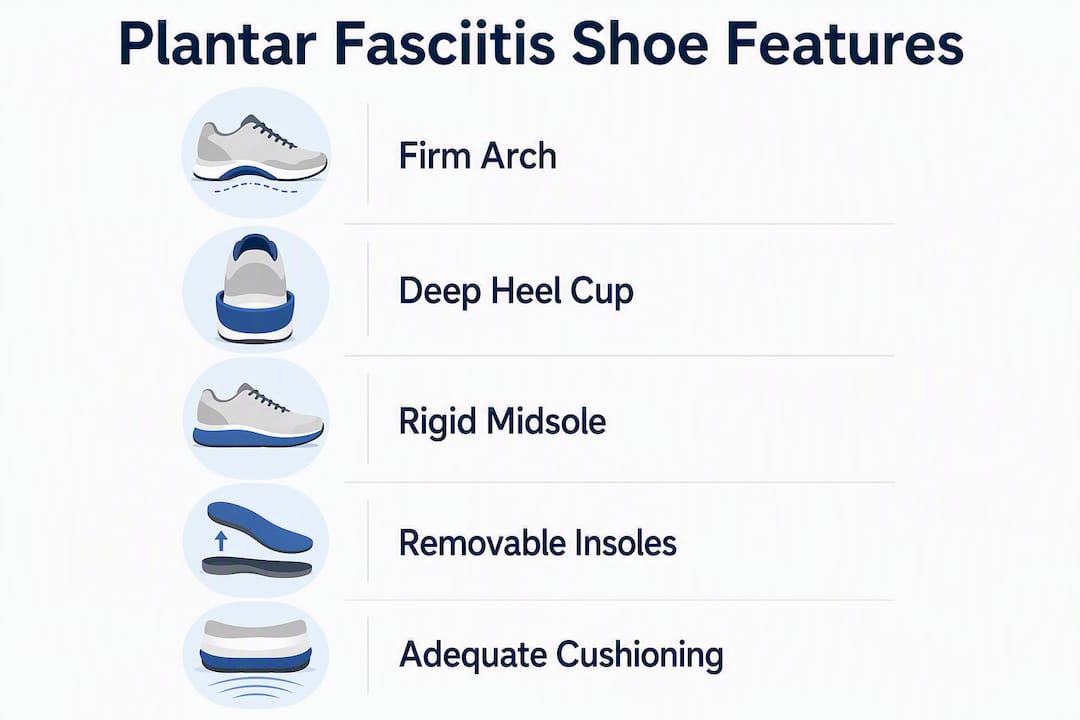
- Firm arch support: the arch should feel supportive, not squishy. Soft, yielding arch structures feel pleasant initially but allow the fascia to stretch excessively under load.
- Removable insole: a footbed you can lift out means you can swap in a custom orthotic without compromising the shoe’s fit. This is non-optional if your podiatrist has prescribed orthotics.
- Rigid or semi-rigid midsole: the shoe should resist twisting along its length. If you can wring it like a cloth, it lacks the structure your foot needs.
- Deep heel cup: look for a heel counter that does not collapse when you press it firmly with your thumb.
- Slight heel-to-toe drop (8–12 mm): this geometry unloads the fascia slightly by reducing the stretch demand at the heel attachment point.
- Shock absorption: a cushioned midsole, particularly under the heel, reduces the impact spike that aggravates inflamed tissue.
- Snug heel fit with adequate toe box width: the heel should not slip, but the forefoot needs room to splay naturally.
- Replacement cadence: midsoles lose meaningful support over time. Once the cushioning feels flat or the heel counter softens noticeably, replace the shoe regardless of how the upper looks.
Pro Tip: Before buying, perform the wring test: hold the shoe at each end and twist as if wringing out a towel. A shoe suitable for plantar fasciitis should barely rotate. Then press the heel counter inward with your thumb. If it collapses easily, the structural support will fail quickly under daily wear.
How do you match a shoe to your arch type?
The arch-matching principle is straightforward: the wrong shoe for your foot type can worsen plantar fasciitis even when it ticks every other box. Start by identifying your arch.

Self-identifying your arch type
Wet the sole of your foot and step onto a piece of dark paper or a dry tile. A flat, full footprint with almost no inward curve indicates a flat arch (and likely overpronation). A footprint with a narrow band connecting heel to forefoot suggests a high arch. A moderate curve in between is a normal arch.
Flat feet and overpronation
Stability or motion-control shoes with medial (inner-side) support are the right category. These shoes have a denser foam or a plastic shank on the inner midsole that resists the inward roll of the foot. For a detailed breakdown of what to look for, Ydauk’s guide on picking shoes for flat feet covers the key specs.
Normal arches
Neutral stability shoes with a firm midsole and a removable insole work well. You have more flexibility here, but avoid ultra-cushioned, highly flexible shoes that sacrifice structure for softness.
High arches
Cushioned neutral shoes that improve shock absorption are the priority. High arches tend to be rigid and do not absorb impact efficiently, so extra cushioning under the heel and forefoot matters more than medial support.
In-store or at-home fit checklist
- Put the shoe on with the socks you normally wear and stand up fully weighted.
- Check that the flex point of the shoe aligns with the ball of your foot, not the midfoot.
- Press your thumb against the heel counter. It should feel stiff.
- Walk a few steps and confirm the heel does not slip.
- Remove the insole and check whether it is thick enough to accommodate a custom orthotic if needed.
- Perform the wring test described above.
Which shoe styles actually help, and when should you wear each?
Different situations call for different styles, and plantar fasciitis footwear is not one-size-fits-all across your day.
Daily walking and training shoes
Structured stability trainers are the workhorse choice for most people. They combine the midsole firmness, heel cup depth, and drop geometry that the condition demands. For general walking, a trainer with a firm medial post and a removable insole covers the majority of daily situations.
Recovery slides and sandals for home use
Contoured recovery sandals are the right indoor choice. Flat flip-flops and standard slippers offer no arch support and allow the fascia to stretch with every step. Keep a pair of supportive slides by the bed specifically for those first morning steps, when the fascia is at its tightest after hours of rest.
Slip-on casuals and slippers
Acceptable only when they have a moulded, contoured footbed rather than a flat one. A slip-on with a structured arch and a firm heel cup can work for short periods, but they are not suitable for long days on your feet.
Work shoes and clogs
For long shifts on hard floors, the demands are high: a rigid shank, substantial heel cushioning, and a removable insole are the minimum. Clogs with a rocker sole can reduce forefoot loading, but check that the heel counter is stiff before committing.
Styles to avoid entirely
- Flat ballet pumps and thin-soled dress flats
- Standard flip-flops and unsupported flat sandals
- Worn-out trainers with compressed midsoles
- Minimalist or zero-drop shoes, which place maximum stretch on the fascia
How to try and buy plantar fasciitis shoes in the UK
Buying online is convenient, but getting the fit wrong is expensive and painful. A few practical steps reduce that risk considerably.
Measuring at home
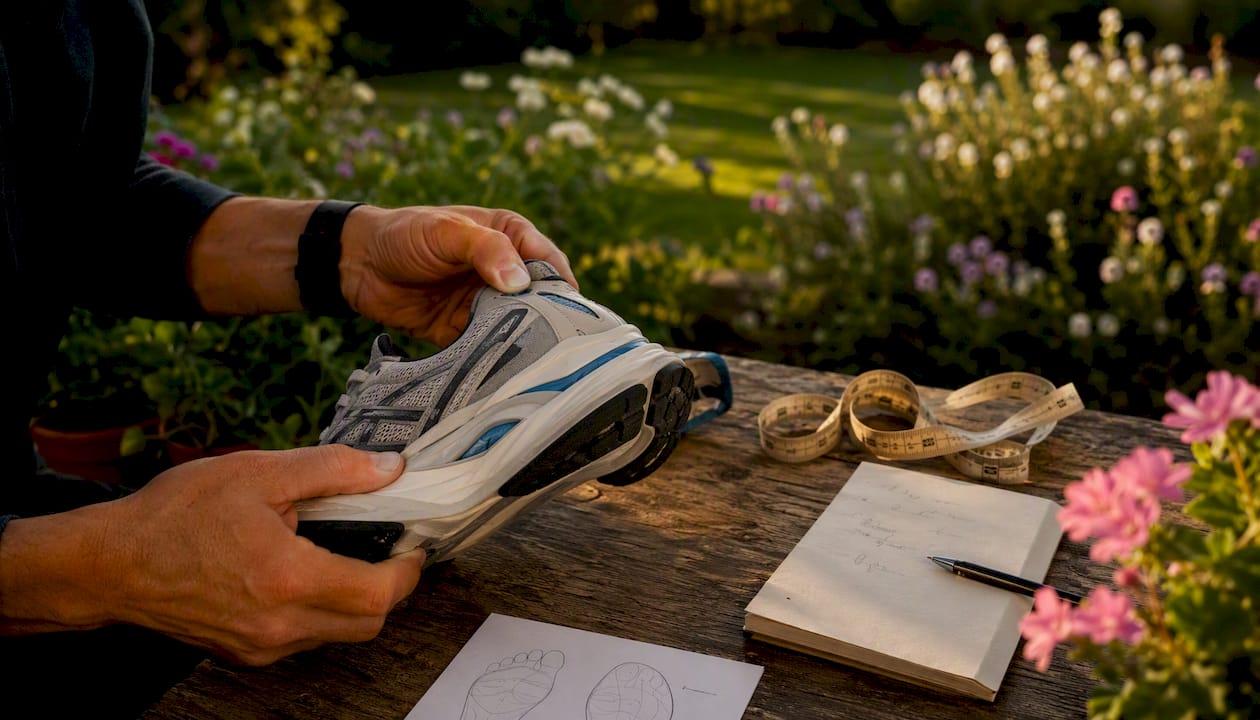
Trace your foot on paper in the afternoon (feet swell through the day) and measure the longest point. UK shoe sizes run in thirds of an inch, so a half-size up from your measured length is often sensible when adding a custom orthotic. Width matters too: many UK retailers offer E, EE, and EEE fittings alongside standard widths. If your foot spreads noticeably when weighted, go up a width.
Trying shoes properly
Wear your usual socks, try both shoes, and walk on a hard surface rather than carpet. The heel should feel locked in without pressure on the Achilles. The flex point should bend at the ball of your foot. If buying online, treat the first two weeks as a trial period: wear the shoes indoors on clean floors so you can return them if the fit is wrong.
Return and trial policies
Look for retailers offering at least 30 days for returns on unworn or lightly worn shoes. Some UK specialist footwear retailers extend this to 60 days for people with foot conditions. Check the policy before you order.
Replacement timing
Worn midsoles and softened heel counters are the most common failure modes that worsen plantar fasciitis. Once cushioning feels noticeably flatter or the heel counter gives under thumb pressure, the shoe has lost its therapeutic value regardless of how the upper looks.
Plantar fasciitis is a common foot condition affecting a significant portion of the population, making it one of the most common causes of heel pain seen in UK GP and podiatry clinics. Most cases improve with the right footwear and stretching within several months, but the footwear choice is the variable most within your control from day one.
Why Ydauk is a practical UK option for plantar fasciitis
Ydauk designs footwear around the YDA technology platform, which addresses the specific structural requirements that matter for plantar fasciitis:
- Arch structure built into the midsole: rather than relying solely on an insole, YDA shoes incorporate arch support into the shoe’s construction, so the support does not degrade when you swap insoles.
- Midsole firmness calibrated for fascia loading: the midsole resists midfoot flex while retaining heel cushioning, matching the semi-rigid profile podiatrists recommend.
- Removable insoles: all relevant models accept custom orthotics, which is the practical requirement for anyone whose podiatrist has prescribed them.
- UK sizing and availability: Ydauk ships within the UK and lists sizes in UK measurements. Pricing includes VAT, so the figure you see is what you pay.
- Fitting guidance: the Ydauk site carries detailed comfort footwear guidance for plantar fasciitis, including advice on matching models to arch type.
If you are between arch types or unsure which model suits your gait, Ydauk’s customer support line can advise before you order.
Key takeaways
Structured footwear with firm arch support, a deep heel cup, and a rigid midsole is the most effective starting point for managing plantar fasciitis pain in everyday life.
| Point | Details |
|---|---|
| Primary shoe choice | Choose a stability trainer or orthotic-friendly shoe with an 8–12 mm heel-to-toe drop and a removable insole. |
| Indoor recovery footwear | Use contoured recovery slides at home; never walk barefoot, especially for those first morning steps. |
| When to see a podiatrist | If pain persists beyond six to eight weeks of wearing appropriate footwear, seek professional assessment. |
| Replacement timing | Replace shoes when the midsole feels flat or the heel counter softens under thumb pressure, regardless of upper condition. |
| Ydauk for UK shoppers | Ydauk’s YDA technology platform offers arch-structured, orthotic-compatible shoes available in UK sizes with VAT-inclusive pricing. |
The part most guides skip
There is a tendency in plantar fasciitis advice to focus entirely on the shoe and treat the foot as a passive recipient. The more useful framing is that the shoe buys you a window, not a cure. Structural footwear reduces the daily mechanical insult to the fascia, which allows inflammation to settle. But if you step out of those shoes onto a hard kitchen floor every morning, or wear them until the midsole is compressed flat, you close that window again.
The other thing worth saying plainly: no single shoe suits everyone. The arch-type matching in this guide is a starting framework, not a guarantee. Some people with textbook flat feet respond better to a neutral shoe with a custom orthotic than to a motion-control shoe. Some high-arch sufferers need a medial post despite the conventional advice against it. The wring test and heel counter check are more reliable than any brand claim, but your own pain response over two to three weeks of consistent wear is the final arbiter.
Ydauk’s approach of building arch support into the midsole construction rather than relying on a removable insole alone is worth noting here. It means the structural benefit persists even when you swap insoles for a custom orthotic, which is the scenario where many shoes quietly fail.
Ydauk footwear: built for the support your feet need
Spending months testing shoes that look supportive but deliver nothing is a frustrating and costly cycle. Ydauk offers a direct alternative: footwear engineered around the structural requirements that podiatrists actually specify, available to UK shoppers with VAT-inclusive pricing and no guesswork on sizing.
The YDA technology page sets out exactly how each design element maps to foot health, including the midsole firmness profile, heel cup geometry, and orthotic compatibility. If you want fitting advice before ordering, the customer support team is reachable by phone. Browse the current range, check your arch type against the model guidance, and use the return window to confirm the fit works for your foot before committing.
Useful sources and further reading
Clinical and podiatry-led sources
- Women’s shoes: best and worst picks — Cleveland Clinic — clinical guidance on styles to avoid
- Best shoes for plantar fasciitis — Health.com — podiatrist-reviewed product testing
Ydauk resources
- Technology of YDA Shoes — proprietary technology and foot health design rationale
- Comfort footwear features: plantar fasciitis mobility — feature guidance specific to plantar fasciitis
- Arch support shoe types: your 2026 guide for UK feet — arch-type matching by shoe category