
Medical Grade Footwear – Why Choice Matters for Foot Health
Most british adults with diabetes will face foot health challenges that demand more than ordinary shoes. Living with foot conditions means comfort cannot come at the expense of support or medical standards. Stylish medical-grade footwear delivers real benefits, combining safety, function, and approved features that ordinary brands simply cannot match. Discover how the latest evidence-backed designs empower individuals to protect their mobility and express their personal style while prioritizing health.
Table of Contents
- Medical Grade Footwear Defined and Debunked
- Types of Medical Grade Footwear Explained
- Key Features Promoting Foot Health
- Benefits for Diabetes and Foot Conditions
- How to Choose and Legal Standards
Key Takeaways
| Point | Details |
|---|---|
| Understanding Medical-grade Footwear | These specialised shoes are engineered to address complex foot health challenges and are not just standard comfort options. |
| Types of Medical-grade Footwear | Three primary classifications exist: ready-made, custom-fitted, and fully bespoke, each tailored for specific clinical needs. |
| Key Features | Important features include appropriate fit, adequate toe box volume, pressure redistribution, and enhanced cushioning to promote foot health. |
| Regulatory Standards | Medical-grade footwear must meet strict regulatory requirements for safety and effectiveness, ensuring they provide genuine therapeutic benefits. |
Medical Grade Footwear Defined and Debunked
Understanding medical-grade footwear is crucial for individuals managing complex foot health challenges. These specialised shoes represent far more than standard retail offerings, designed to address specific foot conditions and structural abnormalities. Medical grade footwear provides targeted solutions for people experiencing foot-related health complications.
Contrary to popular misconceptions, medical-grade footwear is not simply another orthotic shoe or a generic comfort solution. These shoes are engineered with precise specifications to accommodate unique foot structures, particularly for individuals with deformities or abnormal foot shapes that standard shoes cannot support. They often feature specialised design elements like:
- Extra depth and width to reduce pressure points
- Flexible neoprene fabric uppers for enhanced adaptability
- Customised internal structures for improved weight distribution
- Reinforced support zones tailored to specific foot conditions
Medical professionals prescribe these shoes after comprehensive clinical assessments, ensuring they meet stringent health requirements. Specific foot abnormalities demand precision-engineered footwear that standard retail options simply cannot provide. Unlike generic shoes, medical-grade footwear focuses on functional rehabilitation and preventative care.
Pro tip: Consult a podiatrist or foot health specialist to determine whether medical-grade footwear is appropriate for your specific foot condition and health needs.
Types of Medical Grade Footwear Explained
Medical-grade footwear is not a one-size-fits-all solution, but rather a sophisticated range of specialised shoe types designed to address diverse foot health challenges. Medical footwear categories encompass three primary classifications: off-the-shelf, customised, and bespoke options, each serving unique clinical requirements.
The first category, ready-made medical grade footwear, provides accessible solutions for individuals with mild to moderate foot conditions. These shoes feature:
- Extra depth and width for accommodating foot deformities
- Standardised support structures
- Pre-designed comfort features
- Approved manufacturing standards
Custom-fitted medical footwear represents a more personalised approach, offering enhanced adaptability for specific foot structures. These shoes undergo partial modifications to address individual patient needs, bridging the gap between standard and fully bespoke options. Medical grade shoe variations are carefully prescribed to ensure optimal foot health and comfort.

At the most specialised end of the spectrum, fully custom-made medical footwear provides precise solutions for complex foot conditions. Manufactured by contracted specialists, these shoes are meticulously crafted to match individual foot and ankle structures, addressing severe deformities or unique anatomical requirements. The manufacturing process involves detailed clinical assessments, precise measurements, and specialised design techniques to create footwear that goes beyond conventional shoe-making approaches.
Below is a concise comparison of the three main types of medical-grade footwear, highlighting their clinical applications and prescription process.
| Footwear Type | Clinical Use | Customisation Level | Prescription Process |
|---|---|---|---|
| Ready-made | Mild cases | Minimal adjustments | Often direct professional supply |
| Custom-fitted | Moderate cases | Partial modifications | Assessment plus tailored fitting |
| Fully bespoke | Severe conditions | Full individual tailoring | Detailed measurements, specialists |
Pro tip: Always consult a foot health professional to determine which medical-grade footwear category best matches your specific foot condition and therapeutic needs.
Key Features Promoting Foot Health
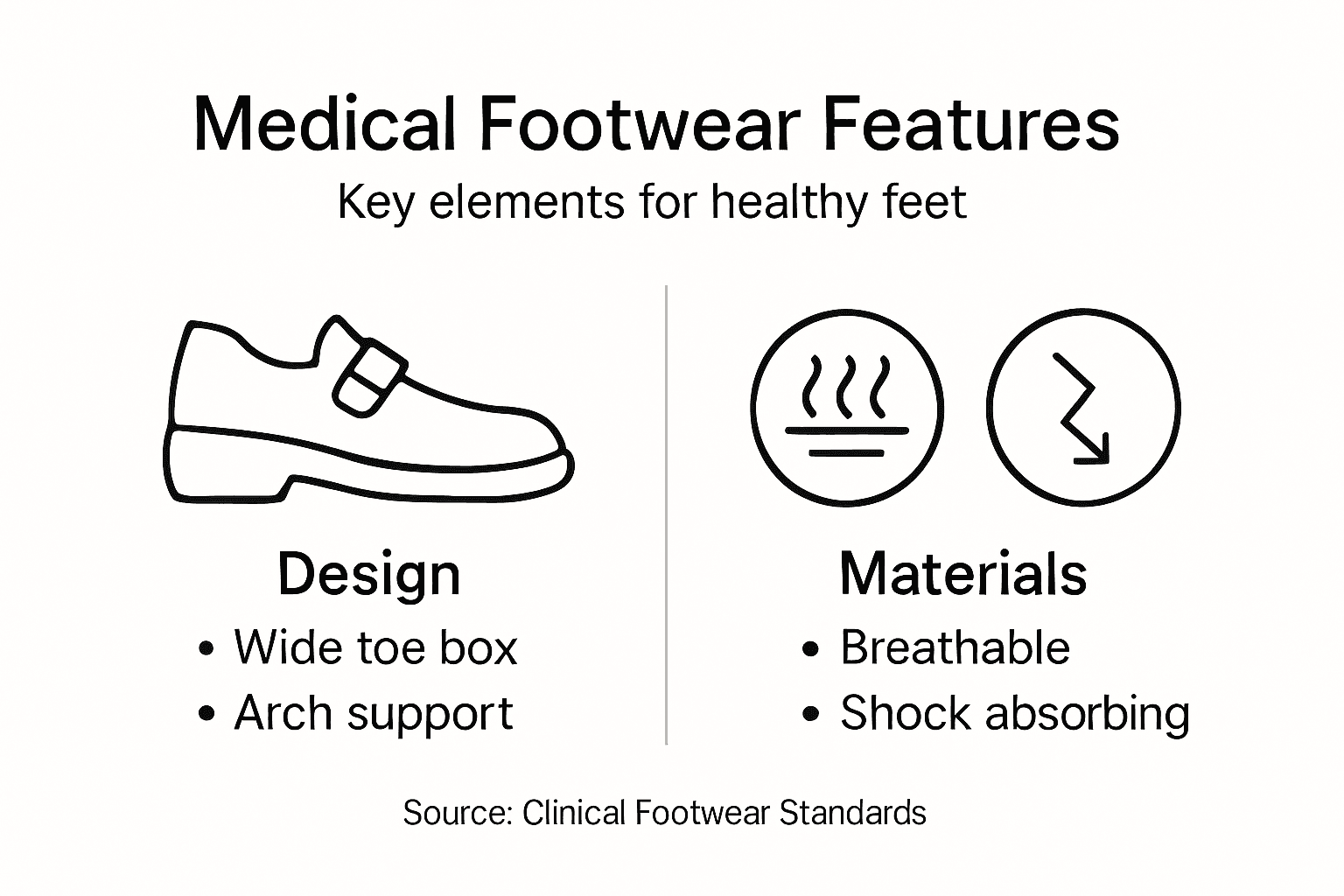
Proper shoe design plays a critical role in maintaining overall foot health, with specific biomechanical features determining the effectiveness of medical-grade footwear. Understanding these key features can significantly reduce the risk of podiatric complications and enhance mobility for individuals with diverse foot health requirements.
The fundamental features that promote optimal foot health include:
- Appropriate Fit: Shoes must conform precisely to individual foot dimensions
- Adequate Toe Box Volume: Providing sufficient space to prevent compression and deformity
- Pressure Redistribution: Strategically designed insoles that minimise high-impact zones
- Enhanced Cushioning: Shock-absorbing materials that protect joints and reduce strain
- Stability Support: Structured design elements that maintain proper foot alignment
Biomechanical Design is paramount in creating footwear that addresses specific medical needs. Orthotic-friendly footwear incorporates advanced technologies that accommodate individual foot structures, ensuring that each step provides maximum comfort and therapeutic benefit. These shoes go beyond aesthetic considerations, focusing on functional support that can mitigate existing foot conditions and prevent future complications.
Advanced medical-grade footwear integrates sophisticated engineering principles, considering factors such as weight distribution, arch support, and individual gait patterns. The goal is not merely to cover the foot, but to provide a dynamic support system that adapts to the wearer’s unique physiological requirements, promoting long-term foot health and overall mobility.
Pro tip: Request a professional foot assessment before selecting medical-grade footwear to ensure the most accurate match for your specific foot health needs.
Benefits for Diabetes and Foot Conditions
Diabetic patients face significant challenges in foot health, with diabetic foot syndrome presenting complex medical risks that require specialised footwear interventions. Peripheral neuropathy and reduced circulation create unique vulnerabilities that demand precise, therapeutic shoe design to prevent potentially devastating complications.
The critical benefits of medical-grade footwear for diabetic patients include:
- Pressure Redistribution: Reducing concentrated plantar pressures
- Ulcer Prevention: Protecting vulnerable foot areas
- Circulation Support: Minimising potential damage from poor blood flow
- Nerve Protection: Accommodating sensory loss in extremities
- Structural Compensation: Supporting compromised foot mechanics
Diabetic shoe selection goes beyond aesthetic considerations, representing a crucial medical intervention. Specialised footwear can significantly mitigate risks associated with diabetic foot conditions, providing strategic support that addresses the nuanced challenges of compromised foot health. These shoes are engineered to distribute weight evenly, reduce friction, and create protective environments that minimise the risk of skin breakdown and ulceration.
Globally, access to appropriate medical-grade footwear remains a significant public health challenge, particularly in low- and middle-income countries. The economic and cultural barriers preventing diabetic patients from obtaining recommended footwear underscore the importance of comprehensive healthcare strategies that prioritise preventative foot care and patient education.
Pro tip: Schedule annual comprehensive foot assessments with a healthcare professional to monitor diabetic foot health and receive personalised footwear recommendations.
How to Choose and Legal Standards
Choosing medical-grade footwear involves navigating complex regulatory requirements and clinical standards. The process extends far beyond simple shoe selection, demanding rigorous assessment and compliance with strict medical device regulations that protect patient safety and ensure therapeutic effectiveness.
The key steps in selecting medical-grade footwear involve:
- Clinical Assessment: Comprehensive evaluation by qualified healthcare professionals
- Prescription Requirements: Detailed documentation of specific foot health needs
- Regulatory Compliance: Ensuring shoes meet medical device standards
- Supplier Verification: Sourcing from approved and certified manufacturers
- Individualised Fitting: Precise measurements and personalised adjustments
Medical footwear prescription guidelines mandate a structured approach that goes beyond standard retail shoe purchasing. Healthcare professionals must complete specific forms, conduct thorough clinical assessments, and ensure that selected footwear meets both individual patient requirements and broader regulatory standards. This process involves careful documentation, follow-up evaluations, and ongoing monitoring to guarantee optimal therapeutic outcomes.
In the European Union, medical-grade footwear is classified as a medical device under the Medical Devices Regulation (MDR 2017/745), which imposes stringent safety, performance, and labelling requirements. Manufacturers must obtain CE marking, conduct clinical evaluations, and implement robust post-market surveillance mechanisms. These regulations ensure that medical-grade footwear provides genuine therapeutic benefits while maintaining the highest standards of patient safety and product quality.
The following table summarises regulatory hallmarks required for compliance with European medical device standards.
| Regulatory Requirement | Purpose | Application to Footwear |
|---|---|---|
| CE marking | Safety and compliance assurance | Mandatory before market release |
| Clinical evaluation | Validates therapeutic effectiveness | Confirms medical function |
| Post-market surveillance | Continuous safety monitoring | Ensures long-term patient safety |
Pro tip: Always request documentation proving your medical-grade footwear meets official regulatory standards and has been prescribed by a qualified healthcare professional.
Discover Medical-Grade Solutions for Your Foot Health at YDA UK
Foot discomfort and foot health complications require thoughtful footwear choices that go beyond standard styles. This article highlights the importance of medical-grade footwear tailored to individual needs such as appropriate fit, pressure redistribution, and specialised support. If you seek innovative shoes designed with the latest biomechanical insights and therapeutic benefits, explore our range of Shoes crafted for everyday comfort and performance.

Take control of your foot health today by visiting YDA UK’s Home page to find footwear that combines style with medical-grade technology. Our collection addresses key concerns discussed in this article with options built for enhanced support and energy efficiency. Don’t wait to experience the difference proper footwear can make. Begin your journey now at https://ydauk.com.
Frequently Asked Questions
What is medical-grade footwear?
Medical-grade footwear is specially designed shoes that address specific foot conditions and structural abnormalities. They offer more than standard comfort shoes by providing targeted support for individuals with complex foot health challenges.
How is medical-grade footwear different from regular shoes?
Unlike regular shoes, medical-grade footwear is engineered with precise specifications tailored to accommodate unique foot structures, focusing on functional rehabilitation and preventative care for specific medical needs.
What are the different types of medical-grade footwear?
There are three main types of medical-grade footwear: ready-made, custom-fitted, and fully bespoke options. Ready-made is for mild cases, custom-fitted allows partial modifications for moderate conditions, and fully bespoke is tailored for severe foot deformities.
How can medical-grade footwear benefit diabetic patients?
Medical-grade footwear for diabetic patients helps redistribute pressure, prevent ulcers, support circulation, protect nerves, and compensate for structural issues, significantly reducing the risk of complications associated with diabetic foot health.
Recommended
- Podiatrist Recommended Footwear: Lasting Comfort and Health – YDA UK
- Orthotic-Friendly Footwear: Enhancing Comfort and Foot Health – YDA UK
- 7 Essential Footwear Selection Tips for Healthy Feet – YDA UK
- 7 Key Benefits of Foot Health Shoes for Everyday Comfort – YDA UK
- Clean Label Supplements: Better Choices for Athletes – Interval