
Role of Footwear in Reducing Fatigue: Key Insights
More than 60 percent of active individuals struggle with foot fatigue, often searching for that rare combination of style and scientifically backed comfort. Whether you are pushing through long urban walks in British cities or training for a marathon, your shoe choice can shape not only daily movement but also your overall foot health. Discover how understanding the science of footwear design helps you make smarter picks—so every step feels lighter, healthier, and made for your active lifestyle.
Table of Contents
- Footwear and Fatigue: Core Concepts Explained
- Types of Fatigue-Reducing Footwear Available
- Essential Design Features for Comfort and Support
- How Footwear Mechanics Impact Body Alignment
- Common Mistakes When Selecting Performance Shoes
Key Takeaways
| Point | Details |
|---|---|
| Footwear Design Impacts Fatigue | Strategic footwear design can significantly reduce energy expenditure and muscular strain during prolonged activities. |
| Choose Activity-Specific Shoes | Opt for footwear tailored to specific activities to maximise biomechanical alignment and efficiency. |
| Consider Essential Comfort Features | Prioritise features such as anatomical fit and breathability to enhance comfort and reduce fatigue. |
| Avoid Common Selection Mistakes | Be mindful of individual biomechanics and avoid choosing shoes based solely on aesthetics or universal sizing assumptions. |
Footwear and Fatigue: Core Concepts Explained
Understanding how footwear influences physiological and psychological experiences of fatigue represents a critical intersection between biomechanical design and human performance. Current research on biomechanical interactions reveals that strategic shoe design can significantly mitigate energy expenditure and reduce muscular strain during prolonged activities.
The complexity of fatigue management through footwear extends beyond simple cushioning or support. Comfort emerges as a multifactorial concept involving intricate interactions between shoe materials, structural design, individual biomechanics, and specific activity demands. Systematic investigations demonstrate that effective fatigue reduction requires a nuanced approach considering:
- Precise anatomical fit
- Responsive material technologies
- Weight distribution mechanisms
- Shock absorption capabilities
- Breathability and thermal regulation
Biomechanical research indicates that well-designed footwear can redistribute mechanical stress, minimise energy loss during movement, and create more efficient locomotion patterns. This means selecting appropriate footwear isn’t just about comfort – it’s about optimising human physical potential and reducing unnecessary physiological strain.
Pro Tip: Choose footwear designed with specific activity requirements in mind, prioritising biomechanical alignment and energy efficiency over purely aesthetic considerations.
Types of Fatigue-Reducing Footwear Available
Comprehensive biomechanical research reveals multiple distinctive footwear categories specifically engineered to mitigate physical fatigue across various activity domains. These specialised shoe designs address different biomechanical requirements, ensuring targeted support for unique movement patterns and physiological demands.
The primary types of fatigue-reducing footwear include:
- Cushioned Running Shoes: Engineered with advanced shock absorption technologies
- Minimal Performance Footwear: Designed to promote natural foot movement
- Therapeutic Support Shoes: Constructed for individuals with specific musculoskeletal needs
- Carbon Fibre Plate Shoes: Optimised for energy return and reduced muscular strain
- Ergonomic Work Footwear: Tailored for prolonged standing and repetitive movement scenarios
Each footwear category incorporates unique design principles aimed at redistributing mechanical stress, minimising energy expenditure, and supporting optimal locomotor efficiency. These innovative shoe technologies represent a sophisticated approach to understanding how structural design can directly influence human movement and physiological performance.
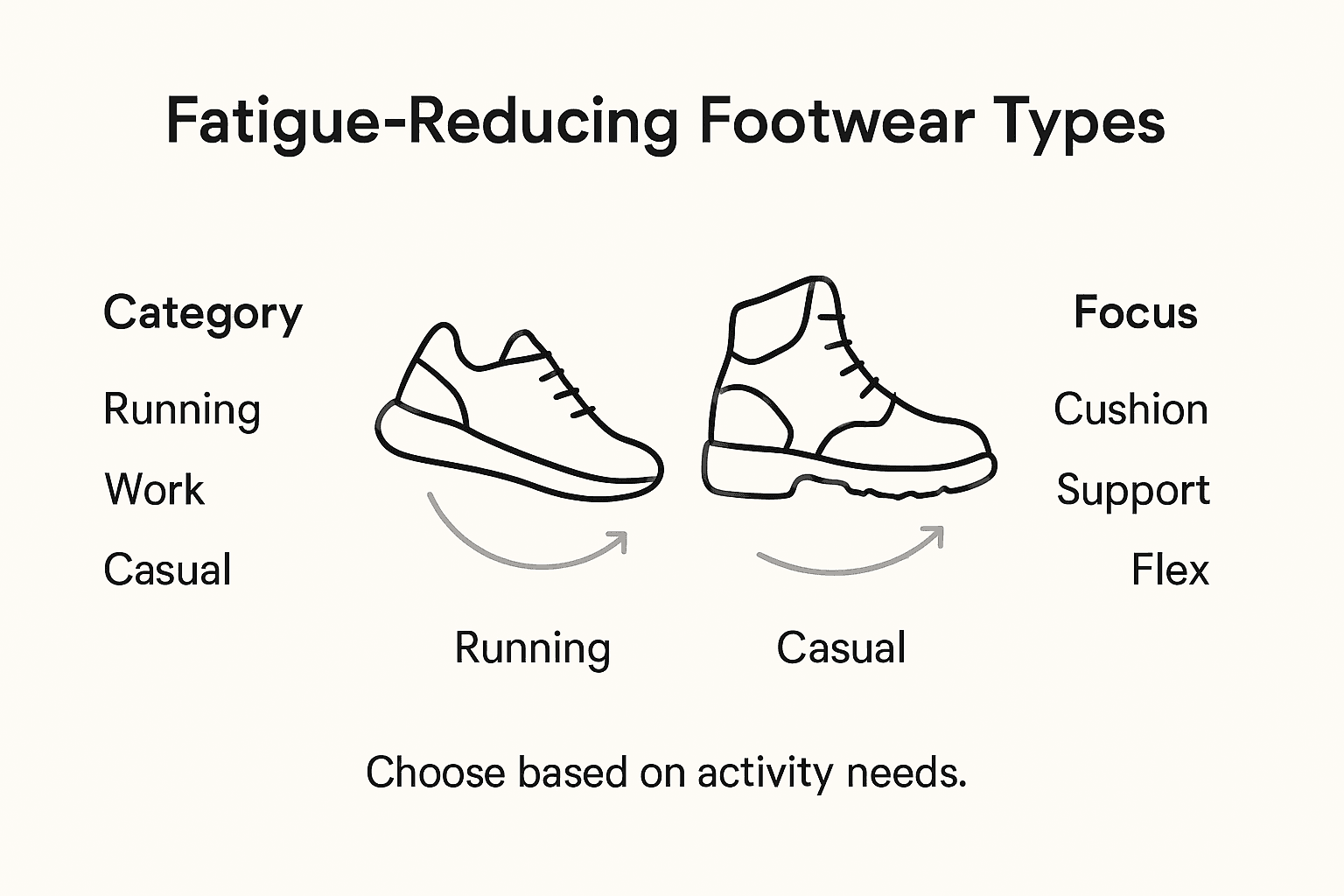
Here’s a side-by-side comparison of fatigue-reducing footwear types and their primary engineering benefits:
| Footwear Type | Main Engineering Focus | Typical Activity Application |
|---|---|---|
| Cushioned Running Shoes | Enhanced shock absorption | Long-distance running |
| Minimal Performance Footwear | Promotes natural foot movement | Barefoot-style exercise |
| Therapeutic Support Shoes | Targets musculoskeletal relief | Medical rehabilitation |
| Carbon Fibre Plate Shoes | Maximises energy return | Competitive athletics |
| Ergonomic Work Footwear | Supports prolonged standing | Industrial or office settings |
Pro Tip: Select footwear aligned with your specific activity type, prioritising biomechanical compatibility over aesthetic preferences to maximise comfort and reduce potential fatigue.
Essential Design Features for Comfort and Support
Comprehensive research on footwear biomechanics reveals critical design features that transform shoes from mere protective coverings into sophisticated comfort systems. Understanding these intricate design elements is paramount for individuals seeking to minimise physical fatigue and optimise movement efficiency.
The essential design features for optimal comfort and support encompass several key characteristics:
- Anatomical Fit: Precise contours matching individual foot shape
- Midsole Construction: Soft, responsive materials providing shock absorption
- Sole Geometry: Curved rocker designs facilitating natural locomotion
- Weight Distribution: Strategic weight reduction and balanced load management
- Material Technology: Breathable, adaptive fabrics supporting thermal regulation
These sophisticated design elements work synergistically to address individual biomechanical requirements. Advanced footwear technologies demonstrate how strategic engineering can transform walking and movement experiences, reducing muscular strain and promoting more efficient energy expenditure.

The following table summarises key comfort-enhancing shoe features and their impact on fatigue management:
| Feature | Comfort Benefit | Fatigue Reduction Impact |
|---|---|---|
| Anatomical Fit | Reduces pressure hotspots | Improves movement efficiency |
| Breathable Materials | Regulates foot temperature | Lessens thermal discomfort |
| Sole Geometry | Encourages natural motion | Minimises muscular strain |
| Weight Distribution | Decreases uneven load | Prevents early fatigue onset |
Pro Tip: Prioritise footwear with customisable features that accommodate your unique foot anatomy and movement patterns, rather than selecting generic, one-size-fits-all solutions.
How Footwear Mechanics Impact Body Alignment
Comprehensive biomechanical research demonstrates that footwear mechanics play a pivotal role in determining human body alignment, influencing everything from posture to joint kinematics. The intricate relationship between shoe design and bodily mechanics extends far beyond simple cushioning, representing a complex interaction of structural support and biomechanical adaptation.
Key mechanisms through which footwear impacts body alignment include:
- Pressure Distribution: Managing load across foot contact points
- Arch Support: Controlling longitudinal and transverse foot mechanics
- Heel Counter Stability: Restricting excessive ankle movement
- Sole Flexibility: Enabling natural foot motion during walking
- Postural Correction: Minimising compensatory movement patterns
Detailed gait analysis studies reveal that subtle variations in shoe design can dramatically alter joint forces, muscle activation sequences, and overall biomechanical efficiency. These mechanical interactions determine not just immediate comfort, but long-term musculoskeletal health and potential injury prevention strategies.
Pro Tip: Regularly assess your footwear’s structural integrity and alignment support, replacing shoes that show significant asymmetrical wear patterns to maintain optimal biomechanical functioning.
Common Mistakes When Selecting Performance Shoes
Comprehensive biomechanical research reveals that selecting performance shoes involves far more nuance than many individuals realise. Consumers frequently make critical errors that compromise comfort, performance, and potentially increase injury risk by approaching shoe selection through overly simplistic or generic perspectives.
The most prevalent mistakes in performance shoe selection include:
- Ignoring Individual Biomechanics: Choosing shoes without considering personal movement patterns
- Prioritising Aesthetics: Selecting shoes based on appearance rather than functional design
- Neglecting Shoe Drop: Overlooking the critical angle between heel and forefoot
- Universal Sizing Assumptions: Assuming identical sizing across different brands
- Disregarding Activity-Specific Requirements: Using generalised shoes for specialised activities
Performance footwear experts emphasise that shoes are sophisticated biomechanical instruments, not merely fashion accessories. Understanding the intricate relationship between shoe mechanics and individual physiology becomes crucial in preventing fatigue, minimising injury risks, and optimising movement efficiency.
Pro Tip: Conduct a thorough gait analysis and consult professional fitters to ensure your performance shoes match your unique biomechanical requirements, rather than relying on generic recommendations.
Discover Footwear That Actively Reduces Fatigue and Enhances Comfort
Struggling with tired, aching feet after a long day or intense activity is a common challenge linked to improper footwear. This article highlights the vital role of anatomical fit, shock absorption, and energy-efficient design in reducing physical fatigue and improving overall movement comfort. Understanding these key factors can help you avoid common pitfalls like wearing shoes that fail to support your unique biomechanics or neglect the importance of weight distribution and breathability.
Experience the difference with our high-performance footwear range at YDA UK, where comfort meets cutting-edge foot health technology. Each shoe is crafted to prioritise fatigue reduction, postural alignment, and long-lasting support. Do not settle for ordinary when you can step into exceptional shoes designed to keep you energised and comfortable every day. Explore our collection now and find footwear made specifically to fit your needs at https://ydauk.com for a healthier, more comfortable stride.
Frequently Asked Questions
What types of footwear can help reduce fatigue during physical activity?
Various types of footwear are designed to reduce fatigue, including cushioned running shoes, minimal performance footwear, therapeutic support shoes, carbon fibre plate shoes, and ergonomic work footwear. Each type targets specific biomechanical needs to enhance comfort and reduce energy expenditure.
How does the design of footwear impact comfort and fatigue management?
The design of footwear significantly impacts comfort and fatigue management through features like anatomical fit, midsole construction, sole geometry, and weight distribution. These elements work together to optimise movement efficiency and minimise muscular strain.
Why is biomechanical alignment important when selecting shoes?
Biomechanical alignment is crucial because proper shoe mechanics influence body alignment, posture, and joint kinetics. Shoes that support proper alignment help to minimise compensatory movement patterns, reduce fatigue, and prevent potential injuries.
What are common mistakes people make when choosing performance shoes?
Common mistakes include ignoring individual biomechanics, prioritising aesthetics over functionality, neglecting shoe drop, assuming universal sizing across brands, and disregarding activity-specific requirements. Understanding these factors can lead to better shoe selection and reduced risk of fatigue and injury.